
End-to-end product development can vary significantly in cost, from a lean MVP to a full-scale enterprise product, depending on complexity, team structure, and the stage of your product development life cycle. But the real question isn’t just what it costs, it’s what drives those costs, and how intelligent business transformation can help you control them.
Why Decision Makers Get Burned on Product Development Budgets
Most CTOs, CEOs, and COOs don’t lose money because they made the wrong technology choice. Instead, They lose money because no one mapped the full new product development process before the first sprint started.
Here’s what actually inflates the cost of building a new product:
- Scope creep during the product design and development phase
- Rework cycles caused by misaligned requirements between business and engineering
- Underestimating product engineering complexity, especially integrations and scalability
- No clear stages of product development defined upfront, leading to chaotic delivery
- Skipping the NPD framework entirely in favor of “move fast”
The solution isn’t a bigger budget. It’s a smarter process. That’s exactly where intelligent business transformation makes its biggest impact.
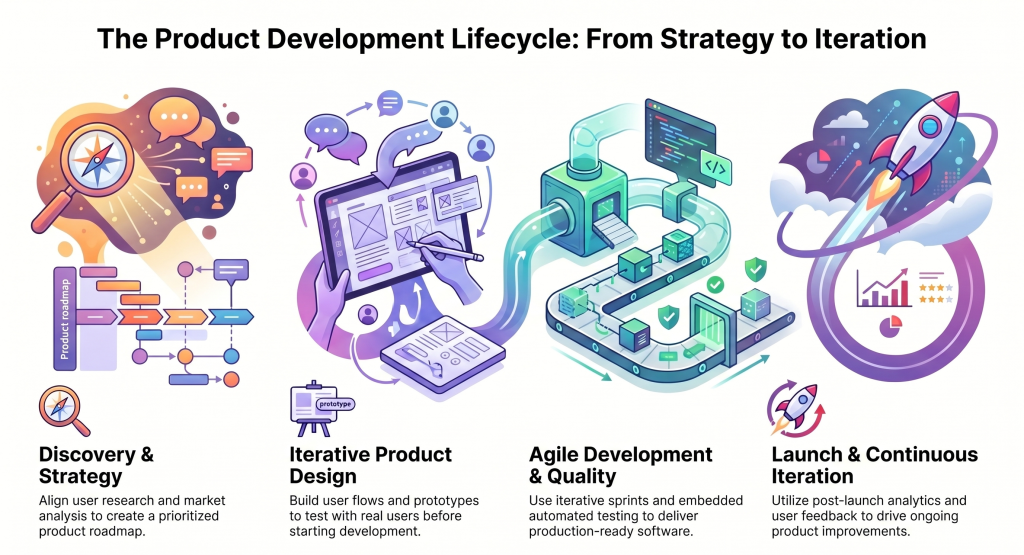
The 5 Stages of Product Development, And What Each One Costs
Understanding the product development life cycle is the single most important step for accurate budget planning. Here’s a breakdown decision-makers can act on.
1. Discovery & Strategy
This is where the development process begins. Business goals get translated into a product vision, the team conducts market research, and technical feasibility gets assessed.
What drives cost here: Depth of competitive analysis, number of stakeholder interviews, and whether you need external consultants to facilitate workshops.
2. Product Design
Product design and development begins with wireframes, user journeys, and design systems. Poor investment here is one of the most expensive mistakes, because every design flaw discovered in engineering costs 10x more to fix.
What drives cost here: Number of screens and features, platform targets (web, iOS, Android), and whether brand design is included.
3. Agile Development
This stage covers pure product engineering strategy, selecting the right stack, defining APIs, planning cloud infrastructure, and mapping data models.
What drives cost here: Integration complexity, compliance requirements (HIPAA, SOC 2, GDPR), and scalability expectations.
4. Quality Engineering
This is the largest cost center in the new product development process. Sprints get executed, features get built, QA runs in parallel, and releases are staged.
What drives cost here:
- Team size and composition (offshore vs. onshore)
- Feature complexity and third-party integrations
- Real-time features (chat, notifications, live data)
- AI/ML components requiring model training or fine-tuning
5. Launch & Iteration
This is where the stages of product development cycle back. A product isn’t done at launch, it evolves based on real user data. Therefore, budgeting for this phase from day one prevents costly surprises post-launch.
What drives cost here: Infrastructure monitoring, user feedback loops, and feature iteration velocity.
How Intelligent Business Transformation Changes the Cost Equation
Working with an intelligent business transformation partner like 200OK Solutions doesn’t just execute your new product development, it restructures how you invest across every stage.
Eliminating Waste Before It Starts
Intelligent business transformation begins by aligning business strategy with engineering from day one. As a result, teams eliminate redundant rework before a single sprint begins. This single shift routinely saves organizations 20–30% of their total build budget.
Accelerating the Development Process
Beyond waste elimination, intelligent business transformation applies AI-assisted workflows to compress the product design and development cycle. Consequently, teams move from concept to working software faster, without cutting corners on quality.
Building for Scale From Day One
Moreover, intelligent business transformation brings structured product engineering architecture decisions to the table early. This approach ensures the system scales with your business, rather than requiring costly rewrites at the growth stage.
Prioritizing What Actually Drives ROI
Finally, intelligent business transformation applies the NPD framework to prioritize features that deliver measurable business value. Instead of building everything, teams build the right things, in the right order.
5 Questions Every CTO, CEO, and COO Should Ask Before Signing a Contract
Before committing budget to any product development engagement, get clear answers on these:
- Does the vendor follow a structured new product development process, or do they figure it out as they go?
- How do they handle scope changes, and what does the renegotiation process look like?
- Who owns the IP, source code, and infrastructure at the end of the engagement?
- What does the post-launch iteration model look like, and what does it cost monthly?
- How does the team handle product design and development when business requirements change mid-sprint?
If you don’t get clear, confident answers to these, that uncertainty will ultimately show up in your invoice.
Frequently Asked Questions
Q. How much does it cost to build a new product from scratch?
A. Most end-to-end new product development engagements range from $50,000 to $500,000+. The range is wide because product complexity, team composition, and the number of stages of product development included in scope all vary significantly. An MVP built for validation is very different from an enterprise-grade platform built for scale.
Q. What is the product development life cycle, and why does it matter for budgeting?
A. The product development life cycle is the structured sequence of phases a product moves through, from discovery and design to engineering, testing, and launch. Consequently, mapping your project to this lifecycle before budgeting helps avoid the most common cost overruns: scope creep, rework, and mid-project pivots.
Q. How long does the new product development process take?
A. A focused MVP typically takes 3–6 months. A fully-featured product following a complete new product development process can take 9–18 months. Therefore, timeline is directly tied to scope definition, the clearer the requirements, the shorter the delivery cycle.
Q. What is NPD in business?
A. NPD stands for new product development. In a business context, it refers to the complete process of bringing a new product from idea to market, including market research, product design and development, product engineering, testing, and commercial launch.
Q. What does product engineering include?
A. Product engineering covers the technical design and build of a product, architecture decisions, backend and frontend development, API integrations, infrastructure setup, and quality assurance. Importantly, it is distinct from product design (UX/UI) and product strategy, though all three must align for a successful launch.
Q. How can I reduce product development costs without sacrificing quality?
A. The most effective levers are: starting with a well-scoped MVP, investing in the discovery phase before writing a line of code, choosing a partner that uses a structured development process, and applying intelligent business transformation practices to eliminate waste across the product development life cycle.
The Bottom Line
End-to-end product development costs what it costs, but how much it costs your organization is largely within your control. Decision-makers who treat product development as a structured investment, rather than an unpredictable expense, consistently build better products for less.
At 200OK Solutions, we apply intelligent business transformation to the entire new product development process, from initial strategy through launch and iteration, so your budget works harder at every stage.
Ready to plan your product budget with confidence? Talk to our team →