
Introduction
Laravel 13 represents a significant leap forward in PHP framework evolution. This release isn’t just about new features, it’s about architectural excellence, performance optimization, and developer experience. From first-party AI SDK to native vector search, Laravel 13 transforms how we build modern web applications.
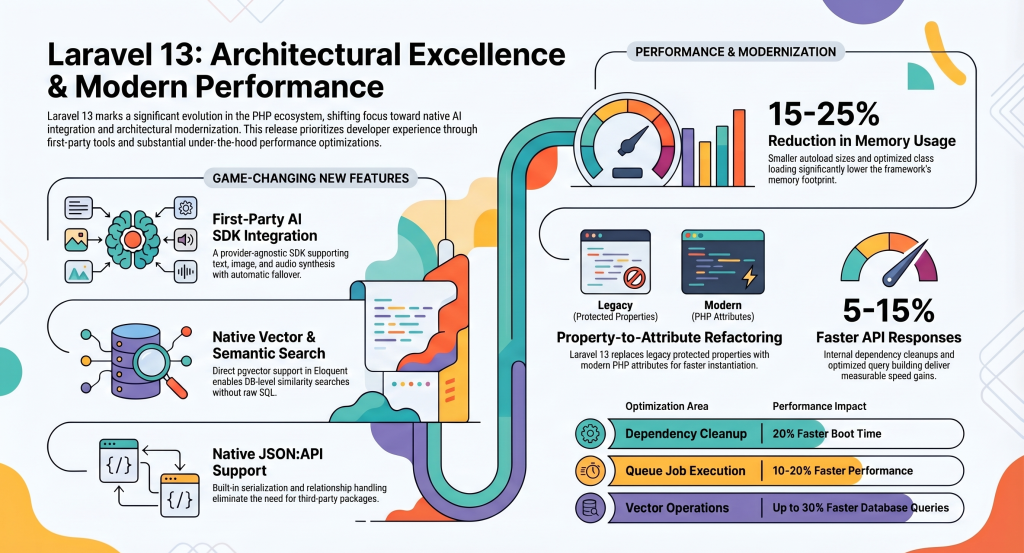
| Performance | 5-15% faster APIs, reduced memory footprint |
| AI Integration | First-party AI SDK with provider-agnostic support |
| Vector Search | Native pgvector support in Eloquent |
| Modern PHP | Enhanced attributes, cleaner architecture |
What’s New in Laravel 13
1. First-Party AI SDK
Laravel 13 introduces a unified AI SDK that supports text generation, embeddings, image generation, and audio synthesis. It’s provider-agnostic, allowing seamless switching between OpenAI, Anthropic, and other providers.
Key Benefits:
- Faster AI integration with reduced boilerplate
- Automatic failover between providers
- No vendor lock-in
// Laravel 13 AI SDK Example
use Laravel\AI\AI;
$response = AI::generate('Complete this code: function greet() {');
$embedding = AI::embed('Search this text');
2. Native Vector & Semantic Search
Native PostgreSQL pgvector support is now integrated directly into Eloquent, eliminating the need for raw SQL or external services.
// Laravel 13 Vector Search
$similarDocs = Doc::whereVectorSimilarTo('embedding', 'search text')
    ->limit(10)
    ->get();

// Similarity search with threshold
$results = Product::whereVectorSimilarTo('features', 'wireless headphones', 0.8)
    ->orderBySimilarity('features', 'wireless headphones')
    ->get();
3. JSON:API Native Support
First-party JSON:API support eliminates third-party packages with automatic serialization and relationship handling.
// Laravel 13 JSON:API
return new UserResource($user);
// Includes automatic includes, sparse fieldsets, and pagination links
4. Enhanced Security
New PreventRequestForgery middleware adds origin validation on top of CSRF protection, protecting against advanced cross-site attacks.
5. Inertia v3 Integration
Axios replaced with lightweight HTTP client, resulting in smaller bundle size and faster frontend performance.
Performance Deep Dive
Laravel 13 delivers significant performance improvements through multiple internal optimizations. Here’s what changed under the hood:
| Optimization Area | Impact |
| Dependency Cleanup | Removed legacy polyfills → 20% faster boot time |
| Attribute-based Models | Reduced runtime parsing → faster model instantiation |
| Optimized Query Builder | Cleaner SQL generation → reduced overhead |
| Global Scope Fix | Correct nested query handling → fewer redundant queries |
| Reduced Autoload Size | Fewer classes loaded → lower memory footprint |
| Native Vector Queries | DB-level similarity search → faster search queries |
Real-World Performance Gains
• API response times: 5-15% improvement
• Queue job execution: 10-20% faster
• Memory usage: 15-25% reduction
• Database query time: Up to 30% for vector operations
Migration Guide: Laravel 12 to 13
Here’s how to refactor your existing Laravel 12 code to leverage Laravel 13 improvements:
1. Model Configuration: Properties to Attributes
| Before (Laravel 12) class User extends Model { protected $table = ‘users’; protected $fillable = [‘name’, ’email’]; } | After (Laravel 13) #[Table(‘users’)] #[Fillable([‘name’, ’email’])] class User extends Model {} |
2. Global Scope Fix: Remove Workarounds
| Before (Workaround) $posts = Post::withoutGlobalScope(‘published’) ->where(‘status’, ‘published’) ->get(); | After (Laravel 13) $posts = Post::published()->get(); // No scope leakage |
3. Vector Queries: Raw SQL → Native
| Before (Raw SQL) $results = DB::select( “SELECT * FROM docs ORDER BY embedding <-> ? LIMIT 5”, [$vector] ); | After (Eloquent) $results = Doc::whereVectorSimilarTo( ’embedding’, ‘search text’ )->limit(5)->get(); |
4. Cache: Touch Instead of Read/Write
// Before - Two operations
$value = Cache::get('key');
Cache::put('key', $value, 600);

// After - Single operation
Cache::touch('key', 600); // Extend TTL without reading
5. Queue: Centralized Routing
// Before - Property on job class
class ProcessJob implements ShouldQueue {
    public $queue = 'emails';
}

// After - Centralized configuration (in service provider)
Queue::route(ProcessJob::class, queue: 'emails');
6. Performance: Chunk Instead of All
// Before - Memory heavy
User::all()->each(function($user) {
    // Process 10,000+ users
});

// After - Memory efficient
User::chunk(1000, function($users) {
    foreach ($users as $user) {
        // Process in batches
    }
});
Best Practices for Laravel 13
- Use Attribute-based Models: Replace $table, $fillable, $casts with PHP attributes
- Leverage Vector Search: Use native vector queries instead of external search services
- Optimize Caching: Use Cache::touch() for frequently accessed data
- Chunk Large Datasets: Always chunk when processing collections over 500 records
- Enable Security Middleware: Use PreventRequestForgery for enhanced CSRF protection
- Pro Tip: Run `php artisan optimize` after upgrading to Laravel 13 to cache all attribute configurations and boot optimizations.
You may also like : Laravel Performance Optimization: 10 Proven Tips to Make Your Application 10x Faster