

Scaling a digital product fails not because of bad ideas, but because of broken foundations. The core reason most product builds collapse under growth is simple: teams optimize for launch, not for scale. If you’re a CTO, CEO, or COO watching a promising product buckle under its own success, the fix starts with choosing the right e2e digital product development approach from day one, one that bakes scalability, resilience, and strategic alignment into every phase, not as an afterthought.
The Hidden Cost of “Launch First, Fix Later”
Most leadership teams greenlight product development under pressure, competitive deadlines, investor milestones, market windows. The result? Technical debt accumulates silently until the product can’t handle real user load, real data volumes, or real business complexity.
Here’s what that looks like in practice:
-
- Architecture decisions made for MVP survive into production : monoliths that can’t be broken apart, databases not designed for horizontal scaling
- Disconnected teams : design, engineering, QA, and DevOps working in silos with no shared definition of “done”
- No observability layer : teams flying blind when production incidents hit
- Vendor lock-in : critical infrastructure tied to platforms that limit flexibility at scale
The companies that escape this pattern don’t just hire better engineers. They partner with a product development company that treats scalability as a first-class requirement, not a future sprint.
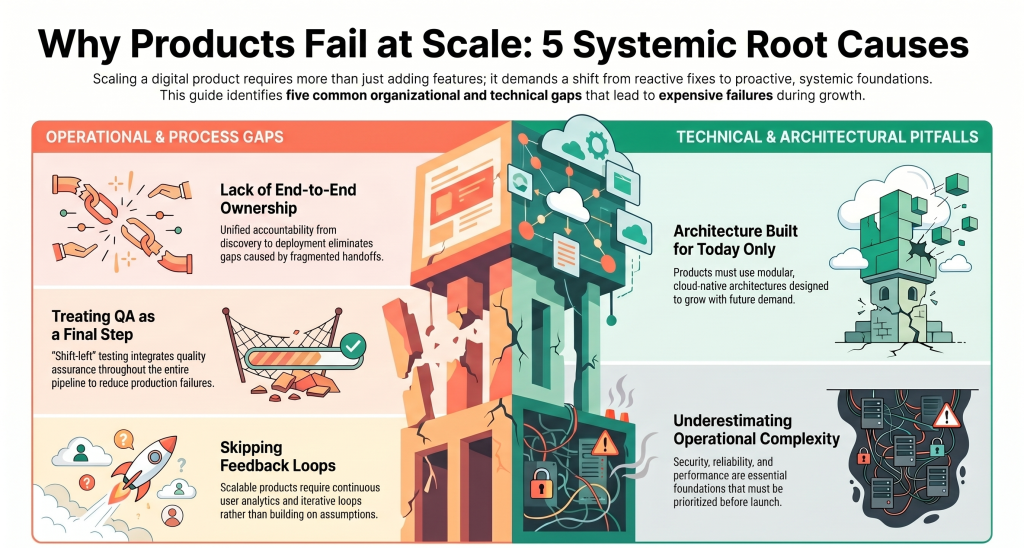
The 5 Root Causes of Product Failures at Scale
Understanding why products fail gives you the leverage to prevent it. Here are the five systemic failures we see most often:
1. No End-to-End Ownership
When strategy, design, and engineering are handled by different vendors or internal teams with no unified accountability, gaps appear between every handoff. End to end product development eliminates this by giving one team full visibility, from discovery to deployment.
2. Architecture Built for Today, Not Tomorrow
Choosing the wrong infrastructure early is expensive to reverse. Products that scale successfully are built on modular, cloud-native architectures designed to grow with demand, not retrofitted when growth arrives.
3. Treating QA as a Final Step
Quality assurance embedded only at the end of the pipeline catches problems too late and too expensively. Shift-left testing, integrating QA throughout development, reduces production failures dramatically.
4. Skipping the Product-Market Fit Feedback Loop
Shipping features without continuous feedback from actual users means building on assumptions. Scalable products are built with instrumentation, analytics, and iterative loops that inform every sprint.
5. Underestimating Operational Complexity
Performance, security, compliance, and reliability aren’t features, they’re foundations. Digital product development services that ignore these until post-launch create compounding problems that are exponentially harder to fix at scale.
How to Build Products That Actually Scale
The following framework is what separates product builds that last from those that collapse under pressure:
Step 1 : Align on scale requirements before writing a single line of code Define your expected user load, data volume, and integration complexity upfront. Build your architecture to handle 10x your launch-day expectations.
Step 2 : Choose a unified product development partner, not a vendor patchwork Working with a product development partner who owns the full lifecycle, strategy, UX, engineering, QA, DevOps, removes the coordination overhead that kills execution speed and product quality.
Step 3 : Implement modular, API-first architecture Services that communicate through well-defined APIs can be scaled, swapped, or upgraded independently. This is the backbone of every product that survives hypergrowth.
Step 4 : Build observability in from sprint one Logging, monitoring, alerting, and distributed tracing aren’t luxuries. They’re the difference between resolving a production incident in 10 minutes versus 10 hours.
Step 5 : Automate your deployment pipeline early CI/CD pipelines, automated testing and infrastructure-as-code reduce human error and deployment risk, making scaling a repeatable, reliable process rather than a stressful event.
Step 6 : Treat security and compliance as architecture, not audit prep Whether you’re handling user data, financial transactions, or healthcare records ,custom software development that embeds security controls at the architecture level costs far less than remediating a breach or a compliance failure post-launch.
What Decision-Makers Should Ask Before Approving a Product Build
Before your next product initiative gets a green light, push your team or your development partner, on these questions:
-
- How does this architecture perform at 10x current load?
- What is our incident detection and response time target?
- Who owns the product end-to-end, and how are handoffs managed?
- How are non-functional requirements (performance, security, uptime) defined and measured?
- What does our rollback strategy look like for a failed deployment?
If the answers are vague, the foundation isn’t ready.
Frequently Asked Questions
Q. What is e2e digital product development?
A. It refers to managing the complete lifecycle of a digital product, from ideation, UX/UI design, and engineering through to QA, deployment, and ongoing optimization, under unified ownership and strategy.
Q. How do I find the right product development partner for a scaling product?
A. Look for partners with demonstrated experience across architecture, design, and DevOps, not just coding. Ask for case studies of products they’ve scaled beyond the initial launch phase.
Q. Why does custom software development outperform off-the-shelf solutions at scale?
A. Off-the-shelf tools are built for average use cases. Custom software is designed around your specific data models, workflows, and growth trajectory, which means fewer bottlenecks and far greater long-term flexibility.
Scaling isn’t a problem you solve after launch. It’s a discipline you build into the product from the first technical decision. The organizations getting this right aren’t the ones with the biggest budgets, they’re the ones with the right digital product development services partner and the strategic clarity to demand scale-readiness before a single user ever logs in.
You may also like : How to Choose a Product Development Partner vs. Hiring In-House