
You can ship compliant healthcare software fast, but only if compliance is built into your development process from day one, not bolted on at the end. Teams that treat HIPAA, HL7, and FDA requirements as a parallel engineering track, not an afterthought consistently cut audit cycles by 40–60% without sacrificing release speed.
Why Healthcare Software Teams Keep Getting This Wrong
Most development teams hit the same wall: they build fast, then pause for compliance review, then scramble to retrofit security controls and documentation. That cycle kills timelines and creates technical debt that compounds with every release.
The root problem is structural, not technical. Compliance is treated as a QA gate instead of an engineering input.
Here’s what that costs you:
- Delayed go-to-market while auditors flag undocumented design decisions
- Expensive rework when security architecture doesn’t meet HIPAA’s minimum necessary standard
- Engineering burnout from repeated compliance cycles on features that “should have been done”
How to Build Healthcare Software That Is Compliant and Fast to Ship
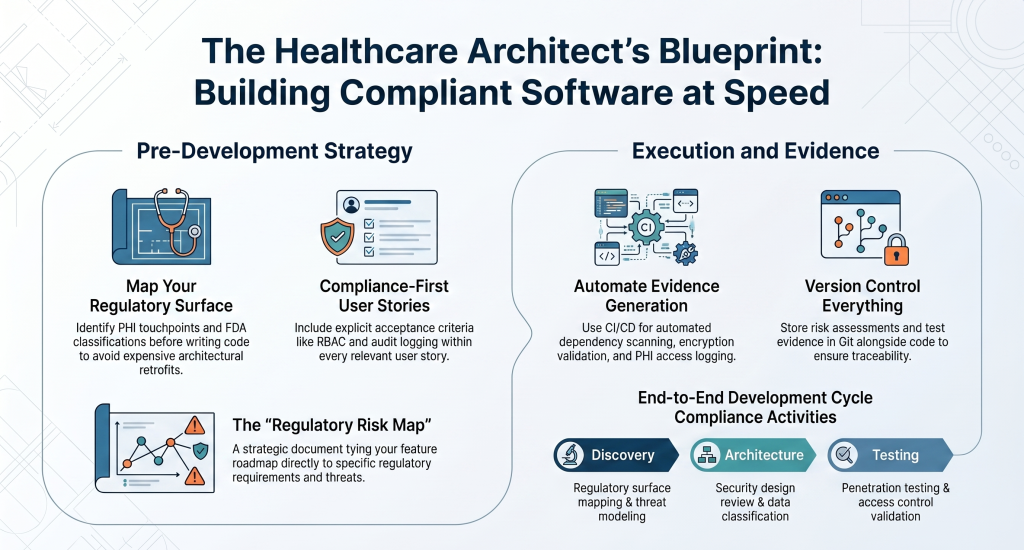
Step 1: Map Your Regulatory Surface Before Writing a Line of Code
Before sprint one, answer these questions:
- Does your software touch PHI (Protected Health Information)?
- Are you integrating with EHR systems via HL7 FHIR or HL7 v2?
- Is your software a medical device under FDA 21 CFR Part 11 or SaMD classification?
Each answer changes your architecture decisions. For example, FDA SaMD classification triggers design control documentation requirements, something you cannot retrofit cheaply after the product is built.
What to produce at this stage:
- A regulatory risk map tied to your feature roadmap
- Data flow diagrams showing all PHI touchpoints
- Preliminary threat model per OWASP Healthcare guidelines
Step 2: Make Compliance Requirements First-Class Tickets
Don’t put compliance in a separate backlog. Every user story that touches patient data, authentication, or third-party integrations should carry explicit acceptance criteria tied to regulatory requirements.
Example: A story for “patient record search” should include:
- Audit log generation for every query
- Role-based access control validation
- Data minimization check, is the response returning only what’s needed?
This approach does two things: it keeps engineers informed rather than surprised, and it creates a natural documentation trail for auditors.
Step 3: Automate the Compliance Evidence You’ll Need Anyway
Auditors want evidence. Most teams produce it manually, which is slow and error-prone. Automate it instead.
Specific automation targets:
- Access logs: Every PHI access event logged with user ID, timestamp, action, and data accessed
- Dependency scanning: Run automated CVE checks in CI/CD, unpatched dependencies are a top HIPAA audit finding
- Encryption validation: Automated tests confirming data at rest and in transit meets AES-256 / TLS 1.2+ requirements
- Backup and recovery tests: Scheduled, automated restore drills with documented results
This is not optional overhead. It is the evidence package that shortens your audit from weeks to days.
Step 4: Structure Your End-to-End Product Development Around Compliance Checkpoints
This is where End-to-End Product Development methodology pays off in regulated industries. Rather than treating compliance as external to the software development lifecycle, you embed checkpoints at every phase:
| Phase | Compliance Activity |
| Discovery | Regulatory surface mapping, threat modeling |
| Architecture | Security design review, data classification |
| Development | Secure coding standards, peer review checklists |
| Testing | Penetration testing, access control validation |
| Deployment | Change control documentation, audit log verification |
| Maintenance | Vulnerability management, periodic access reviews |
When your development partner owns the full cycle, compliance gaps don’t fall through handoffs between vendors.
Step 5: Version Control Everything, Including Your Compliance Artifacts
HIPAA and FDA both require documentation of changes to software that handles patient data. Your compliance documentation should live in version control alongside your code ,not in a shared drive folder someone updates quarterly.
What belongs in version control:
- Risk assessments
- Security architecture decision records
- Test evidence for each release
- Change logs tied to specific builds
The Tradeoffs You Need to Acknowledge
Building for compliance from day one costs more upfront, typically 15–25% more in initial development time. That’s real, and anyone telling you otherwise is selling something.
What they’re not telling you is that retrofitting compliance after the fact typically costs 3–5x more, and that’s before you account for delayed launch, potential breach liability, or failed audits blocking market access entirely.
The math is straightforward. The decision is a risk management call, not a technical one.
Frequently Asked Questions
Q. How do you build HIPAA-compliant software without slowing down your development team?
A. Embed compliance requirements directly into sprint tickets, automate audit evidence generation in your CI/CD pipeline, and conduct regulatory surface mapping before architecture decisions are made. This eliminates the costly stop-and-retrofit cycles that slow most teams down.
Q. What is the difference between HIPAA compliance and FDA SaMD compliance in software development?
A. HIPAA governs how software handles Protected Health Information, it’s primarily a data security and privacy framework. FDA SaMD (Software as a Medical Device) compliance applies when software functions as a medical device itself, triggering design control, risk management (ISO 14971), and quality management system requirements. Many healthcare products require both.
Q. How long does it take to get a healthcare software product audit-ready?
A. With compliance built in from the start, teams typically reach audit-readiness 4–8 weeks after feature completion. Teams that retrofit compliance typically spend 3–6 months in remediation cycles before they can pass a formal audit.
Q. What should I look for in an End-to-End Product Development partner for healthcare software?
A. Look for a partner with demonstrable experience in HIPAA, HL7 FHIR integration, and FDA SaMD classification, not just general software delivery. They should be able to show you how compliance checkpoints integrate into their development lifecycle, not just claim it in a deck.
Bottom Line
Compliance and delivery speed are not opposing forces. They conflict only when compliance is treated as a phase rather than a discipline baked into how you build.
If you’re leading a healthcare product initiative and your development approach doesn’t have explicit answers for PHI handling, audit trail generation, and regulatory risk mapping, those gaps will cost you more than you expect, later than you want.
At 200OK Solutions, our End-to-End Product Development approach is built to handle exactly this: full-cycle ownership from architecture through deployment, with compliance embedded at every stage, not reviewed at the end.
You may also like : End-to-End Product Development: Microservices vs Monolith