

If you need speed, specialized skills, and cost predictability, a product development partner wins. If you need deep cultural alignment and full long-term control, in-house makes sense. Most decision-makers get this wrong by defaulting to one model without evaluating the real tradeoffs.
Why This Decision Is More Complex Than It Looks
You’re a CTO, CEO, or COO staring down a product roadmap. The pressure is real, stakeholders want results, budgets are tight, and the talent market is unpredictable. The question isn’t just “who builds it?” It’s “which model actually gets this to market faster, at lower risk, and with sustainable quality?”
Here’s how to make that call with clarity.
What End-to-End Product Development Actually Involves
Before comparing models, align on scope. True end to end product development covers:
- Discovery & strategy (market research, user personas, product roadmap)
- UX/UI design (wireframes, prototypes, design systems)
- Software architecture & engineering (frontend, backend, APIs, infrastructure)
- QA & testing (automated, manual, performance)
- Launch & deployment
- Post-launch support, iteration, and scaling
Most companies underestimate this scope. That’s where the “we’ll just hire a few devs” plan quietly breaks down.
Head-to-Head: Product Development Partner vs. In-House Team
1. Speed to Market
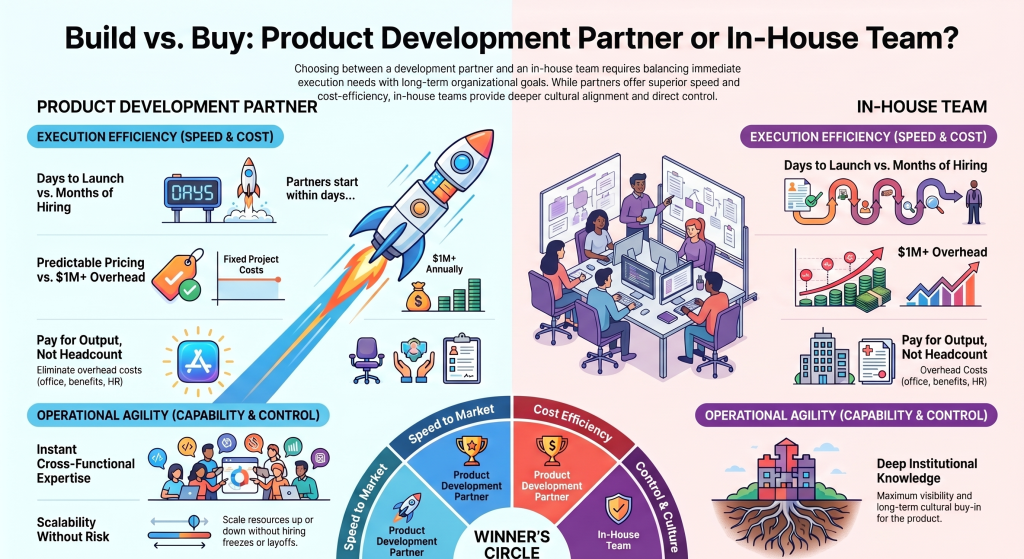
Partner: A specialized product development company already has a team structure in place, designers, engineers, PMs, QA, ready to start within days, not months.
In-house: Recruiting alone takes 60–90 days per senior hire. Building a full team for digital product development can take 6–12 months before the first line of meaningful code ships.
Winner for speed: Product development partner.
2. Cost Structure
Partner: Predictable project or retainer pricing. No overhead costs, no benefits, office space, equipment, or HR processes. You pay for output, not headcount.
In-house: A single senior engineer in a tier-1 market costs $150,000–$220,000/year in salary alone. A full team for end-to-end coverage can push $1M+ annually before you’ve shipped anything.
Winner for cost efficiency (early-stage and mid-scale): Product development partner.
3. Skill Depth and Specialization
Partner: Top software product development firms bring cross-functional expertise built across dozens of product. They’ve already solved the problems you haven’t encountered yet.
In-house: You get deep institutional knowledge over time, but early on, skill gaps are common and expensive to fill.
Winner for specialized, full-stack capability: Product development partner.
4. Control and Cultural Alignment
Partner: Requires clear communication frameworks and well-defined processes. The right partner operates as an extension of your team, but it does require active collaboration.
In-house: Maximum visibility and cultural buy-in. Your team lives and breathes the product.
Winner for control: In-house.
5. Scalability and Flexibility
Partner: Scale up or down based on roadmap phases. No painful layoffs, no hiring freezes, no idle capacity.
In-house: Scaling up means hiring. Scaling down means difficult people decisions.
Winner for flexibility: Product development partner.
When to Choose a Product Development Partner
Consider product development services through an external partner when:
- You need to validate an MVP before committing to full-time hires
- Your product requires multi-discipline expertise you don’t have internally
- Time-to-market is a competitive differentiator
- You’re scaling rapidly and can’t hire fast enough
- You want predictable costs without long-term headcount risk
When to Build In-House
In-house makes sense when:
- The product is your core, proprietary competitive moat
- You’re post-product-market-fit and need deep, long-term institutional knowledge
- Compliance, data security, or IP sensitivity requires full internal control
- You have the budget, time, and infrastructure to recruit and retain top talent
The Hybrid Model: What Most Scaling Companies Actually Do
The smartest approach many growth-stage companies take is a hybrid: partner with an end-to-end product development firm to build and launch the product, then gradually transition to an in-house team for maintenance, iteration, and ownership. This captures the speed and expertise of an external partner while building internal capability over time.
Common Mistakes to Avoid
- Hiring too junior too fast : saving on salary but losing months to mistakes
- Choosing a partner based on price alone : the cheapest firm rarely delivers on complex digital product development
- Not defining ownership clearly : ambiguity on IP, codebase access, and documentation creates long-term risk
- Treating a partner as a vendor, not a collaborator : the best outcomes come from genuine partnership
The Bottom Line
If you’re asking “should I hire a product development company or build in-house,” the honest answer depends on your stage, budget, and timeline. For most companies pre-scale, a partner offering end to end product development services delivers faster results at lower risk.
At 200OK Solutions, we help companies from early-stage to enterprise build, launch, and scale digital products end to end. Whether you need a full product team or a specialized extension of your existing one, we work as true partners, not vendors.
Ready to explore what the right model looks like for your next product? Talk to our team.
You may also like : What Does End-to-End Product Development Actually Cost?