
The short answer: For most startups in 2026, a Modular Monolith is the smarter starting point. Unless you have 15+ engineers, distinct team ownership per domain, or independent scaling needs from day one, microservices will slow you down before they speed you up. Here’s how to make the right call for your product.
Why Architecture Decisions Define Your END TO END DIGITAL PRODUCT DEVELOPMENT Outcome
Your architecture isn’t just a technical choice, it’s a business decision. In end-to-end digital product development, the architecture you pick on day one shapes your release velocity, team structure, infrastructure cost, and how fast you can respond to market feedback.
The wrong choice doesn’t just create technical debt. It creates strategic debt.
What Is a Modular Monolith? (And Why It’s Making a Comeback)
A Modular Monolith is a single deployable application internally divided into well-defined, loosely coupled modules, each owning its own domain logic, data access, and interfaces.
Key characteristics:
- Single codebase, single deployment unit
- Strong internal module boundaries (enforced by code, not network)
- Shared database, but module-scoped access layers
- Easier local development, testing, and debugging
- Lower infrastructure overhead
Think of it as microservices discipline without microservices complexity.
What Are Microservices? (And When They Actually Make Sense)
Microservices split your application into independently deployable services, each responsible for a single business capability and communicating over APIs or message queues.
Key characteristics:
- Independent deployment per service
- Polyglot tech stacks (each service can use different languages/databases)
- Independent scaling per service
- Requires service discovery, distributed tracing, API gateways, and orchestration
- Higher DevOps maturity required
Microservices solve real problems, but only at a scale most startups haven’t reached yet.
Head-to-Head Comparison: end-to-end digital product development architecture microservices vs monolith
| Factor | Modular Monolith | Microservices |
| Time to first deployment | Days | Weeks |
| Infrastructure cost (early stage) | Low | High |
| Developer onboarding | Simple | Complex |
| Independent scaling | No | Yes |
| Team autonomy | Moderate | High |
| Debugging & observability | Straightforward | Requires tooling |
| Best for team size | 2–20 engineers | 15+ engineers |
| Refactoring cost later | Medium | High |
The Real Question CTOs Should Be Asking in 2026
Most architecture debates focus on technology. The right question is about organizational readiness.
Ask yourself:
- Do we have more than 3 independent product teams? If no, microservices coordination overhead will hurt more than help.
- Do different parts of our product have wildly different traffic patterns? If no, shared infrastructure is fine.
- Can our DevOps team manage Kubernetes, distributed tracing, and service meshes today? If no, you’ll spend engineering cycles on infrastructure, not product.
- Are we still discovering our core domain model? If yes, microservices boundaries drawn too early become the wrong boundaries, and migrating is expensive.
How to Choose the Right Architecture for Your Startup: A Step-by-Step Framework
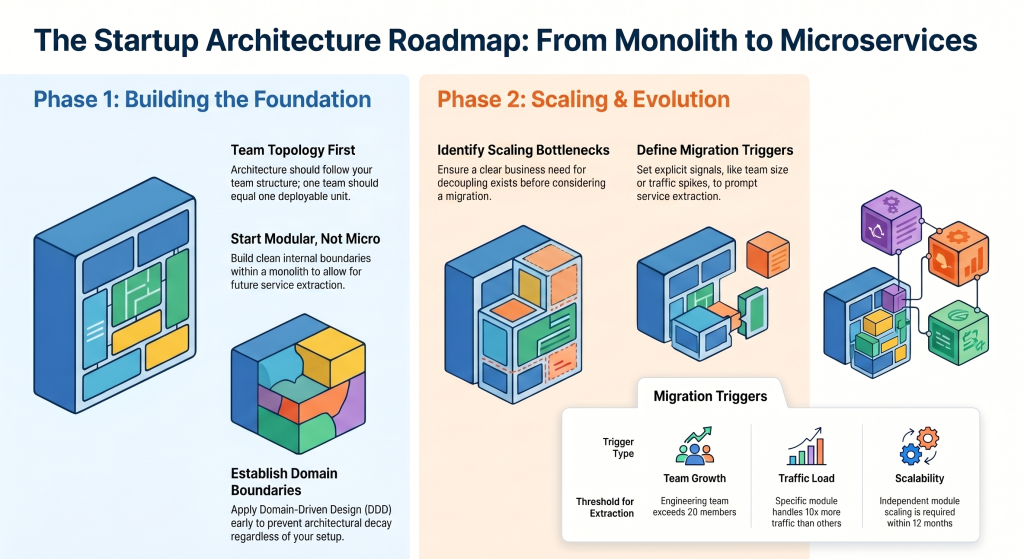
- Map your team structure first. Architecture should follow team topology, not the other way around. One team = one deployable unit is a reasonable default.
- Define your scaling bottlenecks. Identify which specific modules will need to scale independently within 12 months. If you can’t name them, you don’t need microservices yet.
- Start modular, not micro. Build with clean internal boundaries inside a monolith. This gives you the option to extract services later without a full rewrite.
- Establish your domain boundaries early. Whether monolith or microservices, poorly defined domains will destroy either architecture. Domain-Driven Design (DDD) principles apply to both.
- Set a migration trigger. Define the explicit signals that will prompt you to extract a service, e.g., team size crossing 20 engineers, or a specific module handling 10x more traffic than others.
What 200OK Solutions Recommends for Startups in 2026
At 200OK Solutions, our end-to-end digital product development process always begins with an architecture discovery phase, not because we have a preferred answer, but because the right answer is always context-dependent.
For most early-stage and growth-stage startups we work with, we recommend:
- Phase 1 (0–18 months): Modular Monolith with strict domain separation and API-first module design
- Phase 2 (18–36 months): Selective service extraction based on real scaling data, not assumptions
- Phase 3 (36+ months): Hybrid architecture where high-load or high-churn domains operate as services, while stable domains remain consolidated
This approach reduces time-to-market, controls infrastructure spend, and preserves architectural flexibility without betting the product on a complex distributed system before product-market fit is confirmed.
Frequently Asked Questions
Q. Can I migrate from a Modular Monolith to Microservices later?
Yes, and it’s significantly easier than migrating from an unstructured monolith. Clean module boundaries in your monolith map directly to service candidates when you’re ready to extract.
Q. Which architecture is better for SaaS products specifically?
Most SaaS products under $10M ARR are better served by a well-structured Modular Monolith. The multi-tenancy, billing, and auth domains can usually be handled as internal modules until scale demands otherwise.
Q. How does architecture affect end-to-end digital product development timelines?
Microservices can add 30–50% overhead to early development cycles due to infrastructure setup, inter-service communication design, and distributed testing complexity. For time-sensitive launches, this is a critical trade-off.
Q. What does 200OK Solutions offer for architecture decisions?
We provide architecture consulting as part of our end-to-end digital product development engagements, covering discovery, design, build, and scale phases. Reach out here.
Architecture is not a destination, it’s a decision you revisit as your product matures. Start simple, stay modular, and scale intentionally.
You may also like : How a Fintech Startup Went from MVP to £10M ARR in 18 Months