
Digital transformation upgrades your technology. Intelligent business transformation rewires how your entire organisation thinks, decides, and grows, using AI, data, and strategy as one unified force.
If you’re a CEO, CTO, or COO trying to figure out which path your business actually needs, this guide breaks it down clearly.
Why the Distinction Matters for Decision-Makers
Most executives have already been through some form of digital transformation, migrating to the cloud, adopting SaaS tools, digitising paper processes. And yet, many still feel like they’re reacting to the market rather than leading it.
That gap is exactly where intelligent business transformation begins.
What Is Digital Transformation?
Digital transformation is the process of replacing legacy, manual, or analogue systems with digital alternatives. It typically includes:
- Moving infrastructure to the cloud
- Implementing ERP or CRM platforms
- Digitising customer-facing processes
- Automating repetitive back-office tasks
It answers the question: “How do we stop doing things the old way?“
Digital transformation is foundational, but it’s not a strategy. It’s an upgrade. And in today’s competitive landscape, an upgrade alone isn’t enough.
What Is Intelligent Business Transformation?
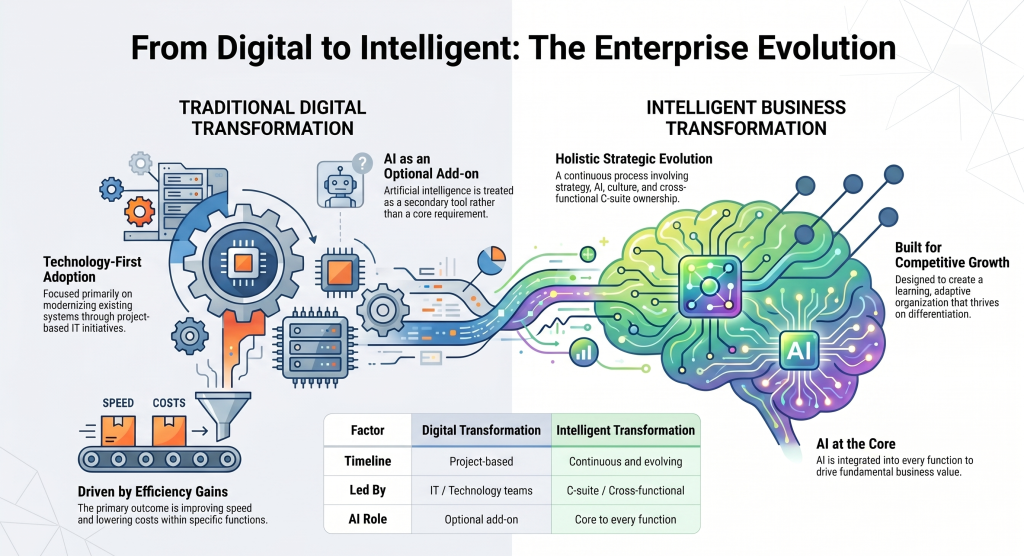
Intelligent business transformation goes several layers deeper. It integrates AI-driven decision-making, predictive analytics, and strategic redesign across every function of your business, from operations and supply chain to customer experience and leadership.
It answers a very different question: “How do we build an organisation that continuously learns, adapts, and outperforms?”
An intelligent transformation strategy doesn’t just digitise what exists. It challenges whether existing processes, models, and structures are worth keeping at all.
Key characteristics include:
- AI embedded into core decisions : not just reporting dashboards
- Data as a strategic asset : governed, integrated, and acted upon in real time
- People and culture aligned : with new ways of working
- Outcomes tied to business KPIs : revenue, margin, speed, resilience
- Continuous evolution : not a one-time project
Digital vs Intelligent Transformation: Side-by-Side
| Factor | Digital Transformation | Intelligent Business Transformation |
| Focus | Technology adoption | Strategy + AI + culture + operations |
| Goal | Modernise systems | Build a learning, adaptive organisation |
| Timeline | Project-based | Continuous and evolving |
| Led by | IT / Technology teams | C-suite with cross-functional ownership |
| Outcome | Efficiency gains | Competitive differentiation and growth |
| AI Role | Optional add-on | Core to every function |
How to Know Which One Your Business Needs
Ask yourself these questions:
- Have you already digitised core operations but still struggle with slow decision-making?
- Do you have data but lack the capability to extract real business value from it?
- Are your competitors using AI to personalise, predict, and operate faster than you?
- Is your transformation strategy tied to measurable business outcomes, or just technology milestones?
If you answered yes to any of these, your business doesn’t need more digital tools. It needs an intelligent transformation strategy built around outcomes, not outputs.
The Role of a Strategic Transformation Partner
One of the most common mistakes businesses make is treating transformation as an internal IT project. The organisations that get the most from AI-driven business transformation are those that bring in a strategic transformation partner, someone who sits at the intersection of business strategy, technology, and change management.
A capable partner will:
- Audit your current state across people, process, data, and technology
- Design a transformation roadmap aligned to your business goals
- Implement and integrate AI and intelligent systems where they drive real ROI
- Upskill your teams so the transformation sticks
- Measure outcomes continuously and adjust the strategy in real time
This is precisely what 200OK Solutions delivers through its intelligent business transformation practice, helping CEOs, CTOs, and COOs across the UK move from reactive modernisation to proactive, AI-powered growth.
Frequently Asked Questions
Q: Is digital transformation a prerequisite for intelligent business transformation?
Not always. Many organisations begin intelligent transformation in parallel with digital modernisation, particularly where AI can deliver quick wins in data-heavy functions like finance, logistics, or customer service.
Q: How long does intelligent business transformation take?
It depends on organisational complexity, but most businesses begin seeing measurable outcomes within 90 to 180 days of a focused engagement, particularly when working with an experienced business transformation consulting partner.
Q: What’s the biggest risk of skipping intelligent transformation?
Competitive irrelevance. Businesses that only digitise are automating the past. Businesses that transform intelligently are building the future.
Q: Can mid-sized businesses benefit from intelligent transformation, or is it only for large enterprises?
Intelligent transformation is especially powerful for mid-sized businesses. The agility of a smaller organisation, combined with AI-driven strategy, creates a significant competitive advantage against slower-moving incumbents.
The Bottom Line
Digital transformation was the last decade’s imperative. Intelligent business transformation is this decade’s competitive edge.
If your goal is to lead your market, not just keep pace with it the question isn’t whether to transform intelligently. it’s how quickly you can start.
Ready to explore what an intelligent transformation strategy looks like for your business? Talk to the team at 200OK Solutions and take the first step toward building an organisation built for what’s next.
You may also like : How to Know If Your Business Is Ready for Intelligent Transformation