
The short answer: end to end digital product development from not just building features but architecting a scalable system, validating fast, and aligning every technical decision with a measurable business outcome. Here’s exactly how it happened, and what decision makers can replicate.
The Starting Point: A Good Idea, A Fragile Foundation
Most fintech startups don’t fail because of bad ideas. They fail because their technology can’t scale with their ambition.
This particular client came to 200OK Solutions with a working MVP, a payments reconciliation tool built by a small in-house team. It worked. But it was held together with workarounds, manual processes, and a tech stack that would crack under real enterprise load.
The CEO had one question: “Can we go from 50 clients to 500 without rebuilding everything?”
The honest answer was no. Not as it stood.
Phase 1: Diagnose Before You Build
Before writing a single line of new code, the engagement began with a structured technical audit, something most agencies skip.
What the audit uncovered:
- Three separate codebases with no shared logic
- No automated testing (meaning every release was a manual, high-risk event)
- A monolithic architecture that made it impossible to scale individual services independently
- Zero observability, the team had no real-time insight into system health
This is where intelligent business transformation begins: not with tools, but with truth. Decision-makers need to know what they’re actually working with before committing budget to growth.
Phase 2: Modernise the Tech Stack Without Stopping the Business
One of the most common fears among CTOs and COOs is that a platform rebuild means downtime, disruption, and missed revenue targets.
The approach used here was a strangler fig migration, a method where new services are built around the existing system, gradually replacing components without switching everything off at once.
Step-by-step, the process looked like this:
- Identify the highest-risk bottlenecks, in this case, the reconciliation engine and the client reporting module
- Build new microservices in parallel, tested independently against real production data
- Route traffic incrementally to the new services, monitoring performance at each stage
- Decommission legacy components only once new equivalents had proven stability under load
- Implement CI/CD pipelines so future releases took hours, not weeks
This is how you modernise a tech stack without gambling your existing revenue.
Phase 3: Build for Business Outcomes, Not Just Features
Here’s where many technology engagements go wrong. Developers build what’s asked. What’s needed is someone who asks why first.
Every feature request during this engagement was mapped back to one of three business outcomes:
- Revenue growth : does this unlock a new client segment or pricing tier?
- Operational efficiency : does this reduce manual hours or error rates?
- Retention and trust : does this make the platform stickier for existing clients?
This framework is the core of business outcomes software thinking. It’s also what separates a technology partner from a development vendor.
Tangible results from this phase:
- Automated reconciliation reduced finance team workload by 60%
- White-label reporting module opened a new enterprise tier, adding £2.1M ARR
- API-first architecture enabled three strategic integrations with enterprise ERP systems in under 90 days
Phase 4: Instrument Everything for Digital Transformation ROI
You cannot manage what you cannot measure. As the platform scaled, a full observability layer was implemented, real-time dashboards, error tracking, performance benchmarks, and customer usage analytics.
This did two things:
- It gave the CTO confidence to release faster, knowing issues would surface immediately
- It gave the CEO hard data to present to investors, proving digital transformation ROI with actual numbers, not projections
By month 12, the data showed a 99.97% uptime record, sub-200ms API response times at scale, and a net revenue retention rate above 120%.
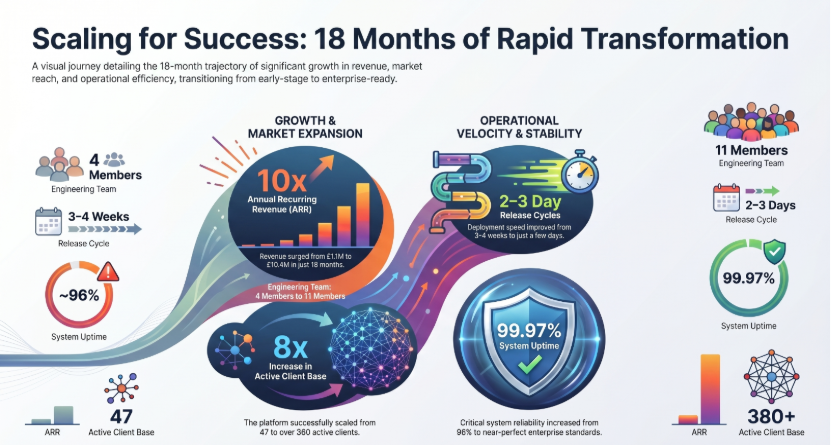
This is what technology business growth looks like when architecture, product thinking, and commercial strategy move together.
What Decision-Makers Should Take From This
If you’re a CEO, CTO, or COO evaluating your next stage of growth, the questions worth asking are:
- Can your current platform support 10x the clients without a rebuild?
- Do your developers know which features drive revenue versus which ones just get requested?
- Are you measuring digital transformation ROI, or just shipping code?
End to end digital product development is not a service. It’s a discipline, one that connects technical execution directly to the outcomes your board cares about.
Frequently Asked Questions
Q. How long does end to end digital product development typically take?
A. Timelines vary by complexity, but most structured engagements move from audit to live product within 3–9 months. The fintech case above reached significant scale in 18 months including a full platform migration.
Q. How do you measure ROI on a digital product investment?
A. Key metrics include ARR growth, reduction in operational costs, release frequency, system uptime, and net revenue retention. A good technology partner will agree on these benchmarks before work begins.
Q. Can we modernise our tech stack without disrupting live operations?
A. Yes, using incremental migration strategies such as strangler fig architecture, it’s possible to rebuild core systems without downtime or revenue disruption.
200OK Solutions delivers end to end digital product development for ambitious businesses. Visit us at 200oksolutions.com
You may also like : Why Most Product Builds Fail at Scale (and How to Prevent It)