
Intelligent business transformation in 2026 means more than adopting new software, it means rebuilding how your enterprise thinks, operates, and competes. The five pillars every organisation needs are: strategic AI integration, data infrastructure modernisation, process intelligence, change leadership, and continuous transformation governance. Miss any one of them, and your transformation stalls.
Why Enterprise Transformation Demands a New Framework in 2026
The rules changed. Enterprises that treated digital transformation as a one-time IT project are now facing compounding disadvantages, slower decisions, fragmented data, and workforces unprepared for AI-augmented roles.
Decision-makers, CEOs, CTOs, and COOs are under pressure to deliver measurable ROI on transformation spend while managing operational continuity. The answer isn’t more tools. It’s a structured enterprise transformation framework built on five interdependent pillars.
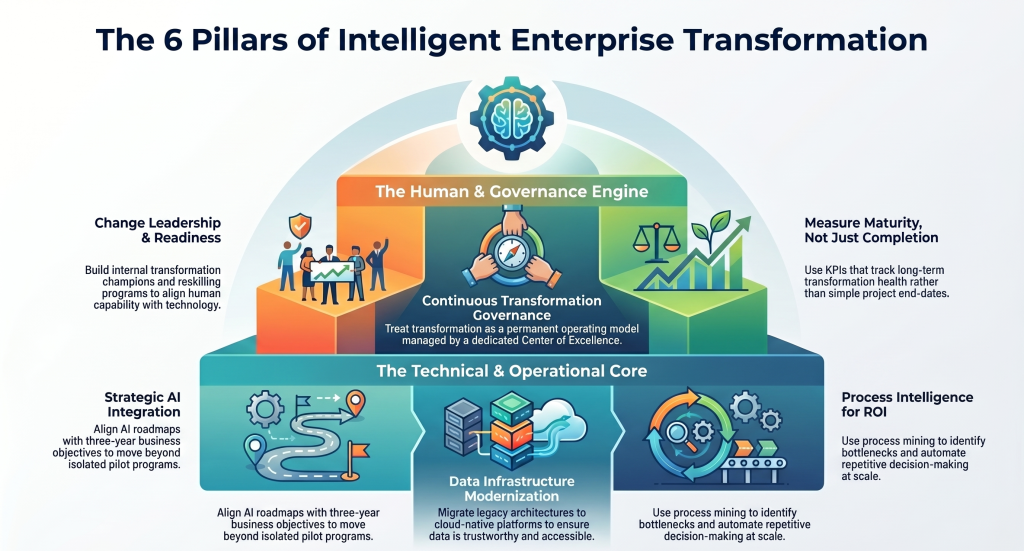
Pillar 1: Strategic AI Integration
What it means: Embedding AI into core business functions not as a pilot, but as operational infrastructure.
Most enterprises still run AI at the edges: a chatbot here, an analytics dashboard there. That is not transformation. Strategic AI integration means:
- Mapping AI use cases directly to revenue, cost, or risk outcomes
- Choosing between build, buy, or partner models for AI capability
- Establishing AI governance policies before scaling deployment
- Aligning AI roadmaps with three-year business objectives
The question executives are asking: “How do we move from AI experiments to AI-driven operations without disrupting what already works?”
The answer lies in treating AI as a capability layer, one that sits beneath every business process, not on top of it.
Pillar 2: Data Infrastructure Modernisation
What it means: Making your data trustworthy, accessible, and transformation ready.
You cannot build intelligent systems on broken data foundations. Enterprise IT modernisation, particularly legacy data infrastructure, remains the single biggest blocker to intelligent business transformation across industries.
Key actions under this pillar:
- Audit existing data silos and ownership gaps
- Migrate from legacy architectures to cloud-native or hybrid data platforms
- Implement data mesh or data fabric models for distributed access
- Establish data quality standards and lineage tracking
This is where the long-tail questions matter: enterprises searching “how to migrate legacy data warehouse to cloud” or “how to build a data governance framework for AI” are in active buying mode. Meeting them with clear answers builds trust and pipeline.
Pillar 3: Process Intelligence
What it means: Replacing manual, assumption-driven workflows with data-informed, automated processes.
Process intelligence combines process mining, workflow automation, and real-time analytics to give leadership a live view of how work actually happens, not how it was designed to happen.
For enterprises pursuing a business transformation roadmap, this pillar delivers the fastest visible ROI:
- Identify bottlenecks costing time and revenue
- Automate repetitive decision-making at scale
- Redesign cross-functional workflows around AI-assisted handoffs
- Reduce operational variance across geographies or business units
The transformation maturity model most organisations follow moves from awareness → analysis → automation → optimisation. Process intelligence accelerates that journey.
Pillar 4: Change Leadership and Workforce Readiness
What it means: Building human capability at the same pace as technological capability.
Technology does not transform businesses. People do or don’t.
The most sophisticated digital transformation strategy for enterprises collapses without change leadership. This pillar requires C-suite ownership, not delegation:
- Define a clear transformation narrative that connects change to purpose
- Build internal transformation champions at every seniority level
- Invest in reskilling programmes tied to specific AI and data roles
- Create feedback loops between frontline employees and transformation leadership
- Measure adoption, not just deployment
Resistance is not a people problem, it is a communication and design problem. Enterprises that solve for it outperform those that don’t.
Pillar 5: Continuous Transformation Governance
What it means: Treating transformation as a permanent operating model, not a project with an end date.
This is the pillar most enterprises skip and the reason most transformations fail to sustain results past 18 months.
Continuous transformation governance means:
- Establishing a dedicated transformation office or centre of excellence
- Creating KPIs that measure transformation health, not just project completion
- Running quarterly maturity assessments against your enterprise transformation framework
- Embedding transformation criteria into investment decisions and product roadmaps
- Reporting transformation progress to the board as a strategic metric
In 2026, transformation is not something you finish. It is something you get better at.
How to Build Your Intelligent Business Transformation Roadmap
Here is a practical starting sequence for enterprise leaders:
- Assess current maturity across all five pillars, objectively, not aspirationally
- Identify your critical constraint, the one pillar blocking progress in all others
- Build a 90-day sprint focused on that constraint with measurable outcomes
- Align investment to the pillars with the lowest maturity scores
- Establish governance from day one, not after the transformation is underway
Frequently Asked Questions
Q. What is intelligent business transformation?
A. It is the end-to-end redesign of how an enterprise operates, competes, and delivers value, using AI, data, and intelligent process automation as core infrastructure rather than supplementary tools.
Q. How long does enterprise transformation take?
A. Initial results are visible within 90 to 180 days when the approach is structured. Sustained transformation operates on a 24 to 36-month horizon, with continuous iteration beyond that.
Q. Where should enterprises start their transformation in 2026?
A. Start with a honest maturity assessment. Most enterprises overestimate their data readiness and underestimate the change leadership required. Fix the foundation before scaling the technology.
200OK Solutions helps enterprises design and execute intelligent business transformation programmes that deliver measurable outcomes. Explore our services.
You may also like : Intelligent Business Transformation : The Next Step