
Legacy systems are not just outdated technology, they are a compounding financial liability. The cost of doing nothing consistently exceeds the cost of intelligent business transformation. Here is how to prove that to your board, in numbers.
What Is Intelligent Business Transformation and Why Does It Matter Now?
Intelligent business transformation is the process of replacing or modernising legacy technology, processes, and data infrastructure using AI, automation, and cloud-native architecture with the goal of measurable business outcomes, not just IT upgrades.
This is not a conversation about technology for its own sake. It is a conversation about competitive survival.
The Real Cost of Legacy Systems on Your Business
A legacy system is any technology platform, software, or infrastructure that is outdated, no longer actively developed by its vendor, or requires disproportionate effort to maintain, integrate, or scale. The problem is not age, it is the widening gap between what your current systems can do and what your business now demands.
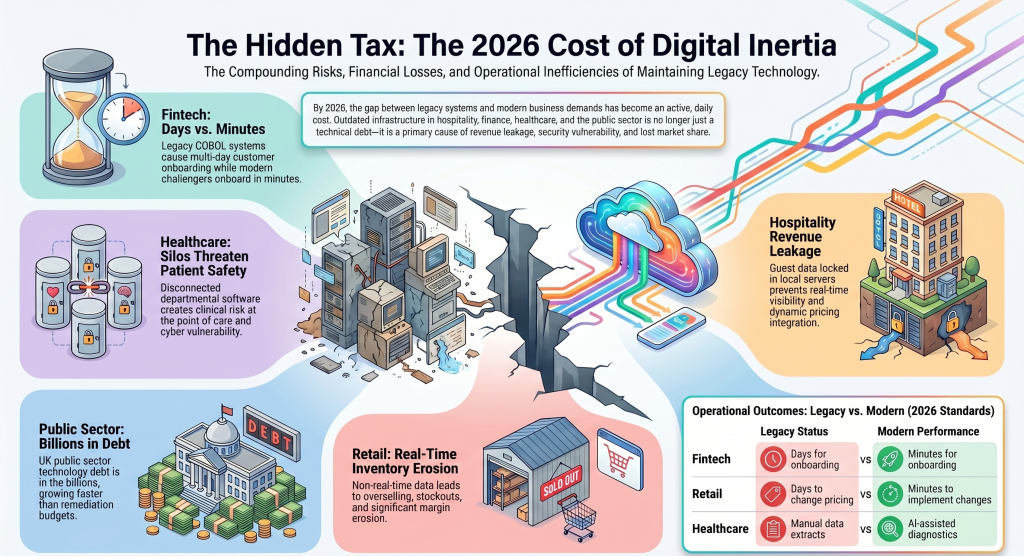
In 2026, this gap is no longer a future risk. It is an active cost being paid every day across five industries.
Hospitality
Most hotel groups and hospitality operators are still running Opera On-Premise or older PMS platforms built on server-based architecture. In 2026, this means:
- Guest data locked in local servers, no real-time visibility across properties
- Manual reporting cycles instead of live revenue dashboards
- Poor integration with modern OTAs, dynamic pricing engines, and guest experience platforms
- Oracle’s own roadmap is pushing toward Opera Cloud, on-premise support is narrowing
The result: revenue leakage, slower response to market changes, and a guest experience that falls behind digitally-native competitors.
Fintech and Financial Services
Legacy core banking platforms, many still running on COBOL-based mainframes or early 2000s middleware, remain the backbone of established banks and financial institutions. In 2026:
- Open banking compliance requires API connectivity that legacy cores simply were not built for
- Fraud detection running on rules-based legacy logic cannot compete with AI-driven detection
- Onboarding journeys that take days instead of minutes, because back-end systems cannot automate decisioning
- Regulatory reporting done manually, increasing compliance risk and audit exposure
Challenger banks built on modern infrastructure are onboarding customers in minutes. Legacy institutions are losing market share one frustrated customer at a time.
Healthcare
NHS trusts, private hospital groups, and healthcare networks are heavily reliant on legacy EPR (Electronic Patient Record) systems, outdated patient administration platforms, and disconnected departmental software. In 2026:
- Clinical data sitting in siloed systems that cannot communicate, creating risk at the point of care
- Reporting to regulators and commissioners done through manual data extracts
- Inability to deploy AI-assisted diagnostics or predictive care tools because the data infrastructure cannot support them
- Cyber vulnerability, legacy clinical systems are among the most targeted by ransomware attacks precisely because patching is difficult
The operational cost is significant. The patient safety risk is the more urgent conversation.
Public Sector
Central and local government organisations are running some of the oldest technology estates in any sector, Oracle EBS, PeopleSoft, and bespoke systems built on procurement frameworks from the early 2000s. In 2026:
- Citizen-facing services that cannot meet modern digital expectations
- Finance and HR systems requiring expensive Oracle-certified contractors for routine changes
- Data that cannot be shared across departments without manual intervention
- Procurement cycles and legacy contract structures that actively slow modernisation efforts
The technology debt in UK public sector alone is estimated in the billions and it is growing faster than remediation budgets.
Retail
Established retailers are carrying legacy ERP, POS, and inventory management systems that were built for a world where online and in-store were separate channels. In 2026:
- Inventory data that is not real-time, leading to overselling, stockouts, and margin erosion
- Loyalty and CRM platforms that cannot connect customer behaviour across channels
- Promotions and pricing changes that take days to implement instead of minutes
- No foundation for AI-driven demand forecasting or personalisation at scale
Retailers who have modernised are competing on speed and margin. Those still on legacy infrastructure are competing on inertia.
The common thread across all five industries:
These systems work just enough to justify not replacing them, while the cost of keeping them compounds quietly in the background, and the gap between you and your most digitally capable competitors widens every quarter.
How to Justify the Digital Transformation Budget Internally
This is where most transformation initiatives stall, not because the business case is weak, but because it is poorly constructed. Decision-makers need numbers, not narratives.
Build your business case in three layers:
1. Cost avoidance (what you stop spending)
- Maintenance contracts you eliminate
- Contractor hours reduced
- Incidents and downtime costs removed
2. Efficiency gains (what your team reclaims)
- Hours saved through automation, convert these to FTE cost equivalents
- Reduction in error rates and rework cycles
- Faster reporting and decision cycles
3. Revenue impact (what becomes possible)
- Faster product launches
- New digital revenue channels that legacy systems cannot support
- Improved customer retention from better service capability
Present the ROI over 3 years, not 12 months. Intelligent transformation is capital expenditure with a compounding return, the payback period matters more than the upfront number.
Technology Debt as a Business Risk, Not Just an IT Problem
If you are presenting to a CEO, COO, or board, reframe this conversation immediately.
Technology debt is not an IT backlog item. It is a business risk register item. It affects:
- Regulatory compliance : legacy systems often cannot meet evolving data protection requirements
- Audit exposure : manual processes leave audit trails that do not hold up to scrutiny
- Insurance and liability : cyber insurers are increasingly pricing legacy infrastructure risk into premiums
- M&A valuation : acquirers and investors now conduct technical due diligence; legacy debt depresses valuation
How to Build the Business Case for Transformation: A Practical Framework
- Audit your current technology stack and quantify annual maintenance costs
- Map every manual process that exists because your systems cannot handle it automatically
- Calculate total cost of ownership for the status quo over 3–5 years
- Model transformation costs (phased, not big bang) against that baseline
- Add strategic value, revenue enablement, risk reduction, talent retention
- Present a phased roadmap with decision gates, not a single massive commitment
The goal is not to win a budget argument. It is to give leadership an honest picture of two futures and let the numbers make the case.
Frequently Asked Questions
Q. How do I calculate the cost of legacy systems for my business case?
A. Start with IT maintenance spend, then add manual process costs (hours × loaded labour rate), downtime costs, and the cost of delayed initiatives. Most organisations find the total is 2–3x what they assumed.
Q. What is a realistic ROI timeline for intelligent business transformation?
A. Most enterprise programmes break even in 18–36 months when the business case is built correctly and the transformation is phased. Cloud migrations with process automation at the core tend to return faster than full platform replacements.
Q. What is the biggest risk of not modernising legacy systems?
A. The compounding nature of the problem. Every year you delay, the modernisation becomes more complex, more expensive, and more disruptive, while competitors who have already transformed pull further ahead.
200OK Solutions delivers intelligent business transformation for organisations ready to move from legacy constraint to competitive advantage. Learn more at 200oksolutions.com.
You may also like : Measure Intelligent Business Transformation With 5 KPIs