
If you’re building a modern digital product in 2026, Next.js combined with React 19 is the most production-ready, scalable, and AI-compatible full-stack framework available. In fact, it’s rapidly becoming the default choice for companies that are serious about intelligent business transformation.
Why This Technology Stack Is Dominating the Market
Decision-makers often ask: “Which technology stack should we bet our digital product on?” The answer, increasingly, is Next.js + React 19, and not simply because it’s trendy. Rather, it’s because this combination solves the real problems businesses face when scaling intelligent digital products.
To begin with, React 19 introduced server components, concurrent rendering, and native async/await patterns that fundamentally change how applications handle data, speed, and AI integration. Furthermore, Next.js wraps all of that into a production-grade framework with built-in routing, serverless deployment, edge computing, and full-stack API capability.
As a result, together they form the backbone of intelligent business transformation at scale.
What “Intelligent Business Transformation” Actually Requires from Your Tech Stack
Intelligent business transformation isn’t just about adopting AI. Instead, it’s about rebuilding your product infrastructure so that AI, automation, and data work together seamlessly. Therefore, your technology stack needs to support:
- Real-time data rendering without page reloads
- AI-powered UI components that respond to user context
- Server-side logic that connects securely to LLMs and internal APIs
- Edge deployment for global performance
- Scalable architecture that doesn’t collapse under enterprise-level load
Consequently, Next.js + React 19 checks every one of these boxes.
How Next.js + React 19 Enables Intelligent Business Transformation
1. Server Components = Smarter, Faster AI Interfaces
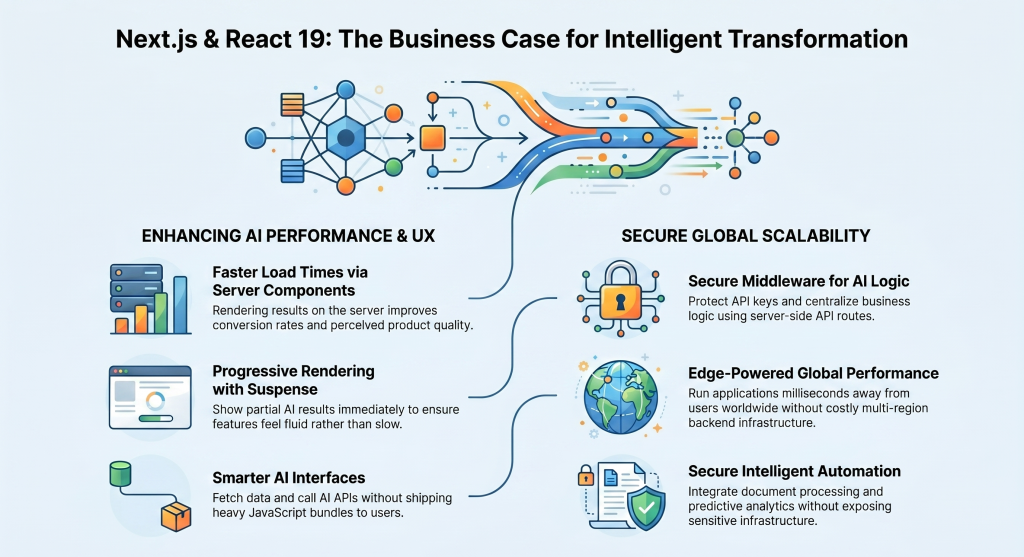
React 19’s Server Components allow you to fetch data, call AI APIs, and render results on the server, without shipping heavy JavaScript bundles to the browser. As a result, your AI-driven dashboards, recommendation engines, and intelligent forms load faster and respond smarter.
Business impact: Faster load times directly improve conversion rates, user retention, and perceived product quality, all of which are critical metrics for digital transformation success.
2. Streaming & Suspense for AI-Powered UX
When integrating large language models or real-time analytics, response times can vary significantly. However, React 19’s Suspense and streaming capabilities allow your UI to progressively render, showing users partial results immediately rather than making them wait.
Business impact: Because of this, users experience AI features as fast and fluid, not slow and unreliable, which ultimately drives adoption across your organization.
3. Next.js API Routes as a Secure AI Middleware Layer
Next.js allows you to create server-side API routes that act as a secure middleware between your frontend and AI services (OpenAI, Anthropic, internal ML models). In addition to keeping your API keys protected, this approach also keeps your business logic centralized and your architecture clean.
Business impact: As a result, you can integrate intelligent automation, such as document processing, customer intent detection, and predictive analytics, without exposing sensitive infrastructure.
4. Edge Runtime for Global Intelligent Products
Next.js supports deployment on edge networks (Vercel, Cloudflare Workers), which means your intelligent business application runs milliseconds away from your users, anywhere in the world.
Business impact: Therefore, enterprises with global teams or customers get consistent, high-performance experiences without costly multi-region backend infrastructure.
How to Migrate a Legacy Application to Next.js + React 19
Many businesses ask: “How do I migrate our legacy web application to Next.js without disrupting operations?” Fortunately, there’s a proven phased approach that minimizes risk at every step:
- Audit your current architecture : First, identify frontend components, API dependencies, and data sources
- Set up a Next.js project alongside your existing app : Next.js supports incremental adoption natively, so you don’t need to rebuild everything at once
- Migrate static and marketing pages first : This carries low risk while delivering immediate SEO and performance wins
- Replace REST endpoints with Next.js API Routes : Start with non-critical services before moving to core systems
- Introduce React 19 Server Components : Then refactor data-fetching logic from client to server progressively
- Integrate AI capabilities : Subsequently, connect LLMs, analytics, and automation workflows via server-side routes
- Deprecate the legacy system : Finally, once feature parity is achieved, sunset the old infrastructure confidently
This approach not only minimizes downtime but also delivers measurable ROI at each phase.
Why CTOs and Decision-Makers Are Choosing This Stack
Beyond the technical advantages, there are also strong business and organizational reasons to commit to this stack:
- Hiring is easier : React remains the most in-demand frontend skill globally
- Ecosystem is massive : Thousands of compatible libraries, tools, and AI SDKs are available
- Vercel and cloud-native deployment : Zero-config CI/CD pipelines reduce DevOps overhead significantly
- Built for AI from the ground up : React 19’s architecture aligns naturally with how AI APIs work
- Long-term investment safety : Backed by Meta (React) and Vercel (Next.js), with enormous community momentum
Frequently Asked Questions
Q: Is Next.js suitable for enterprise-scale intelligent business transformation?
A. Yes, absolutely. Companies like Nike, TikTok, Notion, and Twitch run on Next.js. Moreover, it handles enterprise traffic, complex authentication, and AI integration at scale without compromise.
Q: How long does it take to migrate a legacy system to Next.js?
A. Depending on complexity, a phased migration typically takes 3–6 months. However, because incremental adoption is supported, you see benefits from week one.
Q: Can Next.js + React 19 integrate with existing ERP or CRM systems?
A. Absolutely. Next.js API routes connect to any REST or GraphQL API, including SAP, Salesforce, HubSpot, and custom enterprise systems, so your existing investments are protected.
Q: Do I need a separate backend if I use Next.js?
A. Not always. Next.js handles full-stack logic for most use cases effectively. However, for complex microservices, it works well as an orchestration layer.
The Bottom Line
If intelligent business transformation is your goal, your technology stack is not just an IT decision, it’s a strategic one. Moreover, Next.js + React 19 gives your business the speed, scalability, AI-readiness, and developer ecosystem needed to build products that compete in 2026 and beyond.
At 200OK Solutions, we specialize in intelligent business transformation, helping companies architect, migrate, and scale modern full-stack applications that drive real business outcomes.
Ready to modernize your digital product? Let’s build something that works.