
Short answer: When a client asks for bespoke software, an MSP should not say no and should not build it alone. Confirm that off-the-shelf tools genuinely cannot do the job, define the requirements with the client, then either build in-house or use custom software development outsourcing through a specialist engineering partner. Keep ownership of the client relationship, the contract and the ongoing support.
Key takeaways
- Bespoke software is built for one client’s specific workflow. Packaged software is built for many clients.
- Most requests should first be tested against existing RMM, PSA, Microsoft 365 and automation tools before anything custom is built.
- An MSP has three realistic options: build in-house, buy a packaged product, or partner with a custom software development company.
- Custom software development outsourcing lets an MSP say yes to the client without hiring a development team.
- Before signing, agree who owns the code, who supports it, and how it is priced.
What does “bespoke software” mean for an MSP?
Bespoke software, also called custom software, is an application or integration built to fit one organization’s exact processes. It is designed around the client’s workflow instead of asking the client to adapt to the tool.
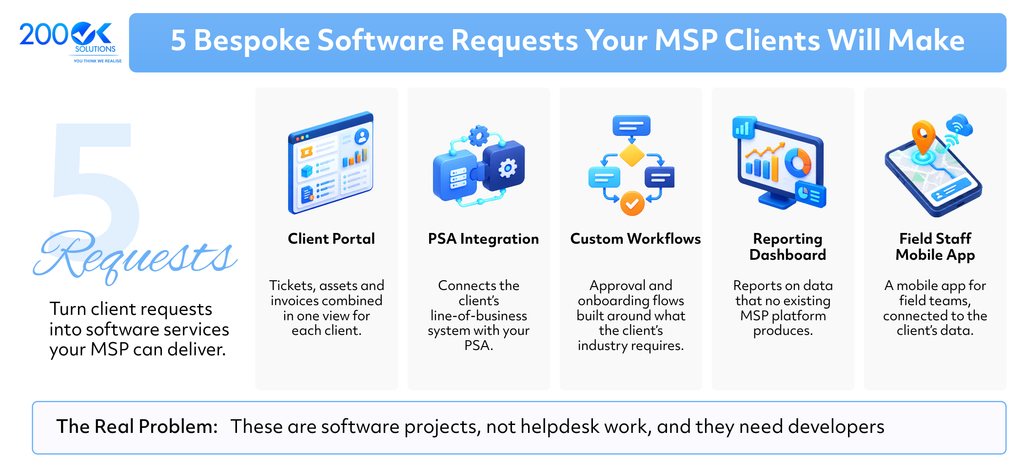
For an MSP, these requests usually look like this:
- A client portal that combines tickets, assets and invoices in one view
- An integration between the client’s line-of-business system and your PSA
- A custom approval or onboarding workflow the client’s industry requires
- A reporting dashboard that no existing MSP platform produces
- A mobile app for field staff that connects to the client’s data
These are not standard managed services. They are software projects, and they need software development skills, not helpdesk skills.
Why are MSP clients asking for bespoke software more often?
Clients want more from their MSP than support, and MSPs know it. In Kaseya’s 2026 State of the MSP Report, a survey of 1,061 MSPs worldwide, 48% named AI and automation as their clients’ top need for 2026, ahead of security (42%) and backup and recovery (36%). Only 13% were earning meaningful revenue from those services.
The same report found that 71% of MSPs say winning new customers is their biggest challenge, and that talent challenges nearly doubled year over year. ScalePad’s 2026 MSP Trends Report adds that 60% of MSPs now run a formal Customer Success program, with improving client experience and becoming a more strategic partner among the top priorities. These pressures push MSPs toward services that deepen existing client relationships, and custom software is one of them.
When a trusted MSP is already managing a client’s IT, the client naturally asks the same provider for the next thing: a tool that fits how their business really works. If the MSP cannot help, the client may look elsewhere. Kaseya found that 33% of new MSP clients are competitive takeaways from another provider, so switching is common.
Should an MSP use custom software or off-the-shelf software?
Start with off-the-shelf. Custom software vs off the shelf is a cost and risk decision, not a prestige one. Bespoke development is the right answer only when packaged tools fall short in a way that affects the client’s operations or revenue.
| Question | Points to off-the-shelf | Points to bespoke |
| Does an existing product cover most of the need? | Yes | No |
| Is the workflow common across the client’s industry? | Yes | No, it is unique |
| Does the process give the client a competitive advantage? | No | Yes |
| Does it need to integrate with unusual or legacy systems? | No | Yes |
| Is a low upfront cost the top priority? | Yes | No |
| Will licensing costs grow with every user? | No | Yes, and ownership is cheaper long term |
If most answers fall in the right-hand column, bespoke software development is justified. If not, configure or extend what already exists. Many requests that sound custom are really MSP automation problems that a workflow tool or script can solve.
What are an MSP’s options when a client needs custom software?
There are three practical paths.
- Build it in-house. This gives full control, but it requires developers, project management, QA and long-term maintenance. Most MSPs are built around engineers who manage infrastructure, not people who ship software products. Hiring a development team for occasional projects is rarely cost-effective.
- Buy or license a packaged product. This is fastest and cheapest when a fit exists. The risk is paying for features nobody needs and hitting limits the vendor will not change.
- Partner with a custom software development company. This is custom software development outsourcing, also called application development outsourcing: a specialist team builds the software while the MSP stays the client’s single point of contact. The MSP gains a new service line without adding headcount or carrying delivery risk alone.
For most small and mid-sized MSPs, the third option is the most realistic way to say yes.
How should an MSP handle a bespoke software request, step by step?
- Clarify the business problem. Ask what outcome the client needs, not which feature they want. “Reduce onboarding time from five days to one” is a requirement. “Build an app” is not.
- Check existing tools first. Review your RMM, PSA, Microsoft 365, Power Automate and the client’s current systems. Document what each one cannot do.
- Write a short requirements brief. Cover users, data sources, integrations, security needs, and what success looks like in numbers.
- Decide: build, buy or partner. Use the table above and your team’s real capacity.
- Run a paid discovery phase. A short scoping engagement produces a fixed scope, a timeline and a realistic estimate before anyone commits to the full build.
- Build in small releases. Ship a minimum working version first, get client feedback, then extend it.
- Agree support and maintenance upfront. Custom software needs patches, updates and monitoring after launch. That ongoing work is a natural recurring revenue line for the MSP.
How do you choose a partner for custom software development outsourcing?
If you decide to outsource custom software development, evaluate partners on these points:
- Relevant experience. Ask for examples of similar integrations, portals or automation work, not only a general portfolio.
- Clear ownership terms. The contract should state who owns the source code and intellectual property. Clients usually expect to own what they paid for.
- Security practices. Ask how they handle access, secrets, code review and client data, especially if your client is regulated.
- Communication and time zones. Confirm overlap with your working hours and a single named contact.
- Documentation and handover. You should receive documentation so the software can be supported without depending on one person.
- Willingness to stay behind the scenes. A good partner supports your relationship with the client and does not compete for it.
- Flexible engagement. Look for fixed-scope projects for defined work and dedicated-team options for ongoing development.
Custom software development consultants can also help at the start. A short consulting engagement can validate whether bespoke software is needed before you commit to a build.
How can an MSP price and protect margin on custom software?
Common commercial models include:
- Resell with markup. The MSP contracts the client, engages the development partner, and adds a project management and delivery margin.
- Referral or revenue share. The partner contracts directly and the MSP receives a fee. This is simpler but gives the MSP less control.
- Build plus managed support. The MSP sells the build as a project and then a monthly support and monitoring plan, which creates recurring revenue.
Whichever model you choose, put three things in writing: the scope and change-request process, ownership of the code, and who handles support after launch.
What mistakes should MSPs avoid?
- Agreeing to a build without a written scope
- Promising a fixed price before any discovery work
- Letting the project run without a named owner on the client side
- Ignoring maintenance, so the software becomes a liability a year later
- Choosing a developer on price alone
Frequently asked questions
Q. What is custom software development outsourcing?
A. Custom software development outsourcing means hiring an external engineering team to design, build and support software for you or your client. For an MSP, it adds a bespoke software service line without recruiting developers, while the MSP keeps the client relationship.
Q. What is bespoke software development?
A. Bespoke software development is the process of designing and building software specifically for one organization’s needs. It differs from packaged software, which is built once and sold to many customers.
Q. Can an MSP offer custom software without hiring developers?
A. Yes. By outsourcing custom software development to an engineering partner, an MSP can offer bespoke solutions under its own client relationship without building an in-house development team.
Q. How much does custom software development cost?
A. Cost depends on scope, integrations, security requirements and team size. Small integrations and automations can be a short project, while full platforms take months. A paid discovery phase gives the most reliable estimate for your specific request.
Q. Is custom software better than off-the-shelf software?
A. Not always. Off-the-shelf software is usually faster and cheaper when it covers most of the need. Custom software is better when the workflow is unique, when integration requirements are unusual, or when licensing costs would keep growing.
Q. What is the difference between white-label and referral partnerships?
A. In a white-label arrangement, the partner works under the MSP’s brand and the MSP owns the client relationship end to end. In a referral arrangement, the partner contracts directly with the client and pays the MSP a fee.
Q. How long does a bespoke software project take?
A. A focused integration or portal can often reach a first release in weeks. Larger systems take months. Building in small releases lets the client use value early while the rest is developed.
About 200OK Solutions
200OK Solutions is a custom software development and intelligent business transformation company. We build bespoke software for our clients and do not sell packaged products. Our engineering work spans .NET, cloud platforms (AWS and Azure), Microsoft 365 and Power Automate, mobile apps, DevOps and enterprise integrations, and we publish technical guides on each of these on our blog. We work with MSPs as an engineering partner, so you can say yes to custom software requests without hiring a development team.
If a client of yours needs bespoke software, talk to us at 200oksolutions.com.
You may also like : AI Ticket Triage for MSPs: How Service Desk Automation Speeds Up Response Times