

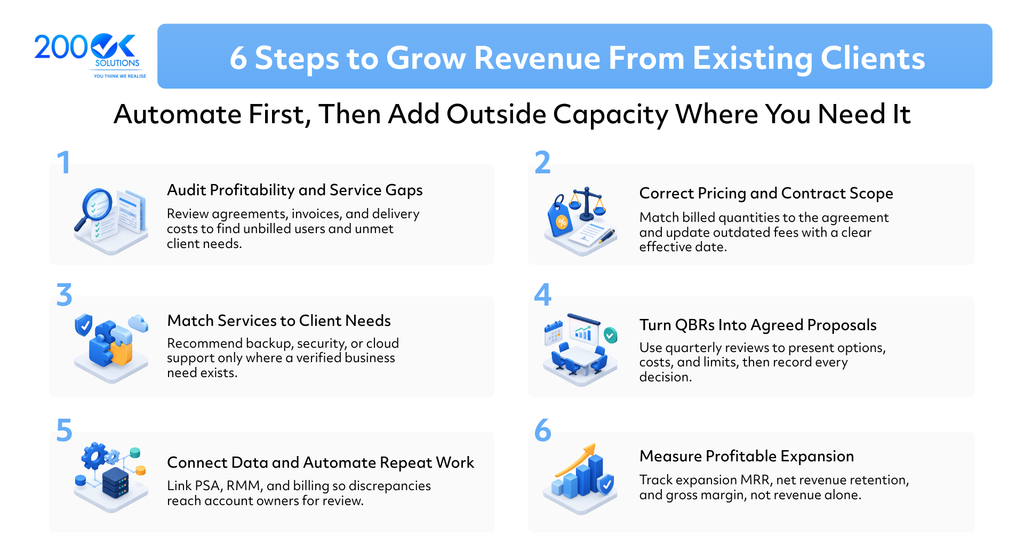
To increase MSP revenue from existing clients, audit account profitability and service gaps, correct pricing and scope, recommend relevant additional services, use quarterly business reviews to agree priorities, and connect delivery data with commercial workflows. Measure incremental gross profit and retention alongside recurring revenue, so account expansion creates a healthier business rather than simply more work.
This guide is for MSP owners, account managers and operations leaders serving UK and US businesses. It focuses on practical account growth, not a generic list of managed IT services.
Where existing client revenue growth comes from
An account can change substantially after an agreement is signed. The client may hire more people, add applications, open a location or need different support. If the monthly fee and service scope have not been reviewed, the MSP may be delivering more value than it is being paid for or missing an opportunity to help the client in a more relevant way.
| Growth mechanism | What changes | Example |
| Repricing | The charge for an agreed scope | Reviewing an outdated fee at renewal, subject to the agreement |
| Scope reconciliation | Billed quantities match the agreement | Verifying user or device counts against the contract |
| Upselling | The client chooses a higher service level | Moving to a package with additional support commitments |
| Cross selling | The client adds a different service | Adding managed backup or reporting support |
| Expansion | Services extend within the business | Supporting a new office or acquired business |
Keep these conversations separate. Correcting an inaccurate user count is not the same as selling a new security service. Clear distinctions make proposals easier to explain and reduce the risk of charging twice for something already included.
Step 1: Audit account profitability and service gaps
Start with the account record rather than a product catalogue. Review the agreement, invoices, service history and delivery costs together. A three to six month review period can be a useful starting point, though use a longer period if seasonal work would distort the result.
Look for two different issues: commercial discrepancies and unmet client needs. Commercial discrepancies include unbilled users, licences outside the agreement or recurring project work absorbed into support. Unmet needs might include an untested recovery process or a new location that is not adequately covered.
Account audit sheet
| Field | What to record |
| Agreement | Scope, exclusions, renewal date and notice provisions |
| Recurring revenue | Recurring charges, separated from one off projects |
| Users and devices | Contracted quantities, verified actual quantities and exceptions |
| Delivery cost | Direct labour, service specific tools and attributable partner costs |
| Service performance | Recurring issues, demand patterns and agreed service outcomes |
| Business changes | Hiring, locations, acquisitions, applications and requirements |
| Validated gaps | What is missing, why it matters and who confirmed the need |
| Next action | Proposed action, accountable owner and review date |
Validate data before making a commercial recommendation. A device found by an RMM tool is not automatically a billable endpoint. Shared devices, test systems and inactive users may need exceptions. Also, do not assume every gap requires something new to sell; some gaps belong to the service the client already pays for.
Step 2: Correct pricing and contract scope
Separate three questions: are you billing the agreed quantities, does the existing price support the agreed work, and does the client need a different package? Keeping these questions distinct makes pricing discussions more transparent.
| Pricing approach | Useful when | Important boundary |
| Per user | Support demand broadly follows supported people | Define shared devices, inactive accounts and supported applications |
| Per device | The service is tied to identifiable endpoints | Define device categories and replacement treatment |
| Tiered packages | Clients need clearly different scopes | Specify outcomes, exclusions and commitments |
| Fixed fee | The environment and responsibilities are well defined | Specify change control and project boundaries |
A justified price adjustment does not always require adding services. Delivery costs may have changed, or the original agreement may no longer reflect the work. Explain the reason accurately instead of disguising a price increase as an upgrade.
Check the agreement’s renewal, notice and variation provisions before proposing a change. Offer a clear effective date, written scope and an opportunity for the client to discuss alternatives. Obtain appropriate commercial or legal review where needed; this article is not contract advice.
Step 3: Match additional services to client needs
The strongest cross sell is connected to a verified business requirement. Start with what the client is trying to achieve, the risk or friction involved and the capability already in place. Only then decide which service fits.
| Client situation | Possible recommendation | Validate first |
| Recovery expectations are unclear | Backup review and recovery testing | Recovery objectives, coverage and responsibilities |
| Microsoft 365 administration is inconsistent | Licence and tenant management service | Current entitlement, ownership and approvals |
| Security alerts lack a response owner | Managed detection and response or partner monitoring | Coverage hours, escalation and response authority |
| Customer requests assurance evidence | Evidence collection and reporting support | Exact request, expertise and assurance boundaries |
| Business opens another location | Onboarding and ongoing managed support | Connectivity, users, equipment and lead times |
Security can be relevant, but it should not become the automatic answer to every account growth question. A client may already have suitable coverage through another provider. In that case, clearer responsibilities or coordination may be more valuable than another overlapping tool.
If a partner provides security operations, define who monitors, investigates, contacts the client and authorises containment. Avoid promising that a service guarantees compliance, prevents every incident or satisfies every insurer. Validate the specific requirement and explain limitations. SOC 2, for example, concerns an examination of controls and related reporting; it should not be described as a universal legal obligation.
Step 4: Turn QBR findings into agreed proposals
A quarterly business review should help the client make decisions, not merely present ticket statistics. Use operational data to explain what has changed and what deserves attention. QBRs are also commonly used by MSPs as a setting for relevant upselling and cross selling.
Prepare recommendations before the meeting, but leave room for the client to challenge assumptions. Their hiring plans, budgets or ownership structure may have changed since the last review.
| QBR stage | Discussion |
| Business priorities | What has changed, and what does the client need next? |
| Service outcomes | What worked, what did not, and what action is underway? |
| Verified gaps | Which issues are evidenced, and what is their impact? |
| Options | What can be addressed now, later or through an alternative? |
| Commercial decision | What is the scope, recurring cost, one off cost and outcome? |
| Next steps | Who owns the decision, and when will it be reviewed? |
Instead of saying “you need a better backup package,” explain that a recovery exercise did not meet an agreed objective. Present options, costs and limitations. If no recovery objective has been agreed, establish it before selling a solution around it. Record the outcome even when the client declines.
Step 5: Connect account data and automate repeatable work
Account expansion becomes harder when agreement data sits in a PSA, device information sits in an RMM platform and billing changes depend on email. A useful integration does not simply move data faster. It helps people identify a discrepancy, verify its meaning and take an authorised action.
Example: from device data to a reviewed scope change
- Collect relevant device and status data from the RMM platform.
- Match devices to the correct client and agreement using a maintained identifier map.
- Apply documented exclusions for inactive, duplicate, test or non billable devices.
- Compare the validated count with the quantity and scope recorded in the PSA.
- Send discrepancies to the account owner for review with supporting evidence.
- Obtain any client approval required by the agreement before changing commercial scope.
- Update approved records and pass the authorised change to billing.
- Log the decision, monitor failures and reconcile the next invoice.
Build in duplicate prevention, access controls, exception handling and an audit trail. Define the source of truth for each field and what should happen when systems disagree. Test the workflow on a small account group before wider rollout.
Automation does not remove all delivery costs. Some services need specialist staff, partner capacity or more coverage hours. Prioritise repetitive, clearly defined work that is expensive enough to justify implementation and maintenance.
For 200OK Solutions, this is where software engineering connects with MSP growth: designing integrations and workflows around how account, service and billing data are actually used. Start with the process, approval boundaries and measurable objective, not just an API connection.
Step 6: Measure profitable account expansion
Track recurring growth alongside contraction, churn and delivery cost. Otherwise, a month with several upgrades can look successful even when another account has left or the expanded services are expensive to deliver.
| Metric | How to calculate or interpret it |
| Expansion MRR | Additional monthly recurring revenue from the existing client cohort |
| Contraction MRR | Recurring revenue lost through downgrades or reduced scope |
| Churned MRR | Recurring revenue lost when clients in the cohort leave |
| Net revenue retention | (Opening cohort MRR + expansion − contraction − churn) ÷ opening cohort MRR × 100 |
| Gross margin | (Revenue − direct delivery costs) ÷ revenue × 100 |
| Proposal acceptance | Accepted proposals ÷ proposals presented, using a consistent period |
| Service quality | Service commitments, recurring issues and client feedback after expansion |
Exclude new client revenue from net revenue retention. Define how you treat licence charges, one off projects, credits and currency changes so comparisons remain meaningful.
Worked example: revenue is only half the story
The following figures are illustrative only. They are not 200OK Solutions client results, UK pricing benchmarks or promised outcomes.
| Monthly account economics | Before | After |
| Recurring revenue | £2,500 | £3,000 |
| Direct delivery cost | £1,750 | £2,050 |
| Gross profit | £750 | £950 |
| Gross margin | 30% | 31.7% |
The additional service generates £500 in monthly revenue and £300 in additional direct delivery cost. Monthly gross profit therefore rises by £200. The decision should still account for implementation costs, client value, delivery risk and any overhead not included in the calculation.
If additional delivery cost were £550 instead, revenue would rise, but monthly gross profit would fall by £50. That is why expansion targets should not operate independently of margin and service quality.
For US accounts, use actual dollar denominated revenue and costs. Changing the currency symbol would not establish a US market price.
UK and US considerations
The account growth process can be shared across markets, but the evidence supporting a recommendation should reflect the particular client. Country alone does not establish a regulatory obligation, certification requirement or appropriate price.
| Area | UK client review | US client review |
| Commercial model | Record GBP charges, applicable tax treatment and agreement terms | Record USD charges, applicable tax treatment and agreement terms |
| Assurance requests | Establish whether Cyber Essentials, ISO 27001 or another assurance goal is relevant | Establish whether SOC reporting, industry requirements or another assurance goal is relevant |
| Sector obligations | Verify activities, data and applicable requirements | Verify activities, data and applicable requirements, including HIPAA where genuinely applicable |
| Service operations | Confirm coverage hours, locations and cross border constraints | Confirm coverage across relevant time zones, locations and cross border constraints |
Treat these as review prompts, not legal conclusions. Keep legal obligations, contractual requirements, certifications and assurance reports distinct in proposals.
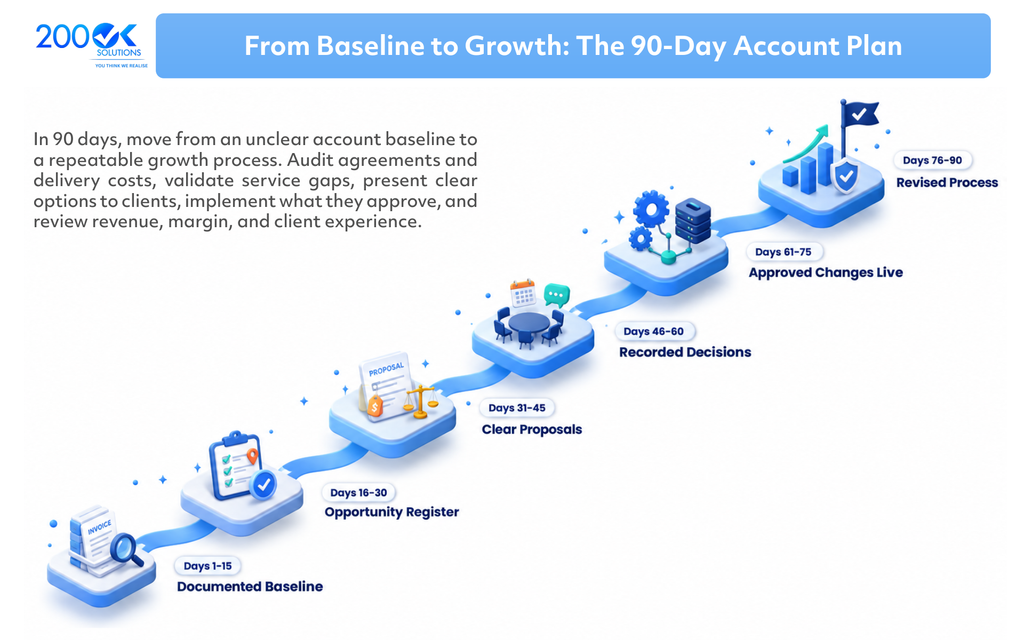
A practical 90 day plan
| Period | Activity | Output |
| Days 1–15 | Review agreements, revenue, delivery costs and data quality | A documented baseline |
| Days 16–30 | Validate service gaps and prioritise accounts | An owned opportunity register |
| Days 31–45 | Design commercial options and check delivery economics | Clear proposals and service boundaries |
| Days 46–60 | Hold selected QBRs and gather client feedback | Recorded decisions and follow-up actions |
| Days 61–75 | Implement approved changes and selected workflows | Updated agreements, systems and tasks |
| Days 76–90 | Review revenue, margin, exceptions and client experience | A revised process and next account group |
Assign an owner to each action. Where account data is unreliable, fixing that foundation may be a better first-quarter outcome than launching several new services.
Frequently asked questions
Q. How do MSPs identify underpriced accounts?
A. Compare the agreed scope and recurring fee with validated quantities and direct delivery costs. Investigate the cause before changing the price: excessive work may indicate scope creep, inefficient delivery, unresolved faults or inaccurate billing.
Q. What is the difference between repricing and upselling?
A. Repricing changes the charge for an agreed scope. Upselling moves the client to a higher service level or broader package. Show these separately so the client understands what is changing and why.
Q. Which services should an MSP cross-sell first?
A. Start with a verified need that fits your delivery capability. Backup, security, cloud administration and reporting can all be appropriate, but none is automatically best for every client.
Q. How can QBRs support revenue growth without becoming sales pitches?
A. Begin with client objectives and actual service outcomes. Present a small number of relevant options, explain costs and limitations, and record the decision.
Q. What is expansion MRR?
A. Expansion monthly recurring revenue is the additional recurring revenue generated from existing clients during the chosen period. Keep it separate from new-client revenue and one-off project fees.
Q. Can automation increase MSP revenue?
A. It can support growth by exposing validated account discrepancies, reducing repetitive administration and helping teams follow up consistently. The outcome depends on data quality, implementation cost, client decisions and delivery economics.
Connect account insight with delivery
A clear expansion strategy needs reliable information underneath it. If agreement, device, licence and billing data are disconnected, account managers can spend more time reconciling records than discussing client priorities.
200OK Solutions can help explore custom software and integration workflows that connect those systems, support account reviews and reduce manual handoffs. Start with one clearly defined problem, establish a baseline and build a process your team can maintain.
Discuss your MSP automation and integration requirements with 200OK Solutions