
Databricks makes it quick to stand up a lakehouse. It does not make it quick to run one well. A few months after the first workspace goes live, platform engineering teams find themselves answering questions the setup screens never asked: who owns access to which tables, why the bill jumped, how pipelines reach production, and how data flows to and from the business systems the company runs on.
That gap is what Databricks consulting services are meant to close. This guide covers what they include, when outside help is worth it, and how to choose a Databricks partner. It is written for the platform engineers who will be on call for whatever gets built.
What do Databricks consulting services include?
Most engagements fall into five areas:
- Architecture and setup: workspace layout, environments, networking, identity, and storage.
- Databricks data governance: catalog structure, permissions, lineage, and audit.
- Migration: moving data and workloads from a legacy warehouse, Hadoop cluster, or another cloud platform.
- Databricks cost optimization: making spend visible, attributable, and predictable.
- Databricks integrations and CI/CD: deployment pipelines, observability, and connections to business systems.
Most also include enablement: runbooks and working sessions so your team can operate the platform alone. Some firms also offer Databricks managed services, where they run the platform for you day to day. That suits teams with no capacity to own operations, but it works best with documentation and a clear handover path.
A note on terminology. “Databricks professional services” usually means services delivered by Databricks itself, while a Databricks consulting partner (or, in UK usage, a Databricks consultancy) is an independent firm. Both can be the right choice. What matters is how well the team fits your stack, timeline, and engineering practices.
When do platform engineering teams need outside help?
Several situations make the case on their own:
- The first use case worked, and now many teams want in. One workspace built for one project rarely holds up when ten teams arrive.
- Access is managed by hand. Permissions granted person by person make audits and onboarding painful.
- The bill is a surprise. Nobody can say which team or pipeline drives spend.
- A migration has a deadline. A legacy contract renewal turns an open-ended project into a scheduled one.
- Deployments are manual. Notebooks are promoted by copy and paste, and nobody is sure what runs in production.
- The team is small. Databricks is one of several systems you own.
Outside help is least useful when nobody internally will own the platform afterward. A good engagement leaves you with something your team understands.
Databricks data governance: Unity Catalog and access control
Unity Catalog is the governance layer in Databricks: a central place to define who can access which data and AI assets, with lineage and audit information alongside. Retrofitting Databricks governance later is disruptive, so design it early.
Decisions to settle with your Databricks consulting partner:
- Catalog structure. Map catalogs to environments, business domains, or both, and keep naming consistent.
- Groups, not individuals. Grant access to groups synced from your identity provider.
- Named owners. Every catalog and schema has an owner who approves access.
- Infrastructure as code. Define catalogs, grants, and workspaces in Terraform so the setup is reviewable and repeatable.
- Audit and lineage. Agree who reviews them, and how often.
Regulated teams in the UK and US tend to feel this pressure first, whether from security reviews, GDPR, or industry audits. A model that is documented and enforced in code makes those conversations easier.
Migration: Snowflake to Databricks and other moves
A Snowflake to Databricks migration is one of the most common starting points, alongside Hadoop or Cloudera, Teradata, Oracle, and SAS. The source differs, but the pattern that works is similar:
- Inventory and classify. List every pipeline, table, report, and consumer. Mark each retire, migrate as-is, or refactor.
- Start with a pilot. Pick a meaningful but non-critical workload to learn the process before stakes rise.
- Run in parallel and reconcile. Keep both systems running and compare outputs until they match.
- Define cutover criteria up front. Agree what “done” means: data parity, performance, access model, sign-off.
- Decommission on a schedule. Otherwise you pay for two platforms indefinitely.
Avoid lifting and shifting legacy logic unchanged. It works, but it carries over the inefficiencies you meant to leave behind.
Databricks cost optimization: make spend visible first
Before tuning anything, answer one question: who or what drives the spend? Then work through the levers:
- Tagging and attribution. Tag compute consistently, then build a regular report from Databricks billing and usage data.
- Cluster policies. Restrict instance types and sizes, and require auto-termination and tags.
- Right compute for the job. Scheduled production workloads should usually run on job compute, which is typically priced lower than all-purpose compute.
- Right-sizing. Review cluster sizes against actual utilization.
- Serverless trade-offs. Serverless can cut idle time and operational effort, but it prices differently, so compare against your workloads.
- A review cadence. Monthly reviews with the owning teams beat one large clean-up.
The aim is less one big saving than the visibility and guardrails that stop costs drifting back up.
Databricks integrations and CI/CD
This is where data work becomes production software, and where many platform teams feel the most friction. It usually covers:
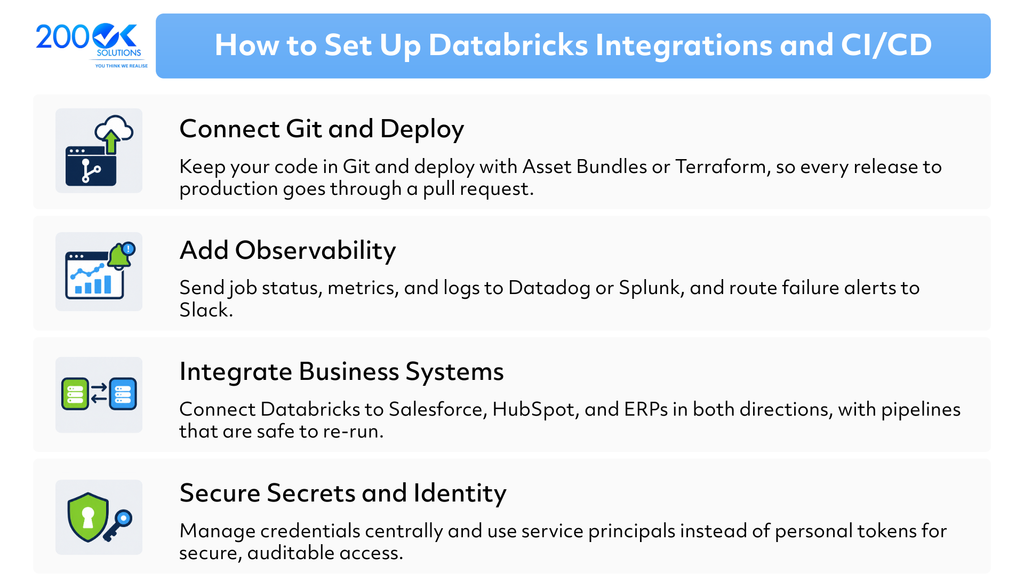
A pipeline that works in a notebook but breaks on schema changes, or has no owner at 3 a.m., is a software engineering problem as much as a data problem.
How to choose a Databricks partner
Whether you are talking to a global firm, a boutique consultancy, or Databricks’ own services team, these questions separate good fits from the rest:
- Who will do the work? Meet the engineers, not only sales.
- Have they run something comparable in production? Ask for an example and a reference.
- What do you keep at the end? Infrastructure as code, documentation, runbooks, and a handover your team joins.
- How do they approach cost? A partner paid on higher consumption has a different interest from yours.
- How do they scope and price? A short fixed-scope assessment lets you test the relationship cheaply.
- What do partner status and certifications tell you? A useful signal, and checkable in Databricks’ partner directory, but not a substitute for delivery experience.
- Do they know your wider stack? Cloud, CI/CD tooling, and the business systems around Databricks all matter.
How 200OK approaches platform engineering and integrations
200OK Solutions is a custom software development company. We build bespoke software rather than selling packaged products, and we focus on the engineering around the data platform: CI/CD pipelines, integrations with business systems, observability, and the application layer that turns platform data into something people use.
If you are planning a Databricks rollout, a migration, or integrations with the rest of the business, our Platform Engineering & Integrations service is the place to start.
Frequently asked questions
Q. What do Databricks consulting services typically include?
A. Architecture and setup, governance with Unity Catalog, migration, cost optimization, CI/CD and integrations, and enablement. The mix depends on where your platform is today.
Q. Do we need a Databricks partner, or can we do this in-house?
A. Many teams do the first project in-house. Outside help pays off when you are scaling to multiple teams, facing a migration deadline, or short on capacity. Plan for your own team to own the platform afterward.
Q. How long does a Databricks migration take?
A. It depends on the number and complexity of workloads, the documentation on the source system, and how much you refactor. An inventory and a pilot give a far better estimate than any rule of thumb.
Q. What is the difference between Databricks professional services and a consulting partner?
A. Professional services usually means services delivered by Databricks itself. A consulting partner is an independent firm, often with broader experience in your surrounding stack. Some projects use both.
Q. How do we keep Databricks costs under control?
A. Make spend attributable with tagging, set guardrails with cluster policies, match compute to each workload, and review costs on a regular schedule.
Conclusion
Good Databricks consulting services do not just stand up a platform. They leave your team with governance enforced in code, a migration path with clear cutover criteria, spend you can explain, and deployments that go through a pipeline. Judge a partner on what you will be able to run yourselves once they leave.