
Most engineering teams are already using AI. Developers are writing code with Copilot, Claude Code, or Cursor. Product teams are shipping AI features. And in most companies, security and governance have not caught up.
This is not a hypothetical risk. It is happening in your codebase right now, whether or not there is a policy for it. In fact, [e.g. “across the AI security reviews we ran in the last 12 months, unsanctioned ‘shadow AI’ tools were present in X% of mid-size engineering teams”]. That one data point is what will make this page quotable by both journalists and AI search engines, replace the bracket with a real number you can stand behind.
This guide is written for CTOs who need a clear, working framework for AI development lifecycle security, not a research paper. It covers where AI introduces new risk, what to actually do about it, and how to build this into your development process without grinding your team to a halt.
What Is the AI Development Lifecycle?
The AI development lifecycle (AI SDLC) is the full journey of building and running an AI system: collecting data, training or fine-tuning a model, testing it, deploying it, and monitoring it in production. If your team uses AI coding assistants, it also includes how AI-generated code enters your codebase and gets reviewed.
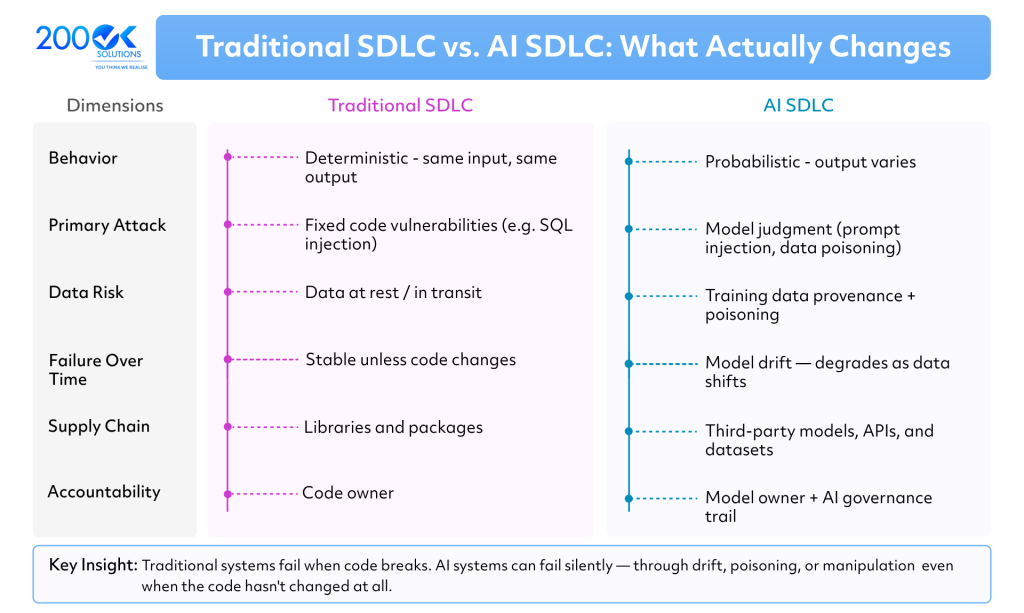
Traditional software security assumes the system behaves the same way every time you run it. AI systems don’t. They are probabilistic, the same input can produce different outputs and they can be manipulated in ways a normal application cannot. A SQL injection attack targets a fixed vulnerability. A prompt injection attack targets the model’s judgment. That difference changes what “secure” even means.
This is why bolting your existing SDLC security checklist onto an AI project doesn’t work. You need controls built for each stage of this specific lifecycle.
The Six Stages Where Security Has to Be Built In
- Data collection and preparation : Training data is often your most sensitive asset, customer records, transaction histories, medical data. It needs access controls, encryption, and clear provenance tracking (where did this data come from, and can you prove it). A single unvetted or manipulated dataset can quietly poison everything downstream.
- Model design and training : This is where technical decisions meet business risk. Who has access to the training environment? Is the process reproducible and auditable? Can you explain, in plain terms, how the model reaches its outputs?
- Testing and validation : Don’t just test whether the model works. Test whether it can be tricked. Run adversarial tests, check for bias across different user groups, and set clear thresholds for what “confident enough to ship” means.
- Deployment : Once a model or AI feature goes live, it’s a live attack surface. It needs the same rigor as any production API: authentication, authorization, rate limiting, and monitoring for unusual patterns.
- Monitoring : AI systems drift. A model that performed well at launch can degrade or behave unexpectedly as real-world data shifts. You need ongoing monitoring for accuracy, fairness, and security anomalies, not a one-time check at launch.
- Governance and retirement. Every AI system needs an owner, a documented decision trail, and a plan for what happens when it’s retired or replaced. This is the backbone of AI governance, without it, you end up with “shadow models” nobody is accountable for.
The AI Security Risks CTOs Actually Need to Worry About
You don’t need to become a machine learning researcher. You need to understand five risk categories well enough to ask your team the right questions.
- Data poisoning and model poisoning. Someone manipulates the training data or the model itself so it behaves incorrectly, either subtly (biased outputs) or dramatically (a planted backdoor).
- Prompt injection. An attacker hides instructions inside content the AI processes, a document, an email, a webpage, to make it do something it shouldn’t, like leak data or take an unauthorized action.
- Insecure AI-generated code. AI coding assistants were trained on public code, including code with vulnerabilities. Generated code can look clean and still contain security flaws that a rushed reviewer misses.
- Shadow AI. Employees using unsanctioned AI tools, pasting proprietary code or customer data into a public chatbot because it’s faster than asking for approval. See the dedicated section below; this is one of the most common and least discussed risks in mid-size companies today.
- Third-party model and API risk. Every AI vendor or API you plug into is now part of your attack surface and your compliance footprint. You are trusting their data handling, their uptime, and their security practices.
Shadow AI: The Risk Hiding in Plain Sight
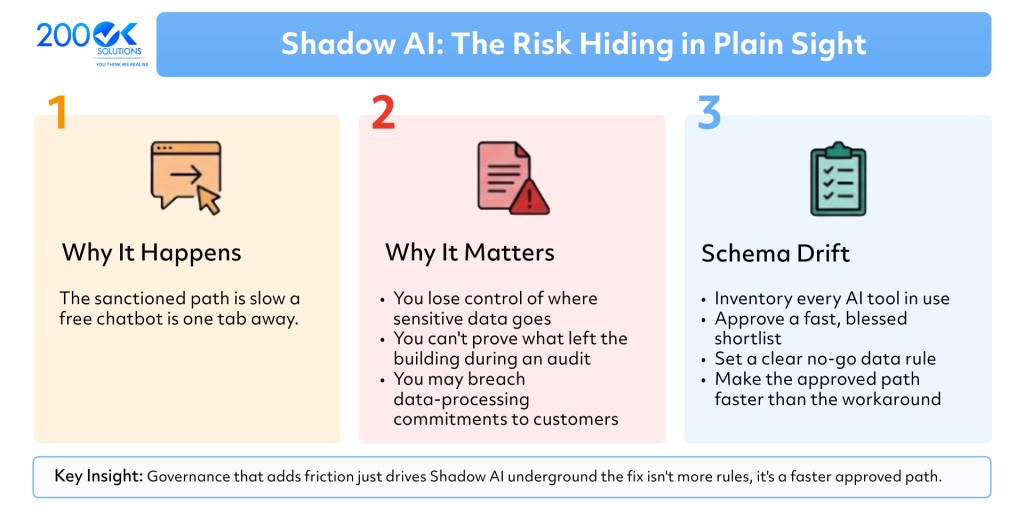
Shadow AI : employees using AI tools your security team never approved is the fastest-growing gap in most engineering organizations. It’s the AI-era version of shadow IT, and it’s more dangerous because the “input” is often your source code, customer data, or internal documents pasted straight into a public model.
Why it happens: the sanctioned path is slow, and a free chatbot is one tab away. Why it matters: you lose control of where sensitive data goes, you can’t prove what left the building during an audit, and you may breach data-processing commitments you made to your own customers.
How to get ahead of it:
- Inventory first. You can’t govern what you can’t see. Survey every team on which AI tools they actually use, sanctioned or not.
- Approve a short list. Give people a fast, blessed option so the shortcut isn’t necessary.
- Set a data-handling rule everyone remembers. No customer data, no credentials, no proprietary algorithms in unapproved tools.
- Make the approved path faster than the workaround. Governance that adds friction just drives shadow AI underground.
A Simple Framework to Anchor Your Approach
You don’t need to invent this from scratch. Two frameworks do most of the heavy lifting:
- NIST AI Risk Management Framework (AI RMF) : a repeatable cycle of Govern, Map, Measure, Manage. Use it to structure how your organization identifies and handles AI risk on an ongoing basis, not as a one-off exercise.
- OWASP Top 10 for LLM Applications : a practical, developer-facing list of the most common ways LLM-based systems get exploited, including prompt injection, data leakage, and insecure plugin design.
Adopting these doesn’t mean a heavy compliance program. It means using their categories as a checklist when you review any new AI feature or tool.
AI Governance and Compliance Checkpoints for 2026
Regulation is no longer theoretical. The EU AI Act is in force and applies to companies serving EU users, regardless of where you’re headquartered, the obligations scale with the risk level of your AI system. The UK is taking a more principles-based, sector-led approach, but that is shifting, and sector regulators (particularly in health and finance) are actively issuing guidance. If you operate in healthcare or fintech, expect scrutiny on top of general AI regulation: existing data protection and sector-specific rules already apply to how you use AI with patient or financial data.
The practical takeaway: don’t wait for a finalized rulebook before you act. Document what your AI systems do, why, and what data they touch. That documentation is the core of good AI governance and it’s what regulators and auditors will ask for first, regardless of exactly which rule applies to you.
Governing AI Coding Assistants (and Securing AI-Generated Code)
This is the most immediate decision most CTOs are facing. A few clear rules go a long way:
- Decide which AI coding tools are approved, and block or discourage the rest don’t leave it to individual choice.
- Set clear rules on what can and cannot be pasted into an AI tool: no customer data, no credentials, no proprietary algorithms.
- Treat AI-generated code like code from a junior developer: useful, often good, but always reviewed. Don’t waive your existing review or security scanning for AI-written code, if anything, increase scrutiny in the first few months of adoption.
- Track what percentage of your codebase is AI-assisted. You can’t manage a risk you’re not measuring.
A 30-Day AI Security Action Plan
- Week 1 : Inventory. List every AI tool currently in use across your engineering team, sanctioned or not. You will likely find more than you expect (this is your shadow AI audit).
- Week 1–2 : Policy. Set a short, clear policy on what data can go into AI tools and which tools are approved.
- Week 2 : Map risk. Map your AI-touching systems against the OWASP LLM Top 10 and flag your biggest gaps.
- Week 3 : Review coverage. Confirm your code review and scanning process explicitly covers AI-generated code.
- Week 3–4 : Assign an owner. Give AI governance a named owner. This cannot sit with no one accountable.
- Week 4 : Document. Write down what you’ve done. This becomes your evidence for clients, auditors, or your board.
Build In-House or Bring in a Partner?
Some of this you can and should own internally, policy decisions, tool approval, code review standards. Where teams typically need outside support is in the technical depth: securing an MLOps pipeline, running a proper adversarial test, or building this into a regulated industry’s existing compliance structure. If your team is stretched thin, the fastest path is often a focused security review with an experienced partner, rather than building this expertise from zero while also shipping product.
The Bottom Line
AI security is not a one-time audit you complete and file away. It’s a discipline that has to sit inside your normal development process, the same way code review and testing already do. Start with visibility, know what AI tools and systems you actually have in use, then build policy, review, and monitoring around that. Most companies are still ad hoc about this. Getting ahead of it now, before an incident or a client questionnaire forces the issue, is the difference between managing this on your terms or someone else’s.
Frequently Asked Questions
Q. What is the AI development lifecycle (AI SDLC)?
It’s the full process of building and running an AI system, from collecting and preparing data, through training, testing, deployment, and ongoing monitoring, plus, for most teams today, how AI-generated code enters the codebase.
Q. What is prompt injection, and how do I defend against it?
Prompt injection is when an attacker hides malicious instructions inside content an AI system processes, tricking it into unintended actions. Defenses include input filtering, restricting what actions the AI can take autonomously, and monitoring outputs for anomalies.
Q. What is shadow AI and why is it a security risk?
Shadow AI is the use of unsanctioned AI tools by employees for example, pasting proprietary code or customer data into a public chatbot. It’s a risk because you lose control of where sensitive data goes and can’t prove what left the organization during an audit. Start with an inventory of every AI tool in use.
Q. Do I need to comply with the EU AI Act if I’m not based in the EU?
Likely yes, if you serve EU users or customers. The Act applies based on where your AI system is used, not just where your company is headquartered.
Q. Should AI-generated code go through the same review as human-written code?
Yes, and arguably more scrutiny, at least initially. AI-generated code can look correct while containing subtle vulnerabilities that a fast review will miss.
Q. What does good AI governance actually require?
At minimum: a named owner for each AI system, a documented decision trail, a data-handling policy, and a plan for monitoring and retirement. That documentation is also your first line of evidence in any audit or client security review.
Q. How much should I budget for AI security?
There’s no universal number. Start by budgeting for the visibility and policy work in the 30-day plan above, that’s low-cost. Budget separately, and more significantly, for deeper technical work (pipeline security, adversarial testing) once you know where your actual gaps are.
Ready to secure your AI development pipeline? 200ok Solutions’s engineering team runs focused AI security reviews, from shadow AI audits to MLOps pipeline hardening and EU AI Act readiness. Talk to our team →
You may also like : Context Engineering vs Prompt Engineering: What’s the Real Difference