
Executive Summary
Digital transformation has changed definition three times in a decade, from digitizing paper processes, to migrating to the cloud, to what it means in 2026: building an organization that can absorb AI-native capability into its core operating model without breaking governance, security, or the people running the business.
Most programs still fail for old reasons, unclear ownership, technology bought before strategy is set, change management treated as an afterthought. What’s different now is the cost of getting it wrong. AI capability is compounding faster than most operating models can absorb it.
A note on naming: Internally, we’ve started calling this next phase “Intelligent Business Transformation” rather than digital transformation. The distinction matters: “digital” describes the medium (systems, cloud, software); “intelligent” describes the capability now driving the redesign (AI agents, copilots, automated decisioning). The strategy discipline is the same, outcomes first, architecture second, but the label better reflects what 2026-era transformation actually optimizes for.
This article gives enterprise leaders, CTOs, CIOs, COOs, and Digital Transformation leads, a practical framework: an 8-step model, a maturity ladder, implementation guidance, AI governance considerations, and a realistic case study.
TL;DR / Key Takeaways
- A digital (or intelligent business) transformation strategy is the deliberate redesign of how a business operates using AI-native capability, not a tech purchase or cloud migration.
- The 2026 shift is from digitization (old processes done digitally) to AI-native operating models (processes redesigned around agents and copilots from the start).
- Most enterprises stall at “Connected” maturity, systems talk, but decisions are still manual. Real ROI lives in “Intelligent” and “Autonomous” maturity.
- Governance has to be present from step one, not bolted on after deployment.
- Integration is the most underinvested step, AI agents can’t act reliably on data they can’t access.
- Success is measured in business outcomes (cycle time, cost-to-serve, retention), not systems migrated or tools deployed.
1. What Is a Digital Transformation Strategy?
A digital transformation strategy is a structured, business-led plan for redesigning processes, technology, data, and decision-making to create measurable advantage using digital and AI-native tools.
It is not a cloud migration, a new CRM rollout, an innovation lab, or a rebranded IT roadmap. It answers four questions, in order: What business outcome are we changing? What operating model change gets us there? What architecture enables that model? How do we get people and governance to actually adopt it?
Most failed transformations start at question three, buy a platform, retrofit a business case afterward. That inversion is the most common root cause of failure.
2. Why It Matters in 2026
AI has moved from tool to coworker. Agentic AI, systems that plan multi-step work and execute actions with oversight rather than requiring human execution, turns “give employees a better tool” into “which workflows should be redesigned around autonomous execution.” That’s an operating-model question, not an IT question.
Legacy debt now blocks AI, not just maintenance budgets. You can’t deploy a reliable AI agent against a system with no clean API layer or structured data. Legacy modernization is now justified on AI-readiness, not just risk reduction.
The cost equation favors redesign over digitization. Gains in 2026 mostly come from augmenting existing staff by redesigning a process around AI assistance, not from digitizing the old version of the same process.
3. The 200OK AI-First Transformation Framework
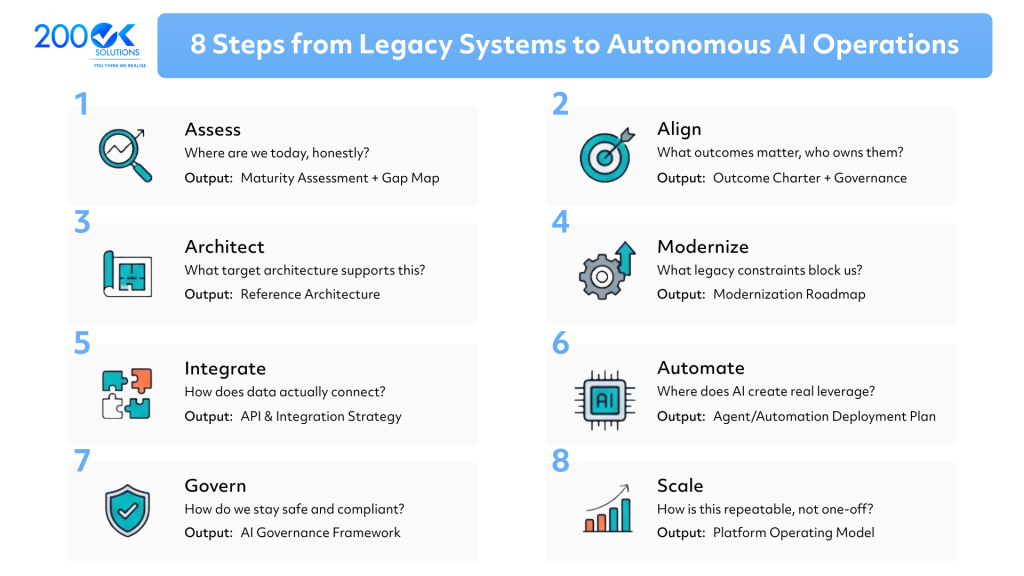
Sequencing matters more than any individual step. Modernize and Integrate must precede Automate, deploying AI on top of disconnected, poor-quality data produces unreliable output regardless of model quality. Govern isn’t step 7 in practice; it needs to be a design constraint from step 3 onward.
4. The Digital Transformation Maturity Model
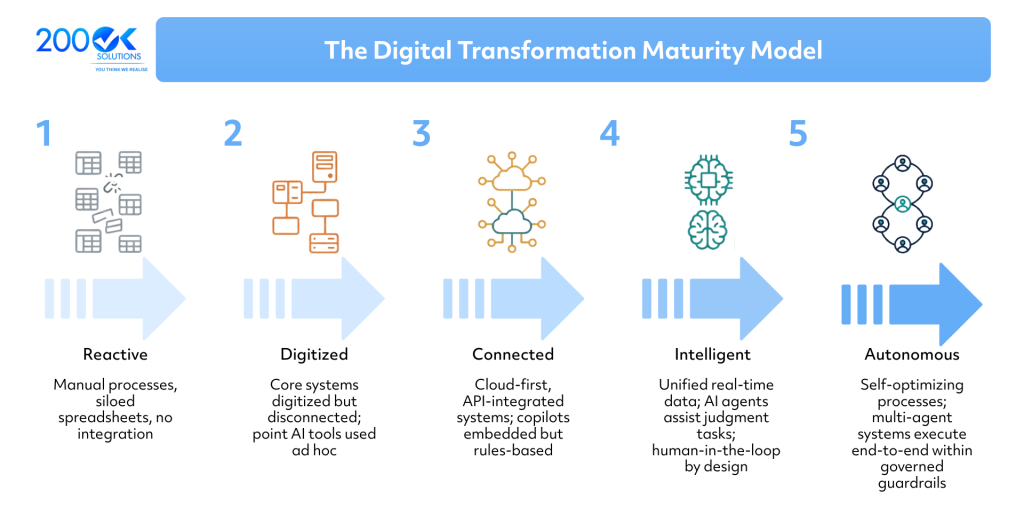
Most enterprises, even ones that feel advanced, sit at Level 2 to low Level 3. The tell: no one can give a fast, accurate answer to “how many active customers do we have” without checking three systems. If that’s you, prioritize Modernize and Integrate before buying more AI tools.
5. Implementation: The Short Version
- Months 1–3 (Assess & Align): Run the maturity assessment, quantify cost of inaction, charter 3–5 outcomes with named executive owners, stand up governance with real authority.
- Months 3–6 (Architect): Lock cloud, integration, and AI platform decisions; define AI governance risk tiers before any agent is deployed.
- Months 6–12 (Modernize & Integrate): Modernize legacy systems incrementally (Strangler Fig pattern, wrap legacy in a stable interface, retire it piece by piece); build the API and data layer.
- Months 9–18 (Automate): Deploy agents/copilots into the now-integrated domain, human-in-the-loop first, expand autonomy only as trust and accuracy data support it.
- Months 12–24 (Govern & Scale): Formalize audit logging and monitoring; stand up a platform team so the second and third domains transform in a fraction of the time the first one took.
Checklist:
– [ ] Named executive owner per outcome
– [ ] Maturity assessment completed honestly, by business unit
– [ ] AI governance risk tiers defined before deployment
– [ ] Integration treated as a gate before automation, not a parallel nice-to-have
– [ ] Change management funded from month one, not added at go-live
6. AI’s Role: Four Layers, Not One
- AI agents, plan and execute multi-step tasks with a defined autonomy boundary; best for high-volume, well-defined, reversible processes.
- Copilots, assist a human who makes the final call; lower-risk, usually the right starting point at Level 2–3 maturity.
- RAG (retrieval-augmented generation), grounds AI output in your actual enterprise data. Quality depends far more on your data architecture than on which model you use.
- Intelligent workflow automation, the orchestration layer connecting agents, copilots, and rules-based automation end-to-end. Most measurable ROI lives here, in removing manual handoffs, not in any single AI feature.
Governance is not optional. Every AI use case needs a risk tier, a matched human-oversight requirement, audit logging, and accuracy/bias monitoring, built into architecture, not retrofitted after launch. A copilot drafting internal emails and an agent approving financial transactions carry entirely different risk profiles and need different oversight, not the same blanket policy.
7. Enterprise Technology Stack (Quick Reference)
| Layer | Purpose |
| Business | Outcome definition, portfolio governance |
| Applications | ERP, CRM, core systems, custom apps |
| APIs | Gateway, catalog, versioning — the connective tissue AI agents depend on |
| Cloud | Compute, storage, infrastructure-as-code |
| Data | Warehouse/lakehouse, master data management, data quality, catalog |
| Security | Identity/access, zero-trust, AI-specific controls (prompt injection defense, model access) |
| AI | Model gateway, agent orchestration, RAG pipelines, vector database |
| Observability | APM, log aggregation, AI drift/cost/accuracy monitoring, FinOps |
Industry priority differs by sector. Healthcare and fintech lead with governance and interoperability, given regulatory exposure. Retail and hospitality lead with unified customer data across fragmented booking/POS/CRM systems. Manufacturing leads with IT/OT integration, connecting shop-floor sensor data to the enterprise data platform before layering predictive maintenance agents on top.
8. Common Mistakes
| Mistake | Fix |
| Buying tech before defining outcomes | Require every purchase to trace to a named outcome |
| Governance as a post-launch checkbox | Build risk tiering into the architecture phase |
| Big-bang legacy replacement | Use the Strangler Fig pattern instead |
| Underinvesting in integration | Treat it as a gate before automation |
| No named outcome owner | Assign one before assigning budget |
| Change management added at go-live | Fund it from Phase 1 |
9. KPIs That Actually Matter
- Business outcomes: cost-to-serve, revenue per employee, time-to-market, customer retention.
- Operational efficiency: end-to-end cycle time, error/rework rate, percentage straight-through completion.
- AI-specific: adoption rate, output accuracy/override rate (how often humans correct AI, a key trust signal), time-to-deploy for new use cases.
- Governance: percentage of AI use cases risk-classified, incident response time, drift detection time.
Avoid vanity metrics, systems migrated and tools deployed measure activity, not impact.
10. Case Study: Mid-Market Financial Services (Composite)
A ~2,000-employee lender operating at Level 2 wanted to “add AI” to cut loan processing time from 9 days. The assessment found the real bottleneck wasn’t a lack of AI, loan officers spent 60% of processing time re-entering the same data across four disconnected systems.
Instead of starting with an AI vendor, the team built an API layer over the legacy origination system (Strangler Fig pattern), unified customer data, then deployed a human-in-the-loop copilot that pre-filled applications and flagged missing documents, plus a RAG-grounded compliance assistant. Cycle time dropped from 9 days to under 2, driven mainly by fixing the integration problem, with AI accelerating an already-fixed process rather than papering over a broken one. That ordering is the most consistent pattern across successful transformations, and the most consistently skipped step in failed ones.
11. Conclusion
Digital or intelligent business transformation in 2026 is a business operating model change that happens to require significant technology work, not an IT initiative run in parallel to the business. The sequencing discipline is the whole game: assess honestly, align on a few real outcomes with named owners, architect deliberately, modernize what blocks you, integrate before you automate, govern continuously.
Next steps: Run an honest maturity self-assessment by business unit. Check whether your top cost-to-serve or cycle-time bottlenecks are actually integration problems disguised as “we need AI.” Build a governance risk-tiering model before your next AI deployment. Assign a named executive owner to each outcome before assigning a budget.
FAQs
Q. What is a digital transformation strategy?
A structured plan aligning business outcomes, operating model, architecture, data governance, and workforce capability to create measurable advantage through digital and AI-native capability.
Q. How is it different from digitization?
Digitization converts a manual process into a digital version of itself. Transformation redesigns the process around what’s newly possible.
Q. How long does it take?
Most enterprise transformations take 18–24 months for a first meaningful outcome, then scale continuously.
Q. Why do most initiatives fail?
Poor sequencing, technology chosen before a measurable outcome and named owner exist, not poor tools.
Q. Agent vs. copilot?
A copilot assists a human who decides. An agent plans and executes multi-step actions within a defined autonomy boundary.
Q. Should governance slow AI adoption down?
Proportionate governance should slow high-risk use cases and barely touch low-risk ones. A single uniform process for everything is usually the real source of delay.
Q. What’s the Strangler Fig pattern?
Incrementally replacing a legacy system behind a stable interface rather than a risky big-bang rewrite.
Q. How do we prioritize what to automate first?
High-volume, easily reversible, well-structured, low-regulatory-risk processes are the best early candidates.
Next Step
200OK Solutions helps CTOs, CIOs, and transformation leaders apply this exact framework, honest maturity assessment, legacy modernization, enterprise integration, governed AI deployment, and platform-based scale. If your transformation is stuck at “we bought the tools, now what,” that’s a sequencing problem and it’s solvable.
Talk to 200OK Solutions about building a roadmap that starts with your business outcomes and ends with measurable results.
You may also like : Context Engineering vs Prompt Engineering: What’s the Real Difference