
Prompt engineering is the practice of crafting the right instruction or question to get a useful response from an AI model in a single interaction. Context engineering is the broader discipline of designing the entire system of information, data, memory, tools, retrieved documents, and instructions, that an AI application uses to reason and act reliably over time. Prompt engineering optimizes what you say. Context engineering optimizes what the AI knows when you say it.
If you’re building a one-off chatbot demo, prompt engineering might be enough. If you’re building a production AI system that needs to work reliably across thousands of users, integrate with your business data, and make decisions with real consequences, you need context engineering.
Below, we break down both disciplines, how they differ, when each applies, and how businesses are actually using them today.
What Is Prompt Engineering?
Prompt engineering is the skill of writing instructions, prompts, that guide a large language model (LLM) toward a specific, high-quality output. It emerged as one of the first practical skills in working with AI models like GPT and Claude, because the same underlying model can produce dramatically different results depending on how a request is phrased.
Prompt engineering techniques typically include:
- Being specific and detailed rather than vague
- Providing examples (few-shot prompting) of the output format you want
- Encouraging step-by-step reasoning (“chain-of-thought” prompting)
- Specifying format, tone, and length explicitly
- Using system-level instructions to set persona or constraints
Prompt engineering is fast, low-cost, and doesn’t require any infrastructure changes. It’s the right tool when you’re working within a single conversation or a single, self-contained AI call, and the model already has (or doesn’t need) outside information to answer well.
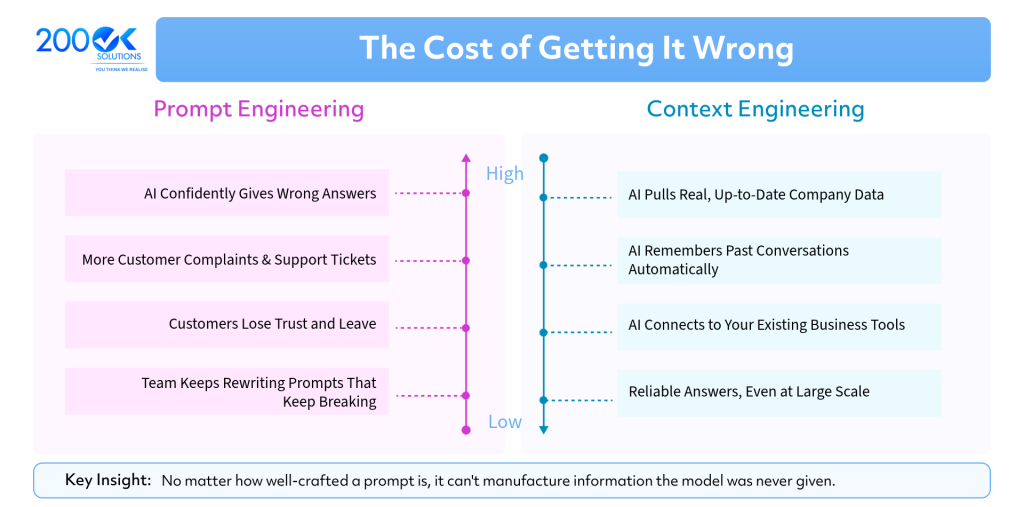
Limitation: Prompt engineering alone breaks down as soon as an AI system needs to remember past interactions, pull in live business data, use tools, or coordinate multiple steps. No matter how well-crafted a prompt is, it can’t manufacture information the model was never given.
What Is Context Engineering?
Context engineering is a newer, broader discipline that has emerged as companies move from AI demos to production AI systems, agents, copilots, and workflow automations that need to behave reliably in the real world.
Rather than focusing on a single instruction, context engineering asks: what is the full set of information the model needs, in what form, at what moment, to make the right decision?
That includes:
- Retrieved knowledge : documents, records, or data pulled dynamically via retrieval-augmented generation (RAG)
- Memory : relevant history from previous interactions or sessions
- Tool outputs : results from APIs, databases, or internal systems the AI can call
- System state : what stage of a workflow the AI is in, and what’s allowed at that stage
- Structured instructions : including prompts, but only as one layer among many
- Context window management : deciding what to include, exclude, summarize, or compress so the model isn’t overwhelmed or misled by irrelevant information
Context engineering treats the prompt as just one component of a larger architecture. It’s less about clever wording and more about system design: data pipelines, retrieval logic, memory management, and orchestration between the AI and your existing software.
Context Engineering vs Prompt Engineering: Key Differences
| Aspect | Prompt Engineering | Context Engineering |
| Scope | Single instruction or conversation | Entire AI system and data flow |
| Goal | Get a good response to one query | Ensure reliable behavior across many interactions |
| Skillset | Writing, reasoning, iteration | Systems design, data architecture, engineering |
| Inputs | Text instructions, examples | Instructions + retrieved data + memory + tools |
| Where it lives | Inside the chat/API call | Across the application architecture |
| Best suited for | Prototypes, one-off tasks, simple assistants | Production AI agents, copilots, enterprise workflows |
| Failure mode if ignored | Vague, inconsistent, or off-target output | Hallucination, lost context, unreliable agent behavior at scale |
The simplest way to think about it: prompt engineering is a subset of context engineering. Every good context-engineered system still needs well-written prompts, but a well-written prompt cannot substitute for a poorly engineered context.
Why This Distinction Matters for Businesses
As companies move beyond chatbot pilots into AI systems that touch real operations, customer support automation, internal copilots, fintech decision support, healthcare workflows, the limits of prompt engineering become obvious fast.
A support agent AI that can’t see a customer’s order history isn’t failing because of a bad prompt. It’s failing because it was never given the context. A financial assistant that gives outdated compliance guidance isn’t a prompting problem, it’s a context freshness problem. This is precisely where context engineering becomes a business-critical discipline rather than a technical nicety.
Common ways companies apply context engineering today:
- Retrieval-augmented generation (RAG) to ground AI responses in company specific, up-to-date data instead of relying on a model’s static training
- Agent memory systems so AI assistants retain relevant history across sessions without re-explaining everything each time
- Tool and API orchestration, letting AI agents pull live data, trigger workflows, or take actions inside existing enterprise systems
- Context window optimization, filtering and structuring what’s passed to the model so it isn’t diluted by irrelevant information
- Multi-agent architectures, where different AI agents are engineered with distinct, purpose-built context rather than one giant prompt trying to do everything
This is also why “vibe coding” and simple prompt-based tools tend to plateau: they work well for demos but weren’t built with the data architecture needed to scale or stay accurate.
Do You Need Prompt Engineering, Context Engineering, or Both?
In practice, this isn’t an either/or decision, it’s a maturity curve.
- Early stage / prototyping: Prompt engineering alone is usually sufficient. You’re testing what’s possible, iterating quickly, and don’t yet have production data pipelines.
- Scaling to real users: Context engineering becomes essential. You need retrieval systems, memory, and integrations so the AI has accurate, current information, not just a clever instruction.
- Enterprise-grade AI systems: Both disciplines work together. Prompt engineering shapes how the model reasons over the context; context engineering ensures that context is complete, relevant, and trustworthy in the first place.
Businesses that treat AI as a strategic, long-term capability, rather than a one-off feature, inevitably need to invest in context engineering: the data architecture, integrations, and system design that let AI operate reliably inside real workflows.
Frequently Asked Questions
Q. Is context engineering replacing prompt engineering?
A. No. Context engineering is expanding the discipline, not replacing it. Prompts are still necessary, they just become one input among several within a larger, engineered system.
Q. What are the fundamental differences between context engineering and prompt engineering?
A. Prompt engineering optimizes the instruction given to an AI model in a single interaction. Context engineering designs the full information environment, data, memory, tools, and retrieval, that the model draws on across an entire application or workflow.
Q. How do companies use context engineering in production?
A. Most commonly through retrieval-augmented generation (RAG), persistent memory for AI agents, API/tool integrations, and context window management to keep AI systems accurate and grounded in real business data.
Q. Which is more important for enterprise AI systems?
A. Context engineering typically has a bigger impact on reliability at scale, since even a perfect prompt can’t compensate for missing or outdated information. But both disciplines are needed together for production-grade AI.
Q. Are there services that specialize in context engineering?
Yes, technology partners with platform engineering and cloud-native architecture experience are increasingly building context engineering into AI-enabled digital products, connecting retrieval systems, memory layers, and enterprise data sources into reliable AI applications.
Building AI Systems That Actually Scale
At 200OK Solutions, we help businesses move past AI experimentation and into intelligent business transformation, architecting the data pipelines, integrations, and platform engineering that make AI systems reliable, not just impressive in a demo. Whether you’re evaluating how to bring context engineering into your existing digital products or scoping a new AI-enabled platform from the ground up, our team combines deep engineering expertise with strategic product thinking to get it right.
Ready to move from AI prototypes to production-grade systems? Get in touch with our team to discuss how intelligent business transformation can work for you.
You may also like : Port.io Deep Dive: Scorecards & Workflow Automation