
The short answer: API-first architecture means you design the API contract before writing any code. In 2026, teams that follow this approach ship faster, break less, and scale more cleanly. Below, we walk through exactly how to apply this across cloud-native systems built for the long run.
Why API-First Architecture Still Gets Ignored in 2026
Most teams don’t fail at building APIs. Instead, they fail at governing them over time.
You ship v1. Then a client needs a field change. Next, a mobile team needs a different response shape. Six months later, nobody knows which version is live, who depends on what, or whether deprecating an endpoint will break a partner integration.
This is precisely the problem API-first architecture solves, not just at launch, but across years of product evolution.
The irony is that most cloud-native transformations invest heavily in containerisation, Kubernetes, and CI/CD pipelines, yet treat API design as an afterthought. That’s essentially building a high-performance engine with a broken gearbox.
What API-First Architecture Actually Means
Simply put, it’s a design philosophy where the API contract is defined first, agreed upon by all stakeholders, and only then implemented.
In practice, this means:
- The API spec exists before frontend and backend work begins
- The spec is the source of truth, not the code
- Every change goes through a defined review process
- Internal teams, partners, and third parties are all treated like external customers
Furthermore, in a cloud-native architecture built on microservices, this becomes critical. Because loosely coupled services communicate through APIs and events, your API surface multiplies fast. Without deliberate governance, you end up with dozens of drifting contracts that nobody fully owns.
How to Implement API-First Architecture: Step-by-Step
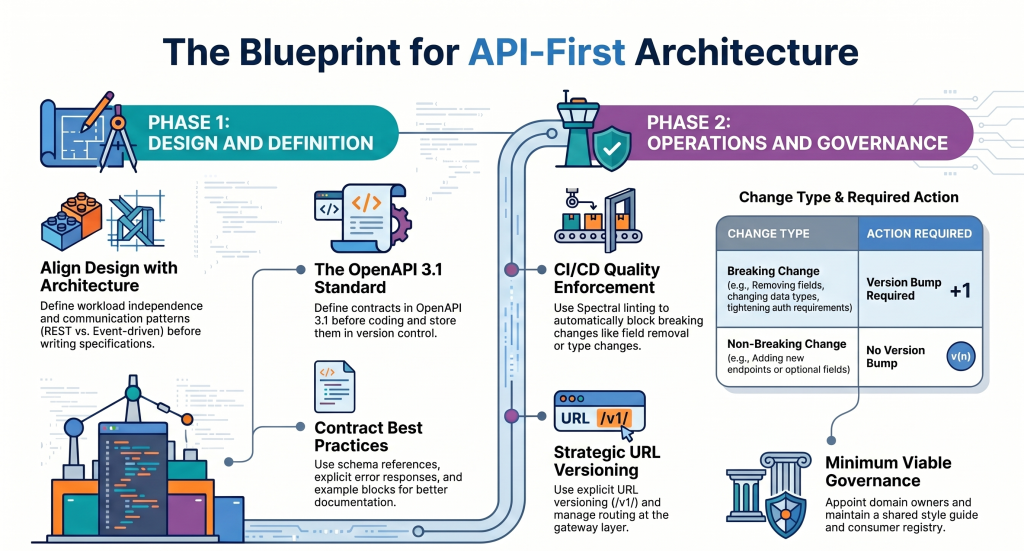
Step 1: Align API design with your target architecture
First, API design doesn’t happen in isolation, it reflects your architectural decisions directly.
Before writing a single spec, you need clarity on:
- Which workloads are independently deployable microservices vs. shared services
- Whether communication is synchronous (REST/gRPC) or event-driven (messaging)
- Which APIs are internal-only and which cross a trust boundary
Consequently, this thinking drives workload classification and cloud readiness analysis. API design is its downstream output.
Step 2: Define the contract in OpenAPI before writing code
Next, use OpenAPI 3.1, not Swagger 2.0, which is outdated. Your spec file should live in version control alongside your code, not in a wiki.
Key OpenAPI specification best practices to follow:
- Use $ref to avoid repeating schema definitions across services
- Define error responses explicitly, not just 200s
- Include operationId on every endpoint so code generators can track operations
- Add field-level descriptions, not just endpoint-level summaries
- Use examples blocks, they become both documentation and test fixtures
Step 3: Enforce spec quality inside your CI/CD pipeline
Because automation drives cloud-native success, it should also drive API governance. Specifically, use Spectral to lint your OpenAPI specs in CI so breaking changes get caught before they reach consumers.
Breaking changes include:
- Removing a field or endpoint
- Changing a field’s data type
- Making an optional field required
- Changing authentication requirements
By contrast, non-breaking changes, new optional fields, new endpoints, don’t require a version bump. Most teams over-version because they haven’t defined this boundary clearly.
Step 4: Version with intent, not habit
A practical REST API versioning strategy for long-running products:
- Use URL versioning (/v1/, /v2/) for major breaking changes, it’s explicit and easy to route at the API gateway
- Avoid header-based versioning unless your infrastructure handles it cleanly; otherwise it hides version decisions from developers
- Set a formal deprecation policy: at minimum a 6-month window, communicated via Deprecation and Sunset response headers
- Always route version traffic at the gateway layer, not inside application code
Step 5: Build governance before you need it
Finally, API governance isn’t bureaucracy. Rather, it’s what prevents three teams from owning three versions of the same endpoint with nobody knowing which is canonical.
Minimum viable governance for a growing product:
- An API owner per domain, aligned to your microservice boundaries
- A shared style guide covering naming, pagination patterns, and error formats
- A changelog that non-engineers can actually read
- A consumer registry so you know who depends on what before you deprecate anything
How This Fits Our Cloud-Native Approach
At 200OK Solutions, API design is Week 1 work, not a pre-launch cleanup task.
When we design cloud-native systems, microservices are built to be independently deployable and communicate through APIs and events. That only works reliably when the contracts governing that communication are explicit, versioned, and governed. For example, containerised workloads running in Kubernetes don’t care about undocumented API drift, until they do, and the result is a 2 AM incident.
Our default stack for API-first cloud-native architecture:
- OpenAPI 3.1 specs in Git, reviewed on every PR
- Spectral for automated linting inside CI/CD pipelines
- Stoplight or Redocly for developer-facing documentation
- Version routing handled at the API gateway layer
- Deprecation notices embedded in release checklists, not just engineering memory
To illustrate the cost of skipping this: one client came to us with 4 parallel API versions in production, three of which had undocumented consumers. Migration took longer than the original build.
Common Questions
Q. How do you handle backward compatibility when requirements keep changing?
A. Design for extension from the start. Use nullable fields over required ones where possible. When you must break compatibility, deprecate with a clear timeline, not silently.
Q. When should you move from v1 to v2?
A. Only when changes cannot be made backward-compatible. If you’re considering v2 after six months, you’re versioning too eagerly, it typically signals the v1 design wasn’t thought through.
Q. How do you govern APIs across multiple teams without slowing them down?
A. Automate enforcement first. Linting rules in CI move faster than approval gates. As a result, you can reserve human review for architectural decisions rather than style choices.
Q. What’s the biggest mistake in API-first adoption?
A. Writing the OpenAPI spec after the code. That’s documentation, not API-first. The spec must precede implementation, otherwise you’re describing what was built, not designing what should be.
The Bottom Line
API-first architecture in 2026 is table stakes for any cloud-native product that expects to grow, integrate, or survive team turnover. Moreover, the teams that treat it as a real design discipline, with explicit contracts, clear versioning logic, and structured governance, spend significantly less time in incident calls.
If your APIs are currently a mix of undocumented endpoints and informal versioning, that risk compounds with every quarter you don’t address it.
200OK Solutions helps engineering and product leaders build cloud-native systems where APIs are a managed asset, not a liability.
You may also like : How to Migrate to Cloud Native Architectures Using Microservices: Complete Strategy for 2026