
Most AI agent failures aren’t dramatic. A classifier misreads a support ticket. A chatbot writes a plausible answer with no way to flag its own uncertainty. A routing step burns a full LLM call on a decision that should take milliseconds. TypeSafe AI built Jev to fix exactly that class of problem, a model that returns a typed decision with a confidence score instead of a paragraph of text. This guide focuses on how you’d actually put it to work: where it fits in an AI agent stack, what integration looks like today, and which use cases are worth building first. TypeSafe only came out of stealth on September 15, 2026, so this sticks to what’s publicly confirmed.
What TypeSafe AI and Jev Are, Briefly
TypeSafe AI is a San Francisco-based lab founded by Diogo Almeida, a former OpenAI researcher and co-inventor of RLHF (the technique used to train ChatGPT). It raised a $40 million seed round led by DCVC. Its premise: much real-world AI usage isn’t conversational, support routing, fraud scoring, moderation, approvals so instead of another chat model, it built what it calls a System One model: fast, intuitive decisions rather than generated prose.
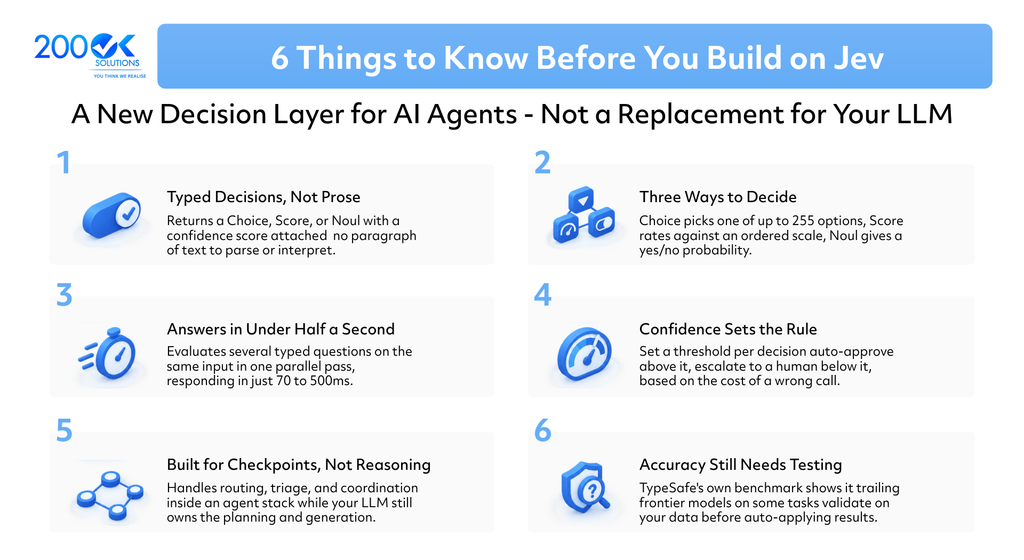
Jev, TypeSafe’s first release, takes a “state” (text, JSON, or an array) plus one or more typed questions, and returns:
- Choice : pick one option from up to 255, with a probability per option (e.g. route a ticket to Billing, Technical, or Sales).
- Score : rate against an ordered scale, e.g. urgency from 1 to 5.
- Noul : a yes/no judgment as a probability, e.g. “Is this a refund request?” → 0.83.
It answers in 70–500ms, evaluating several typed questions on the same input in one parallel pass rather than one autoregressive call per question.
How to Get Started With Jev
1. Request access : Jev is in early access behind a waitlist at typesafe.ai; a couple of third-party inference gateways also list it without a waitlist. There’s no public API reference yet. so budget time to work from early third-party documentation and the SDK directly rather than polished docs.
2. Design your typed questions, not a prompt : The shift from LLM to Jev is architectural: instead of writing a prompt and parsing the reply, you define a schema, a Choice with a fixed option list, a Score range, or a Noul for each decision point. Tickets, documents, or events become the “state”; each question is a discrete, checkable output.
3. Set a confidence threshold per decision, not a global one : Because Jev returns a calibrated probability, the integration work is mostly deciding thresholds: auto-approve above 0.9, escalate to a human below it, and adjust per use case based on what a wrong answer costs. A misrouted support ticket and an auto-approved refund don’t deserve the same threshold.
4. Plan for the API’s current shape : Jev uses a REST endpoint and SDK with rate limits around 250,000 tokens/second and 1,200 requests/minute; it is not compatible with the OpenAI chat-completions format, so existing LLM integration code won’t drop in unchanged. Input is text/JSON only (no images or audio), context is capped at 64,000 tokens, and pricing is $0.042 per million input tokens with output unmetered.
5. Keep a human-review path from day one : TypeSafe’s own benchmark shows Jev trailing frontier models like GPT and Claude on several of four tested workflows, notably invoice processing, by roughly 17 points and its “can’t hallucinate” claim only means it can’t return malformed output, not that the decision is correct. Route low-confidence and high-stakes decisions to a person until you’ve validated accuracy on your own data.
Where Jev Fits in an AI Agent Stack
If you’re building AI agents, systems that plan, call tools, and take multi-step actions, every decision point (classify this, route that, is this step done) is usually another call to a large, general-purpose LLM. Jev is meant to sit at those checkpoints, not replace the agent’s main reasoning model. A practical pattern: use a frontier LLM for planning and generation, and hand off the repeated, structured checks along the way to Jev.
Support ticket triage: instead of one LLM call parsed for department, urgency, and refund likelihood, send the ticket to Jev once with three typed questions answered together in under half a second. Anything above your confidence threshold routes automatically; anything below queues for a person with Jev’s suggestion attached.
Multi-agent orchestration: as you move from one agent to several, small coordination decisions multiply, which agent owns this task, has a step succeeded, should a human take over. Routing every one of these through a full LLM adds latency and cost at each hop; a structured decision layer can absorb that overhead. Reserve the larger model for steps that need real reasoning, and test Jev’s accuracy on your own coordination logic before relying on it for anything consequential.
Model routing: not every request needs frontier-model pricing. A simple yes/no or single-label classification is a candidate for Jev; open-ended writing or multi-step reasoning still belongs with a general-purpose LLM.
Practical Use Cases to Build First
- Support classification : department, urgency, and issue type as three typed questions on one ticket; start with a conservative threshold and tighten it as you validate accuracy.
- Lead qualification : score leads at volume, with borderline scores routed to a human rather than auto-dropped or auto-advanced.
- Approval gating : confidence-gated auto-approval for low-risk requests, with everything else escalated; a good first deployment since the failure mode (extra human review) is cheap.
- Document field extraction : typed extraction per field, but given the accuracy gap TypeSafe’s own benchmark shows on invoice-style tasks, treat outputs as a draft for review rather than an auto-applied result until you’ve tested it on your own documents.
None of these are confirmed TypeSafe case studies, they’re a reasonable starting point for a pilot, not a track record.
Jev vs a Traditional LLM Call
| Factor | Traditional LLM | Jev |
| Output | Free text, needs parsing | Typed value + confidence, ready to branch on |
| Speed/cost per decision | Higher | Lower, by design |
| Integration today | Mature APIs, broad tooling | Early-access API, no public docs, own SDK shape |
| Explainability | Can generate reasoning | Decision + confidence only |
| Accuracy (own benchmark) | Stronger on tested workflows, notably invoicing | Vendor-reported 67.8% vs. 74.1% for best comparator |
Jev’s advantage in the data so far is speed and cost, not necessarily higher accuracy, plan pilots accordingly.
Before You Build on It
Test on your own data before committing a production workflow to Jev: accuracy against your actual tickets /documents/leads, how the integration effort compares to what you already have, what you lose in explainability, and how the threshold-and-escalation logic holds up under real volume. Because it’s early access, also ask how much the product itself is likely to change under you.
Evaluating and wiring in a new decision layer is architecture work, deciding where thresholds live, how they’re audited, and how a workflow degrades gracefully when a model is unsure or the API is down. That’s the kind of work 200OK Solutions does as part of intelligent business transformation: identifying where structured automation genuinely fits, designing the decision logic and fallback paths, and building the platform engineering layer that connects a decision API to the systems a business already runs.
200OK Solutions is not affiliated with or endorsed by TypeSafe AI; this is independent analysis, not a partnership announcement.
Bottom Line
Jev is worth piloting for the narrow, repeated decisions inside your workflows, routing, classification, gating, not for the reasoning-heavy steps an LLM still does better. Start with a low-stakes use case, set thresholds by what a wrong decision actually costs, keep a human in the loop below your confidence bar, and re-test as TypeSafe publishes real documentation and independent benchmarks appear.
Looking to explore AI automation or intelligent decision systems for your business? Connect with 200OK Solutions to discuss your requirements.
You may also like : OpenAI Astra and the Rise of Autonomous AI Agents