
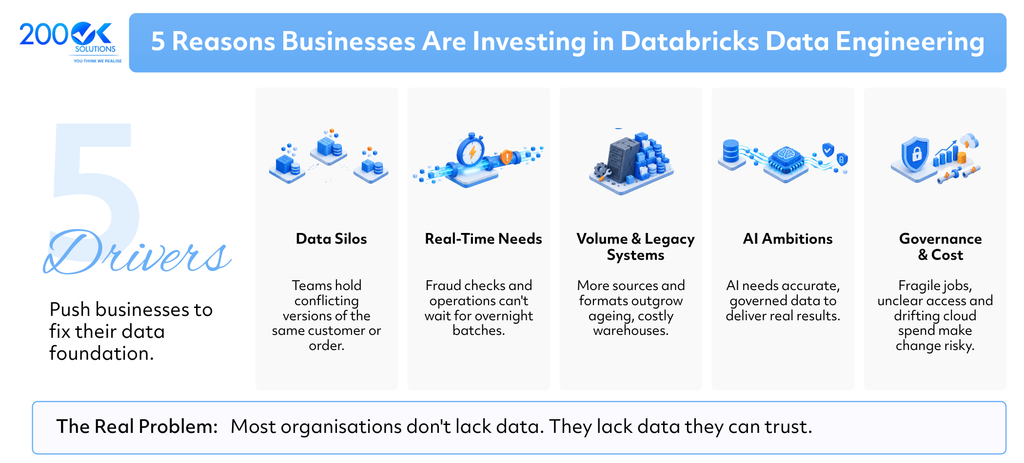
Most organisations don’t lack data. They lack data they can trust. Information sits across CRMs, ERPs, legacy warehouses and cloud apps, and joining it up is hard.
The Databricks Data Intelligence Platform supports data engineering, analytics and AI in one environment. But switching on a platform is not the same as getting value from it. Pipelines still need designing, data validating, access governing and costs controlling.
That gap is where Databricks data engineering consulting comes in.
What Are Databricks Data Engineering Consulting Services?
These are specialist services that help organisations design, build, migrate and run data pipelines and platforms on Databricks. They connect what the platform can do with what the business needs.
Three stages matter:
- Using Databricks: working in an existing environment.
- Implementing it: Databricks implementation services set up architecture, security, ingestion and first pipelines properly.
- Optimising it: improving reliability, performance, cost and governance of a live environment.
Databricks consulting services also differ from general data engineering consulting, which spans any technology.
Why Businesses Are Investing in Databricks Data Engineering
What Is Included in Databricks Data Engineering Consulting Services?
Scope varies, but a full Databricks data engineering engagement typically covers the following.
Data Strategy and Architecture
Assessing sources, workloads and skills, then designing the target architecture, so pipelines aren’t built before their purpose is agreed.
Data Pipeline Design and Development
Building repeatable Databricks data pipelines with Lakeflow, Apache Spark and SQL, replacing fragile manual jobs that reports and models depend on.
Batch and Real-Time Data Processing
Deciding which data moves on a schedule and which arrives continuously. Streaming adds cost, so use it selectively.
Data Migration and Modernisation
Databricks migration services move workloads from legacy warehouses onto the lakehouse in phases, reconciling results against the old system. Done well, this is Databricks data modernization without disrupting reporting.
Enterprise Data Integration
Enterprise data engineering means connecting CRMs, ERPs and third-party systems through APIs and change data capture, so a new platform doesn’t recreate old silos.
Data Quality and Validation
Automated checks for completeness, duplicates and schema changes, with alerts when something breaks. It ends the “which number is right?” debate.
Data Platform Engineering
Engineering services treat the platform as a product: environments, infrastructure as code, testing and monitoring, so changes ship safely and repeatably.
Data Governance and Security
Setting up Unity Catalog access controls, lineage and auditing, which matters most in healthcare, fintech and the public sector.
Performance and Cost Optimisation
Reviewing compute sizing, job design and query patterns, and adding cost visibility. Savings depend on the starting point and can’t be promised.
Analytics and AI Readiness
Preparing governed, well-modelled data for SQL analytics, BI, machine learning and MLflow. AI projects depend heavily on the data behind them.
How Databricks Supports Modern Data Engineering
A well-built Databricks data platform rests on a few pieces:
- Lakehouse: the Databricks lakehouse combines the benefits of data lakes and warehouses, so analytics and machine learning share the same governed data. Databricks SQL serves analysts and BI tools.
- Apache Spark: the engine that spreads large jobs across many machines.
- Delta Lake: the storage layer. It adds ACID transactions and schema enforcement.
- ETL and ELT: ETL transforms data before loading. ELT loads first and transforms inside the platform.
- Lakeflow: Lakeflow Spark Declarative Pipelines (formerly Delta Live Tables) builds batch and streaming pipelines in SQL or Python.
- Unity Catalog: one governance layer for permissions, lineage and audit.
When Does a Business Need Databricks Data Engineering Consulting Services?
- Starting out: Databricks implementation services set foundations early.
- Migrating a legacy warehouse: you need a phased plan that protects reporting.
- Unreliable pipelines: jobs that fail often or depend on one person.
- Scaling or integrating: many systems, many teams, one platform.
- Preparing for AI or governance: the data isn’t ready, or audit questions can’t be answered.
- Optimising or upskilling: costs or performance disappoint, or your team is strong but new to the platform.
Business Benefits of Working With a Databricks Consulting Partner
- Lower risk, better architecture: a structured approach and experience with common pitfalls give choices that hold up as usage grows.
- Reliable data: validation and monitoring catch issues before decision-makers do.
- Scale and integration: new sources and workloads without redesign.
- Governance, visibility and cost control: clear access rules, lineage and usage tracking.
- A stronger base for analytics and AI : Results depend on scope and starting point, and no partner can guarantee them.
Databricks Consulting Partner vs. Traditional Data Engineering Company
| Area | Databricks consulting partner | Traditional data engineering company |
| Platform expertise | Deep, single-platform | Broad, less depth on any one tool |
| Architecture | Lakehouse-first | Platform-neutral |
| Data pipelines | Spark, Delta Lake, Lakeflow | Works with your existing stack |
| Migration | Moving onto the platform | Many source and target platforms |
| Cloud integration | AWS, Azure or Google Cloud | Wider multi-tool estates |
| Governance | Centred on Unity Catalog | Across several catalogues |
| AI readiness | Platform ML and AI tooling | Wider range of AI platforms |
| Optimisation | Platform-specific tuning | General tuning practice |
| Long-term support | Focused platform support | Whole data estate |
Neither is universally better. If you have chosen Databricks, a Databricks consulting partner usually adds the most. If it is one part of a wider estate, a broader firm offering data engineering consulting services may fit better.
How to Choose the Right Databricks Data Engineering Consulting Partner
Databricks consulting services vary widely in depth, so test for:
- Hands-on Databricks knowledge: ask how they would structure workspaces and environments.
- Engineering depth: specialist or wider data engineering consultancy, they need strong fundamentals in pipelines, quality and integration.
- Cloud and architecture: cloud data engineering experience on your cloud, and clear reasoning on trade-offs.
- Migration and governance: how they prove new results match the old, and handle security.
- Business understanding and support: do they ask about decisions before tools, and offer long-term support and knowledge transfer?
Also ask what partner status means. It isn’t the same as individual certifications.
How 200OK Solutions Supports Data Engineering and Databricks Initiatives
200OK Solutions is a UK-headquartered software engineering consultancy and a Databricks Partner, working across hospitality, fintech, retail, healthcare and the public sector. It also offers data engineering, data platform engineering services, cloud data engineering on AWS, Azure and Google Cloud, cloud-native architecture, enterprise integrations, legacy system modernisation, AI readiness and platform engineering.
The approach is architecture-led: assess the existing environment, design a suitable approach, modernise in phases that protect operations, build reliable pipelines, connect business systems and lay foundations for analytics and AI.
Speak with 200OK Solutions about your data engineering or Databricks initiative.
Frequently Asked Questions
Q. What are Databricks data engineering consulting services?
A. Specialist services that help organisations plan, build, migrate and run data pipelines and platforms on Databricks.
Q. Why do businesses need Databricks consulting services?
A. A platform alone doesn’t fix fragmented data or unreliable pipelines. Consultants add platform experience, reduce risk and fill skills gaps.
Q. Can Databricks consultants help migrate legacy data warehouses?
A. Yes. A phased approach redesigns workloads for the lakehouse and validates results against the legacy system before switching over.
Q. How does Databricks support data pipelines?
A. Through Apache Spark, Delta Lake and Lakeflow, which support batch and streaming pipelines in SQL or Python.
Q. What is the difference between Databricks consulting and data engineering consulting?
A. Data engineering consulting services cover any technology. Databricks consulting applies the same work within the platform.
Q. Can Databricks support AI and machine learning initiatives?
A. Yes. It supports analytics, machine learning and AI on the same governed data, with MLflow for model lifecycle management.
Q. How do businesses choose a Databricks consulting partner?
A. Look for hands-on Databricks knowledge, engineering and cloud depth, migration and governance skills, and willingness to work with your team.
Q. How can 200OK Solutions help with Databricks and data engineering?
A. As a Databricks Partner, 200OK combines data engineering, platform engineering, cloud-native architecture and legacy modernisation to build reliable, governed foundations for analytics and AI.
Conclusion
Databricks gives organisations a strong base for data engineering, analytics and AI, but the value comes from how it is designed, governed and run. The right Databricks consulting partner is the one whose skills and working style fit your environment.
You may also like : What Does a Databricks Consulting Partner Actually Do?