
Choosing the right Databricks consulting partner decides whether your data platform delivers value or turns into an expensive experiment. Databricks is a strong data and AI platform. But the platform alone does not deliver results. Outcomes depend on architecture, data engineering, cloud infrastructure, integration, governance, security and ongoing optimisation.
Many businesses focus on the tool and overlook the team building on it. This guide shows how to evaluate Databricks consulting partners on technical expertise, implementation experience, cloud capability, industry understanding, integration skills, support model and long-term fit.
What Is a Databricks Consulting Partner?
A Databricks consulting partner is an external firm that designs, builds, migrates or supports data and AI solutions on the Databricks platform. Its work typically covers lakehouse architecture, data pipelines, Spark and Delta Lake workloads, governance and performance tuning.
The terms overlap, but they are not identical:
- Databricks partner: a company with a formal relationship with Databricks. The type and level of that relationship vary, so ask for specifics.
- Databricks consulting partner: a partner that focuses on advice, architecture and strategy, often through Databricks consulting services.
- Databricks implementation partner: a partner that does the hands-on build, using Databricks implementation services such as setup, migration and pipeline delivery.
- General data engineering consultancy: a firm that works across many data tools and may not specialise in Databricks.
Do not assume that any of these labels guarantees quality. Ask each firm to show what it has actually delivered.
Why Choosing the Right Databricks Consulting Partner Matters
The right partner reduces risk in areas that are expensive to fix later. Poor early decisions tend to surface months after go-live, when they cost the most to correct.
- Architecture quality: weak design leads to slow queries and rising costs.
- Implementation risk: unclear scope and poor planning cause delays.
- Migration complexity: moving from legacy systems needs careful sequencing.
- Pipeline reliability: broken pipelines erode trust in data.
- Security and governance: retrofitting access control is harder than building it in.
- Integration: Databricks must connect to the systems your business already runs.
- Performance and cost: unmanaged clusters and jobs can inflate cloud bills.
- Scalability and support: the platform must grow with your data and be maintained after launch.
A good partner fits Databricks to your business and technical needs, not the other way round.
Questions to Ask Before Hiring a Databricks Consulting Partner
Use this checklist in your evaluation calls:
- What Databricks projects have you delivered, and what were the outcomes?
- Do you have experience with our cloud platform?
- How do you approach Databricks implementation?
- How do you handle legacy data migration?
- How do you approach data quality and governance?
- Can you integrate Databricks with our existing business systems?
- Do you provide ongoing support or managed services?
- How do you approach performance and cost optimisation?
- How will knowledge transfer work with our internal team?
- How will you measure project success?
Vague answers to questions 4, 9 and 10 are the most common red flags.
Databricks Consulting Partner vs. General Data Engineering Company
Neither option is better in every case. The right choice depends on your scope and your current technology environment.
| Area | Databricks Consulting Partner | General Data Engineering Company |
| Databricks expertise | Deep, platform-specific knowledge | Varies; may cover several platforms |
| Data engineering | Strong on Spark, Delta Lake and lakehouse patterns | Strong across many tools and stacks |
| Implementation | Follows Databricks-specific practices | Flexible approach across technologies |
| Migration | Experienced in moving to Databricks | Experienced in many migration types |
| Cloud architecture | Focused on Databricks on major clouds | Often broader multi-platform knowledge |
| Governance | Familiar with Databricks governance features | Applies general governance practices |
| Ongoing support | May offer Databricks managed services | May offer broader platform support |
| Platform optimisation | Tuned for Databricks performance and cost | Depends on the team’s Databricks exposure |
If Databricks is your main platform, specialist depth matters. If it is one part of a mixed environment, a broader firm may fit better.
When Should You Hire a Databricks Consulting Partner?
Hire a partner when the work is complex, time-sensitive or outside your team’s experience. Common situations include:
- Starting a new Databricks implementation
- Migrating from a legacy data warehouse
- Modernising an existing data platform
- Building complex data pipelines
- Connecting multiple enterprise systems
- Preparing data for AI and machine learning
- Improving performance or controlling cloud costs
- Needing extra Databricks expertise
- Requiring ongoing managed services
If your team is already strong and the project is small, you may need less outside help than you think.
How 200OK Solutions Supports Databricks Initiatives
200OK Solutions is a UK software engineering partner, working since 2011, that builds AI-enabled platforms, cloud-native architecture and enterprise integrations. Its website lists Databricks among its partners.
Databricks projects rarely sit alone. They depend on the wider environment around them. 200OK Solutions supports that environment through:
- Cloud-native architecture on Azure, AWS and Google Cloud
- Platform engineering and enterprise integrations, connecting systems that were not built to work together
- Intelligent business transformation, using better data and automation in how businesses run and decide
- Modernisation of complex estates for large organisations
This broader software engineering and integration capability can support Databricks work as part of a wider technology environment, from data foundations to AI and automation.
If you are evaluating Databricks for data modernisation, analytics, AI or enterprise data engineering, speak with 200OK Solutions to discuss your requirements.
Frequently Asked Questions
Q. What is a Databricks consulting partner?
A. A Databricks consulting partner is an external firm that helps businesses plan, build, migrate and optimise data and AI solutions on Databricks. It usually combines architecture, data engineering and platform knowledge.
Q. How do I choose a Databricks consulting partner?
A. Assess hands-on Databricks skills, data engineering depth, implementation approach, cloud experience, migration and integration capability, governance practices, support model and business understanding. Ask for examples of delivered work and talk to the engineers involved.
Q. What does a Databricks implementation partner do?
A. A Databricks implementation partner does the hands-on delivery. That includes setting up the platform, building pipelines, migrating data, configuring security and handing the platform over to your team.
Q. What services do Databricks consulting companies provide?
A. Typical Databricks consulting services include strategy and architecture, data engineering, migration, integration, governance setup, performance optimisation, machine learning enablement and ongoing support.
What are Databricks professional services?
A. Databricks professional services are expert-led services for planning, building and improving Databricks environments. They may be offered by Databricks itself or by partner firms, so confirm who delivers them and what is included.
Q. Do Databricks partners provide managed services?
A. Some do. Databricks managed services can include monitoring, troubleshooting, tuning and cost management. Not every partner offers them, so check before you sign.
Q. Can a Databricks consulting partner help with data migration?
A. Yes. A capable partner can plan and carry out migration from legacy warehouses and ETL tools, including deciding what to move, redesign or retire, and testing the results.
How much does Databricks consulting cost?
A. Costs vary. They depend on scope, architecture, migration complexity, cloud environment, integrations, team requirements and ongoing support. Ask for a written scope and a clear breakdown before agreeing to anything.
Conclusion
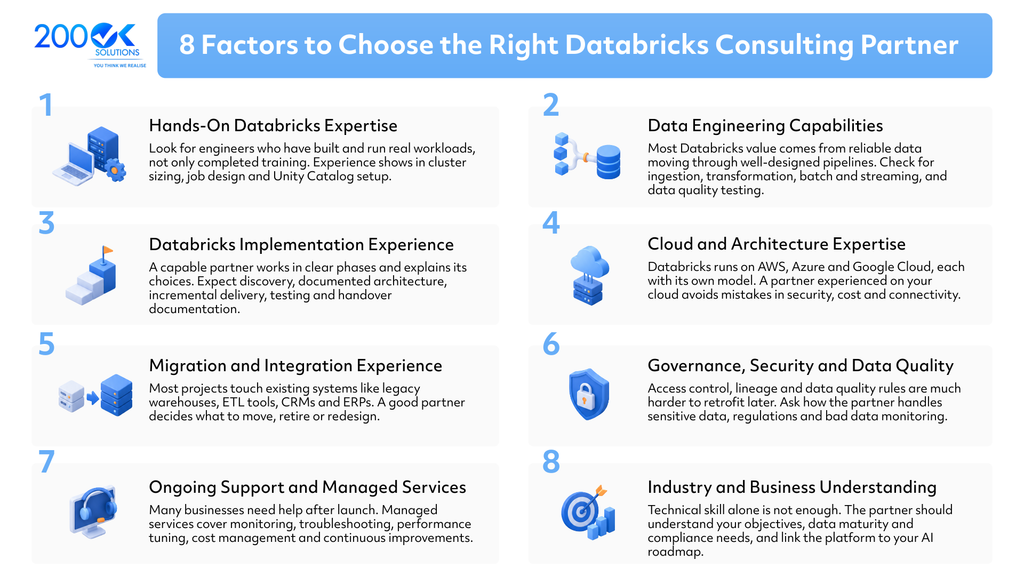
The best Databricks consulting partner is the one whose skills match your project. Compare platform expertise, data engineering depth, implementation experience, cloud architecture, migration capability, governance, integration expertise, ongoing support and business understanding. Use the checklist above, ask for evidence, and be cautious about broad claims.
If you are evaluating Databricks consulting for a new build, migration or modernisation project, speak with 200OK Solutions about your requirements.
You may also like : Databricks Data Engineering Consulting Services: What Businesses Need to Know