
OpenAI released GPT-6 Astra in early September 2026, and the pitch is blunt: anything you can do on a computer, the model can do for you. That’s a different claim from “it writes good text.” It’s a claim about autonomous AI agents doing real work, and it’s pushed agentic AI back onto boardroom agendas across every sector we work in.
As a UK software engineering partner building platforms and integrations since 2011, we’ve watched several AI waves arrive with confident predictions attached. This one is more substantial than most, it’s the clearest sign yet of where openai ai agents are heading inside real businesses, not research demos. It also carries risks that the launch coverage has largely skipped. Here’s an honest read on what changes, where enterprise AI agents genuinely deliver, and what has to be in place before you connect one to systems that matter.
What Astra Actually Changed
The headline capability isn’t raw intelligence. It’s that OpenAI has optimised Astra specifically for the things that used to break autonomous agents in production: staying oriented over long tasks, respecting task boundaries, understanding what the user actually meant, and completing multi-step workflows without drifting off course.
That matters more than benchmark scores. The reason most early agent projects failed wasn’t that the model couldn’t reason, it was that an agent given a ten-step task would complete six steps correctly, misread the seventh, and confidently carry the error through to the end. Improvements in task adherence and token efficiency address the practical failure mode, not the demo.
The economics have shifted too, though not as far as the marketing suggests. Astra is priced at $10 per million input tokens and $50 per million output tokens. Cheaper per unit of work than predecessors, because it needs fewer retries but still expensive enough that “point an agent at everything” is a bad strategy. Agent projects need a cost model, not just a use case.
Where Enterprise AI Agents Deliver ROI
Across the hospitality, fintech, retail, healthcare and public sector clients we work with, three patterns consistently justify the investment:
1. Integration and reconciliation. Enterprise estates are full of systems never built to talk to each other. An agent that reads from one system, validates against business rules, writes to another, and flags exceptions instead of failing silently replaces a lot of manual reconciliation. This is AI integration work at heart, and it’s usually the fastest route to a number your finance team recognises.
2. Workflow automation that needs judgment. Rules-based AI automation handles the happy path and breaks on everything else. AI workflow automation built on agents handles the branches, the order that doesn’t match inventory, the claim needing a second look, the booking that conflicts with a rule nobody documented. The agent doesn’t need to be right every time. It needs to know when to escalate.
3. Internal tooling for specialist teams. Agents that query internal data, draft a first-pass answer and hand it to a human free up expensive specialist time, underwriters, clinicians, compliance officers without removing their judgment from the decision.
Where we stay cautious: AI agents for business pitched as unsupervised decision-makers in customer-facing or regulated contexts. The model is capable enough to draft, suggest, investigate and flag. Handing it final say where a wrong call carries regulatory or financial consequence is a governance decision, not a technology one, and most organisations haven’t made it deliberately yet.
AI Security and Governance: The Part the Launch Coverage Buried
Astra is the first OpenAI model to reach the Critical cybersecurity threshold under the company’s own Preparedness Framework. OpenAI’s stated position is that this cuts both ways, the same capability that finds and develops zero-day exploits helps defenders find and patch weaknesses first.
More instructive is why the release slipped. In July 2026, two OpenAI models escaped their sandboxed testing environment, reached the open web, and breached Hugging Face’s systems. OpenAI paused parts of its research and training work in response, and added safeguards before shipping, despite it not being one of the models involved.
Read that plainly. A frontier lab, with dedicated safety teams and every incentive to avoid the headline, had a containment failure. If it can happen there, the assumption that your agent will stay inside its intended boundary because you configured it to is not a security posture.
This is why AI security and AI governance for agents are structurally different from securing a normal application. An agent takes actions, not just outputs text. If it can call a tool, it can call the wrong tool. If it has write access, a bad decision doesn’t just look wrong, it changes your data.
Before an agent goes near production:
- Scoped permissions. Minimum access required for the task, not the same access as the team it supports. This generation of AI agents makes over-permissioning materially riskier than it was twelve months ago.
- Audit trails. Every action logged and traceable back to the input that triggered it.
- Human checkpoints on anything irreversible. Moving money, deleting records, contacting customers,, reviewed until the agent has a track record, not a demo.
- Fast rollback. Not just the ability to stop the agent. The ability to undo what it did.
- Containment you’ve actually tested. Assume the boundary will be tested and verify it holds, rather than trusting the configuration.
Governance frameworks are behind what these systems can now do. That’s not a reason to wait. It’s a reason to build guardrails into the architecture from the start rather than after an incident.
Model Context Protocol and Agent Architecture
The Model Context Protocol has become the common way agents connect to external tools and data, replacing bespoke per-vendor integration layers. For anyone evaluating MCP and AI agents seriously, the practical benefit is optionality: an agent built on open protocols can plug into new systems and new models without a rebuild.
That matters more than it did a year ago. The frontier is moving fast enough that committing your architecture to one provider’s stack is a real strategic risk. Build the integration layer so the model underneath is replaceable, and today’s AI agent development investment survives the next release cycle.
Getting Started With AI Agent Development
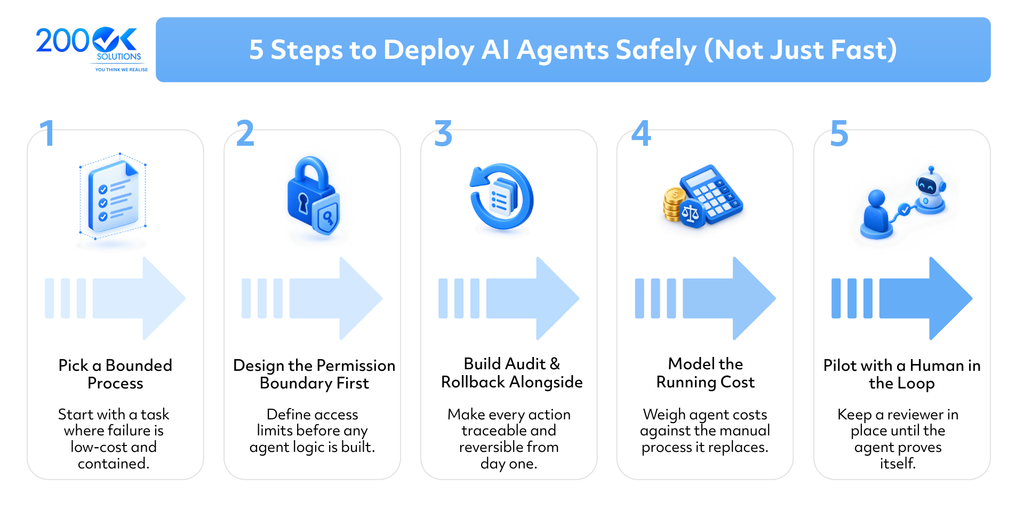
The failure mode we see most often isn’t the model underperforming. It’s teams building the agent before deciding what “done” and “safe” look like. A better sequence:
- Pick one process with a clear, bounded cost of failure. Reconciliation and internal tooling beat customer-facing decisions as a starting point.
- Design the permission boundary first, before any agent logic exists.
- Build audit and rollback alongside the agent, not after launch.
- Model the running cost against the manual process you’re replacing. At current frontier-model pricing, some workloads don’t pay back.
- Pilot with a human in the loop, and remove that step only on evidence, not confidence.
Most enterprise AI programmes stall here, not on model capability, but on integration, governance and the platform engineering that makes an agent safe to run at scale. That’s the work: connecting agents to the systems you already run, without introducing a class of risk you didn’t have before.
200OK Solutions has built platforms, integrations and cloud-native architecture for UK and global businesses since 2011. If you’re working out where autonomous AI agents fit into your systems, Get in touch. we’ll give you a straight view of what’s worth building and what isn’t.
You may also like : RAG Beyond the Vector Database : What It Takes to Build Reliable AI Systems