
Enterprises are moving past chatbots and simple automation. Leaders now ask whether AI can not only answer questions but also complete work across their systems. That is where AI agents and agentic AI come in.
The two terms are often used as if they mean the same thing. They don’t, though vendors and researchers use them in slightly different ways.
Quick answer: What is the difference between AI agents and agentic AI?
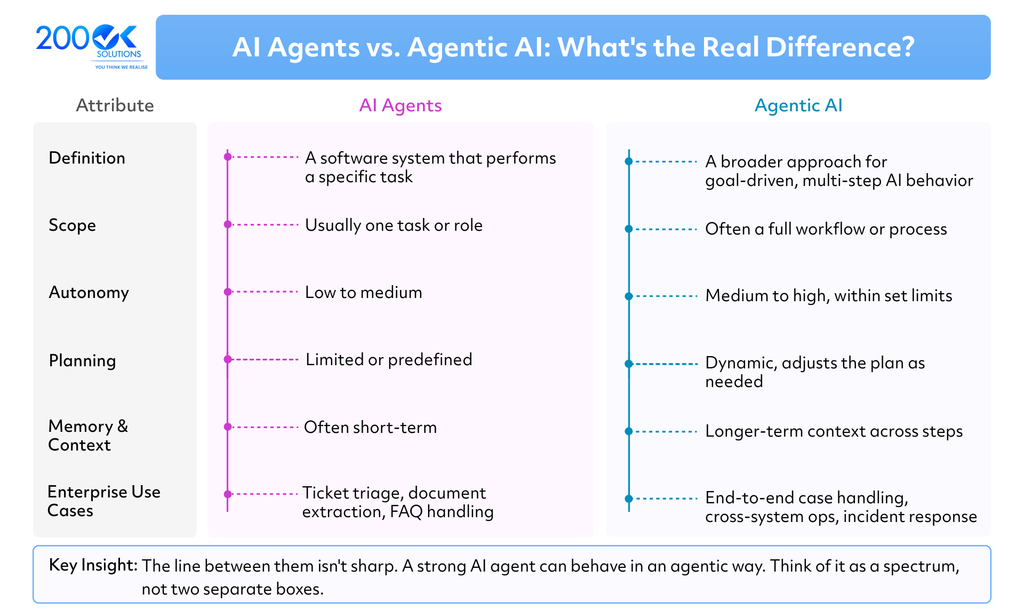
- An AI agent is a software system that can take in information, reason about it, make decisions, and act to complete a specific task or goal.
- Agentic AI is a broader approach, or system design, where AI shows more autonomy, planning, tool use, adaptation, and multi-step goal-directed behavior. It may involve one or several AI agents.
Put simply, an AI agent is a building block. Agentic AI is the wider capability built from those blocks. These are not fixed industry standards, so always check how a vendor defines the terms.
What Are AI Agents?
AI agents are software systems that pursue a task with some level of independence. They are also called intelligent agents. Classic AI textbooks use this term too, often alongside the idea of a “rational agent,” one that picks the action most likely to reach its goal.
An AI agent typically works through these parts:
- Perception (input): It receives text, data, events, or documents.
- Reasoning: It interprets the request and decides what matters.
- Decision-making: It chooses the next step.
- Tool use: It calls APIs, searches databases, or runs code.
- Action (output): It sends a reply, updates a record, or triggers a task.
Examples of AI agents:
- A support agent that reads a ticket, checks order data, and drafts a reply.
- An IT agent that resets passwords after verifying identity.
- A document agent that extracts fields from invoices and flags errors.
Most agents like these handle one clear job well.
What Is Agentic AI?
Agentic AI describes AI systems that pursue goals over multiple steps with limited supervision. They don’t just respond. They plan, act, check results, and adjust.
Key traits:
- Goal-oriented behavior: The system works toward an outcome, not a single answer.
- Planning: It breaks a goal into steps.
- Reasoning: It weighs options and handles unexpected results.
- Memory and context: It keeps track of what has happened so far.
- Tool calling: It uses enterprise systems, APIs, and data sources.
- Autonomous execution: It carries out approved actions.
- Adaptation: It changes its approach when something fails.
- Human oversight: It escalates to people when risk or uncertainty is high.
The word “agentic” describes a level of behavior, not one specific product. That is why definitions differ.
AI Agents vs Agentic AI: Key Differences
How Do AI Agents Work?
Most AI agent workflows follow this loop:
- Receive a goal. A user, system, or event triggers the task.
- Understand context. The agent reads relevant data, history, and rules.
- Reason about the task. It decides what needs to happen.
- Select tools or data sources. It picks the right API, database, or document.
- Take action. It executes the step.
- Evaluate the result. It checks whether the outcome is correct.
- Continue, adapt, or ask a human. It moves on, tries another path, or escalates.
Step 7 matters most in enterprises. A good agent knows when to stop and ask.
Types of AI Agents
Academic sources list several types of agents in AI. Each maps to real enterprise use.
- Simple reflex agents: React to a set condition. Example: route an email containing “invoice” to finance.
- Model-based agents: Keep an internal picture of the situation. Example: monitoring tools that track system state.
- Goal-based agents: Choose actions to reach a target. Example: scheduling agents that fill a delivery window.
- Utility-based agents: Weigh trade-offs such as cost, speed, and risk. Example: an agent that picks the cheapest shipping option that still meets a deadline.
- Learning agents: Improve from feedback. Example: a recommendation agent that improves as users respond.
- Knowledge-based agents: Use a structured knowledge base to reason and answer. Example: internal policy assistants.
- Autonomous AI agents: Act over longer tasks with little supervision.
- Multi-agent systems: Several agents working together (covered below).
Most enterprise deployments combine these types instead of using just one.
Enterprise Use Cases for AI Agents
- Customer support: Triage tickets, draft replies, and pull account details.
- IT service management: Handle access requests, password resets, and incident routing.
- Software development: Assist with code review, test generation, and documentation.
- Data analysis: Answer business questions by querying approved data sources.
- Sales operations: Update CRM records, summarize calls, and prepare account briefs.
- Marketing automation: Draft campaign variants and segment audiences for human review.
- Document processing: Extract and validate data from contracts, forms, and invoices.
- Finance operations: Match invoices, flag anomalies, and support reconciliation.
- Supply chain: Monitor delays and suggest alternate suppliers or routes.
- Hospitality operations: Handle booking changes, guest requests, and staff task routing.
- Enterprise workflow automation: Connect steps across systems that were once handled by hand.
Where Agentic AI Fits in Enterprise Operations
An AI agent usually does one task. An agentic system manages a whole chain of tasks.
Take a late-shipment problem in a supply chain. An agentic AI system could:
- Detect the delay from a tracking feed.
- Gather order, contract, and inventory data.
- Call APIs to check alternate suppliers.
- Analyze cost and delivery impact.
- Recommend the best option.
- Execute the change once a manager approves it.
- Monitor whether the fix worked.
- Escalate to a person if the risk stays high.
The value is coordination. The system connects steps that normally need several people and several tools. This kind of AI orchestration depends heavily on solid enterprise AI integration.
Multi-Agent AI Systems
Multi-agent AI uses several specialized agents that work together, each with a defined role.
A simple example:
- Research agent: Collects information.
- Analysis agent: Interprets the data.
- Validation agent: Checks accuracy and policy compliance.
- Execution agent: Runs an approved workflow.
Specialization can make each agent easier to test and control. The trade-off is added complexity: more handoffs, more places for errors, and higher cost. Use multiple agents only when the task truly needs it.
Benefits of AI Agents and Agentic AI for Enterprises
- Automation of repetitive work: Staff spend less time on routine steps.
- Faster decision cycles: Information is gathered and analyzed in less time.
- 24/7 workflow execution: Processes keep moving outside working hours.
- Better use of enterprise data: Agents can pull from systems people rarely have time to check.
- Scalable digital operations: Volume can grow without a matching rise in manual effort.
- Employee productivity: People focus on judgment-heavy work.
Results depend on the workflow, data quality, and integration. Avoid promises of fixed gains before testing.
Challenges and Risks Enterprises Should Consider
- Hallucinations and wrong decisions: Models can produce confident but incorrect output.
- Security and access control: An agent with broad permissions is a larger target.
- Data privacy: Sensitive data must not leak through prompts, logs, or third-party tools.
- API and tool permissions: Give each agent only the access it needs.
- Monitoring and reliability: Multi-step systems can fail in ways that are hard to trace.
- Cost: Model calls, tool use, and orchestration add up, especially in multi-agent setups.
- Governance and compliance: Regulated industries need audit trails and clear accountability.
- Human oversight: High-impact actions should need human approval (human-in-the-loop).
Strong AI governance is not optional. It decides whether a pilot becomes a production system.
How Enterprises Can Start With AI Agents
- Identify a suitable workflow. Pick something repeatable, well understood, and low to medium risk.
- Define the business objective. Decide what “success” means before building.
- Map data and systems. List what the agent needs to read and change.
- Select the right AI model. Match model size and capability to the task. AI model routing can send simple tasks to cheaper models and harder ones to stronger models.
- Design tools and integrations. Build clean, secure APIs the agent can call.
- Set permissions and guardrails. Limit access, actions, and spending.
- Add human approval. Require sign-off for sensitive steps.
- Test and monitor. Test with real cases and track errors, cost, and behavior.
- Measure business outcomes. Compare results against the original objective.
- Scale gradually. Expand only after the first workflow proves stable.
AI Agents vs Agentic AI: Which Approach Does Your Enterprise Need?
There is no universal winner. The right choice depends on:
- Workflow complexity: Single-step tasks suit AI agents. Multi-step processes may need agentic AI.
- Required autonomy: More independence needs stronger controls.
- Number of systems involved: More systems mean more integration work.
- Risk level: Higher risk calls for tighter limits and more approvals.
- Need for human approval: Decide which steps people must own.
- Data requirements: Poor or scattered data limits what any agent can do.
- Integration requirements: Agentic systems rely on reliable APIs and clean system connections.
A practical path: start with a focused AI agent, prove the value, then expand toward agentic workflows as trust and infrastructure grow.
Frequently Asked Questions
Q. What is the difference between AI agents and agentic AI?
A. An AI agent is a software system that performs a task or pursues a goal by perceiving information, reasoning, and acting. Agentic AI is a broader approach in which AI plans, adapts, and completes multi-step goals with greater autonomy, sometimes using multiple agents. Definitions vary across vendors and researchers.
Q. Are AI agents and agentic AI the same?
A. No. They are related but not identical. AI agents are the individual systems that act. Agentic AI describes a wider capability or architecture where autonomy, planning, and tool use extend across a whole workflow. Some vendors use the terms interchangeably, so check the definition in use.
Q. What are examples of AI agents?
A. Common examples include a customer support agent that drafts replies, an IT agent that handles access requests, a document agent that extracts invoice data, and a sales agent that updates CRM records. Each performs a defined task using data and tools.
Q. What are the different types of AI agents?
A. Common types include simple reflex, model-based, goal-based, utility-based, and learning agents. Enterprises also use knowledge-based agents, autonomous AI agents, and multi-agent systems. Each type differs in how it perceives situations, makes decisions, and improves over time.
Q. What is multi-agent AI?
A. Multi-agent AI is a setup where several specialized AI agents work together on a shared goal. One agent may research, another analyze, another validate, and another execute. It can handle complex workflows but adds coordination, cost, and monitoring needs.
Q. How are AI agents used in enterprises?
A. Enterprises use AI agents for customer support, IT service management, document processing, finance operations, sales support, data analysis, and workflow automation. They usually connect to business systems through APIs and operate under set permissions, with human review for sensitive actions.
Q. Is agentic AI suitable for enterprise workflows?
A. It can be, especially for multi-step, cross-system processes. Suitability depends on risk, data quality, integrations, and governance. Enterprises should start with lower-risk workflows, set clear guardrails, and keep human approval for high-impact decisions.
Conclusion
AI agents complete defined tasks. Agentic AI extends that idea into planning, coordination, and multi-step execution across systems. The difference is one of scope and autonomy, and the line between them is still moving.
Enterprises should not adopt either because it is trending. The stronger approach starts with a clear business outcome, then focuses on integration, governance, security, and human oversight.
Enterprises exploring AI agents or agentic AI should first identify the workflows where greater automation, decision-making, and system integration can create measurable business value. 200OK Solutions can help businesses design and integrate AI-enabled software solutions around their existing technology environment, drawing on its work in custom software development, AI automation, enterprise integrations, platform engineering, and cloud-native solutions.
You may also like : How to Use TypeSafe AI’s Jev: A Practical Guide to AI Guardrails and Decision Automation