
Choosing a custom software development partner is one of the few technology decisions you cannot easily undo. Once a partner knows your systems and your code, switching costs real time and money. Yet many buyers pick on price or a polished sales deck, and only find the gaps after launch.
This guide explains why businesses choose a partner over other routes, and how to choose a custom software development partner with a clear checklist, cost advice and red flags. It is written for operations, IT and finance leaders at mid-sized and enterprise organizations in the US and UK.
Why Businesses Choose a Custom Software Development Partner
Most companies do not start by looking for a partner. They start with a problem: a tool that no longer fits, a process held together with spreadsheets, or a product idea with no engineering team behind it. Three reasons come up again and again.
Off-the-shelf software stops fitting
In the custom software vs off-the-shelf debate, packaged software wins on speed and upfront cost. It starts to lose when your workflows, pricing rules or compliance needs differ from what the product assumes. Teams then pay for extra licenses, build workarounds, or change how they work to suit the tool. Custom (or bespoke) software is built around your process instead.
Hiring in-house is slow and narrow
An in-house team takes months to recruit and only covers the skills you hire for. Many organizations outsource custom software development to get architects, testers and DevOps engineers without building every role themselves.
Integration and ownership
Custom software can be designed to connect to your ERP, CRM and billing systems. You can also agree to own the code. Ownership terms depend on the contract, so confirm them in writing before you sign.
Vendor vs Partner: What Is the Difference?
A vendor delivers what is written in the contract. A partner questions the brief, flags risk early and stays involved after launch.
A vendor asks, “What do you want built?” A partner asks, “What result do you need, and is this the best way to get it?” For enterprise software development, where systems run for years and touch many teams, that difference matters more than the hourly rate.
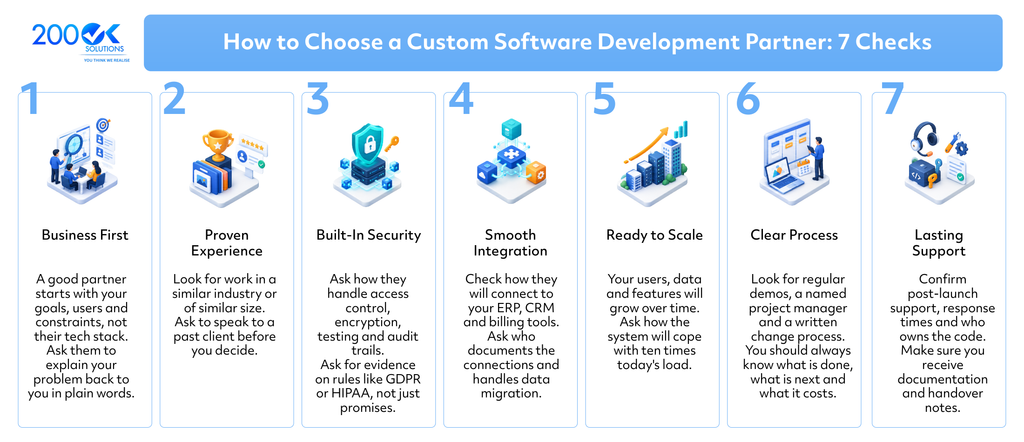
How to Choose a Custom Software Development Partner: 7 Checks
Use these checks to compare options on the same basis.
1. They understand your business before they talk technology
A good partner spends the first calls on your goals, users and constraints. If the first meeting is mostly about their tech stack, they are selling, not listening. Ask them to explain your problem back to you in plain words.
2. They have relevant experience at your scale
A team that builds small websites may struggle with an enterprise system that has many users, roles and integrations. Ask for work in a similar industry or of similar size, and ask to speak to a past client.
3. Security and compliance are built in
Ask how they handle access control, data encryption, testing and audit trails. If you work in finance, healthcare or the public sector, ask which regulations they have worked under, such as GDPR in the UK and EU or HIPAA in the US. Ask for evidence, not a promise.
4. They plan for integration with your current systems
Most software projects fail at the edges, where the new system meets the old one. Ask how they would connect to your existing tools, who documents the connections, and how they handle data migration.
5. The architecture can grow with you
Your user numbers, data and features will grow. Ask how the system will cope with ten times today’s load, and what would need to change. A clear answer shows they have thought about it.
6. Their process and communication are clear
Look for regular demos, a named project manager and a written process for changes. You should always know what is done, what is next and what it costs.
7. Long-term support and ownership are agreed upfront
Software needs updates, security patches and fixes after launch. Ask what support is included, how fast they respond, and whether you receive code, documentation and handover notes. A partner who plans for life after launch is thinking about your results, not just the delivery date.
Understanding Custom Software Development Cost
Cost is the question every buyer asks first, and the one least likely to get a straight answer. Prices vary widely because projects vary widely. The main drivers are:
- Scope: the number of features, user roles and screens.
- Integrations: every connected system adds work and testing.
- Compliance: regulated industries need extra design, testing and documentation.
- Team model: fixed price, time and materials, or a dedicated team.
- Timeline: rushing usually costs more.
Two quotes for the same project can differ a lot because one includes discovery, testing and handover and the other does not. Ask every partner for an itemized estimate and compare line by line.
Also count the costs after launch: hosting, maintenance, support and future features. A cheaper build with expensive upkeep is not cheaper.
For a fixed-price contract, confirm how changes are handled. For time and materials, ask for regular budget reports.
An Illustrative Example
This is a hypothetical case, not a client story.
A UK distribution company takes orders through three tools that do not connect. Staff re-key the same data every day, and errors reach customers. A partner worth hiring would start by mapping the order flow and finding where time is lost. Then they would recommend one of three paths: connect the existing tools, adjust one of them, or build something new.
Sometimes the honest answer is that off-the-shelf software with a good integration layer is enough. A partner who tells you that is worth more than one who sells a build every time.
Red Flags to Watch For
- A price quoted before they understand your requirements.
- No relevant work to show, or no past clients you can speak to.
- Vague answers on who owns the code and documentation.
- Security answered with buzzwords instead of specifics.
- One technology pushed for every project.
- No plan for support after launch.
- The team you meet in sales is not the team that will build.
Questions to Ask Before You Sign
Ask these of any shortlisted partner, including 200OK Solutions. A good partner answers them directly.
- Who will work on my project, and how many of them are full-time?
- Can you show a similar project and connect me with that client?
- How will you handle a change in scope halfway through?
- Who owns the code, designs and documentation?
- What happens if I want to move to another team later?
- What does support cost after launch, and what response times do you commit to?
Conclusion
The best custom software development partner is not the cheapest or the biggest. It is the one that understands your business, tells you the truth about risk and cost, and stays useful after launch. Use the seven checks, compare itemized estimates, and treat red flags as reasons to walk away.
If you are comparing options, 200OK Solutions is happy to talk through your requirements and answer the questions above.
Frequently Asked Questions
Q. What is a custom software development partner?
A. A custom software development partner is an external team that designs, builds and supports software made for your business. Unlike a one-off supplier, a partner stays involved in planning, delivery and long-term improvement.
Q. Why choose custom software development?
A. Businesses choose it when packaged software does not fit their workflows, integrations, security needs or growth plans. It gives more control over features and, depending on the contract, over ownership of the code.
Q. Is custom software better than off-the-shelf software?
A. Not always. Off-the-shelf software is faster and cheaper to start. Custom software makes sense when your needs are specific and you will use the system for years. Compare total cost over several years, not just the first invoice.
Q. How much does custom software development cost?
A. It depends on scope, integrations, compliance needs and the team model. Ask for an itemized estimate that covers discovery, build, testing, handover and support, and compare it against what you would spend on licenses and workarounds.
Q. How long does custom software development take?
A. A small internal tool can take weeks. A large enterprise system can take many months. Ask for a milestone plan with dates tied to features, and review it at every demo.
Q. What is the difference between a software vendor and a development partner?
A. A vendor delivers a defined product or task. A development partner challenges the brief, shares responsibility for results and supports the software after launch.
You may also like : Digital Transformation Strategy: A Step-by-Step Framework for 2026