
Quick answer: FinOps for AI is the practice of applying financial accountability, forecasting, and cost governance specifically to AI and machine learning workloads, GPU compute, model training, inference, and data pipelines. Traditional FinOps frameworks were built for predictable cloud spend like storage and web servers. AI workloads break those assumptions, so organizations need a version of FinOps designed for volatile, high-cost, hard-to-forecast AI infrastructure.
If your organization is running AI workloads without a cost governance model built for them, you are already overspending. You just haven’t seen the invoice yet.
What Is FinOps, and Why Does AI Change the Equation?
FinOps (Financial Operations) is the discipline of bringing engineering, finance, and business teams together to manage cloud spend as a shared responsibility. It replaces the old model, where finance sees the bill weeks later and has no context for it, with real-time visibility, shared accountability, and continuous optimization.
That model works reasonably well for standard cloud infrastructure. Compute usage is fairly predictable. Storage grows in a linear, plannable way. You can forecast next quarter’s cloud bill within a reasonable margin of error.
AI workloads don’t follow those rules.
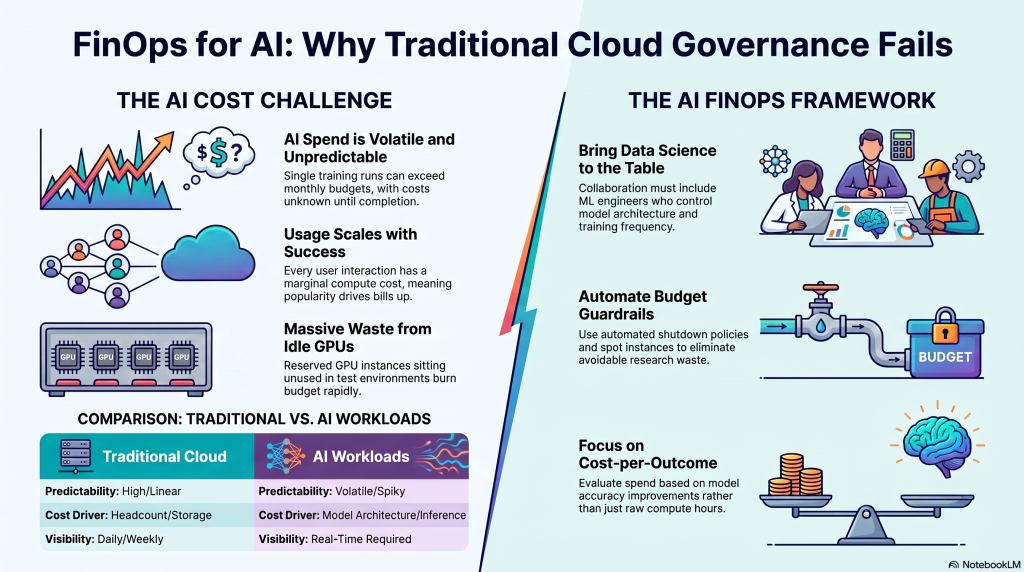
- GPU pricing is volatile and scarce : Demand for GPU capacity regularly outpaces supply, and pricing across providers shifts frequently.
- Training costs spike unpredictably : A single large model training run can cost more than an entire team’s monthly cloud budget, and the exact cost isn’t known until the run finishes.
- Inference costs scale with usage, not headcount : Every user interaction with an AI feature has a marginal compute cost, success literally makes the bill go up.
- Idle GPU capacity is expensive waste : Reserved GPU instances that sit unused for testing or staging environments burn budget fast.
This is why applying a generic FinOps framework to AI spend usually fails. The cost drivers, the forecasting models, and the optimization levers are fundamentally different.
The Core Principles of FinOps, Applied to AI
The FinOps Foundation defines a few core principles that guide any FinOps practice. Here’s how each one needs to be reinterpreted for AI workloads:
- Teams need to collaborate : In traditional FinOps, this means engineering and finance talking regularly. For AI, you need a third voice in the room: data science and ML engineering, because they control the biggest cost lever, model architecture and training frequency.
- Everyone takes ownership of their cloud usage : AI teams often treat compute as a research tool, not a budget line. Ownership means every model training run, every inference endpoint, has a named owner accountable for its cost.
- A centralized team drives FinOps : For AI, this central team needs technical fluency in GPU pricing models, spot instance strategy, and model optimization, not just cloud billing dashboards.
- Reports should be accessible and timely : Standard cloud cost reports update daily or weekly. AI cost visibility often needs to be near real-time, because a single misconfigured training job can burn thousands of dollars in hours.
- Decisions are driven by business value : The real question isn’t “how do we reduce AI spend,” it’s “what business value are we getting per dollar of compute.” A $50,000 training run that improves model accuracy by 15% may be worth it. The same spend on a marginal 0.3% improvement is not.
The Real Cost Drivers Behind AI Workloads
Before you can govern AI spend, you need to understand where it actually goes. The main categories are:
- Training compute : the cost of running and re-running model training, often on high-end GPU clusters.
- Inference compute : the ongoing cost of serving predictions to users, which scales with adoption.
- Data pipeline and storage : the cost of storing, cleaning, and moving the large datasets AI models depend on.
- Experimentation overhead : the cost of failed experiments, abandoned model versions, and duplicate training runs that never make it to production.
Most organizations only track the first two. The last one, experimentation overhead is often the largest hidden cost, because it’s treated as “the cost of doing research” rather than a governable line item.
How Cloud Cost Management Platforms Support FinOps for AI
Cloud cost management platforms give you the visibility layer FinOps depends on, but visibility alone doesn’t solve the AI cost problem. The platforms that actually move the needle for AI workloads do three things:
- Tag and attribute GPU usage down to the model, team, and experiment level, not just the project or department level.
- Forecast training costs before a run starts, based on model size, dataset size, and hardware configuration.
- Flag idle or underutilized GPU capacity in near real-time, since GPU waste compounds faster than standard compute waste.
A dashboard that shows you last month’s total AI spend is not FinOps. It’s a rear-view mirror. Real FinOps for AI means catching cost overruns while the training job is still running, not after the invoice arrives.
Building a Practical FinOps Framework for AI Teams
Here is what a practical, working FinOps model for AI workloads actually requires, not the theory, the implementation:
- Set budget guardrails at the experiment level, not just the project level. Every training run should have a pre-approved cost ceiling.
- Separate research spend from production spend in your reporting. Experimentation should be allowed to be inefficient within a bounded budget; production inference should not.
- Use spot and reserved instances strategically. Training jobs that can tolerate interruption are strong candidates for spot pricing; production inference generally is not.
- Automate shutdown policies for idle GPU environments, this single practice eliminates a significant share of avoidable AI cloud waste.
- Review cost-per-outcome, not just cost-per-hour. Track cost against model performance improvements, not just raw compute spend.
This is where FinOps automation earns its place. Manual cost reviews cannot keep pace with how fast AI workloads scale or how quickly a misconfigured job can run up cost. Automated budget alerts, auto-scaling policies, and scheduled shutdown rules are not optional extras, they are the mechanism that makes FinOps for AI actually work in practice, rather than existing as a quarterly spreadsheet exercise.
Platform vs. Custom Engineering: What Actually Solves This
Off-the-shelf cloud cost management platforms solve the visibility and tagging problem well. What they generally don’t solve is the architecture-level decisions that determine your AI cost baseline in the first place, model selection, training frequency, infrastructure design, and workload placement across cloud providers.
That’s an engineering problem, not a dashboard problem. A cost management tool can tell you that a training run cost $40,000. It can’t tell you that the same result was achievable with a smaller model, a more efficient data pipeline, or a different GPU allocation strategy. That requires the same architecture-led thinking that governs any cloud-native infrastructure decision, applied specifically to AI workloads.
Organizations that treat FinOps for AI purely as a tooling purchase tend to plateau. The ones that treat it as an engineering discipline, where cost is a design constraint from day one, not a report generated after the fact, see sustained, compounding savings.
FAQ: FinOps for AI Workloads
Q. What is FinOps for AI?
A. FinOps for AI is the application of financial accountability and cost governance practices specifically to AI and machine learning workloads, including GPU compute, model training, inference, and data pipeline costs.
Q. Why is FinOps for AI different from standard cloud FinOps?
AI workloads have volatile, spike-prone costs driven by GPU scarcity, unpredictable training runs, and usage-scaled inference costs. Standard FinOps frameworks are built for more predictable infrastructure spend and don’t account for these dynamics.
Q. What are the biggest hidden costs in AI workloads?
Experimentation overhead, failed training runs, abandoned model versions, and idle GPU capacity during research and development, is typically the largest untracked cost category in AI spend.
Q. Can automation reduce AI cloud costs?
Yes. Automated budget alerts, spot instance strategies, and scheduled shutdown policies for idle GPU environments are the most effective levers for reducing avoidable AI cloud waste, because manual review cannot keep pace with how fast AI costs can scale.
Q. Do I need a cloud cost management platform for FinOps on AI workloads?
A platform helps with visibility and cost attribution, but it doesn’t solve architecture-level inefficiencies like model size, training frequency, or infrastructure design. Sustainable AI cost control requires both the right tooling and the right engineering decisions upstream.
The Bottom Line
AI spend is not just another line item in your cloud bill, it behaves differently, scales differently, and punishes organizations that apply generic cost governance to it. FinOps for AI works when cost accountability is built into the architecture and engineering process itself, not bolted on after the invoices start climbing. Organizations that get this right treat every model training run and every inference endpoint as a design decision with a cost consequence, not an afterthought for the finance team to sort out later.
You may also like : How a Fintech Startup Went from MVP to £10M ARR in 18 Months