
Quick answer: No single AI coding agent can safely modernize a legacy codebase alone. We tested Claude Code, Cursor, GitHub Copilot Agent Mode, Devin, and Windsurf. Each one excels at a different layer, syntax, refactoring, planning, or autonomy. But all five share the same weak spot: they can’t see the business context behind the code. That’s why legacy modernization still needs a human-led strategy, not just a smarter tool.
Why We Tested This
Every AI coding vendor claims their agent “understands your codebase.” Legacy systems put that claim to the real test. They’re old. They lack documentation. They carry dead code that isn’t actually dead. And they hide business rules nobody ever wrote down.
So we picked a 12-year-old monolithic application: legacy PHP, a half-migrated Java service layer, and a MySQL schema with no foreign keys. Then we pointed five leading AI coding agents at it. The task sounded simple. It wasn’t: identify what needs to change to modernize this system safely, and start making the changes.
Here’s what we found.
The Setup
- Codebase: roughly 180,000 lines, no test coverage on core modules, three different coding styles from three eras of developers
- Task given to each agent: review the codebase, flag technical debt and risk areas, then refactor the payment processing module without breaking existing behavior
- Constraints: no extra documentation. Each agent worked from the code alone, just like a real legacy project.
What Each Agent Missed
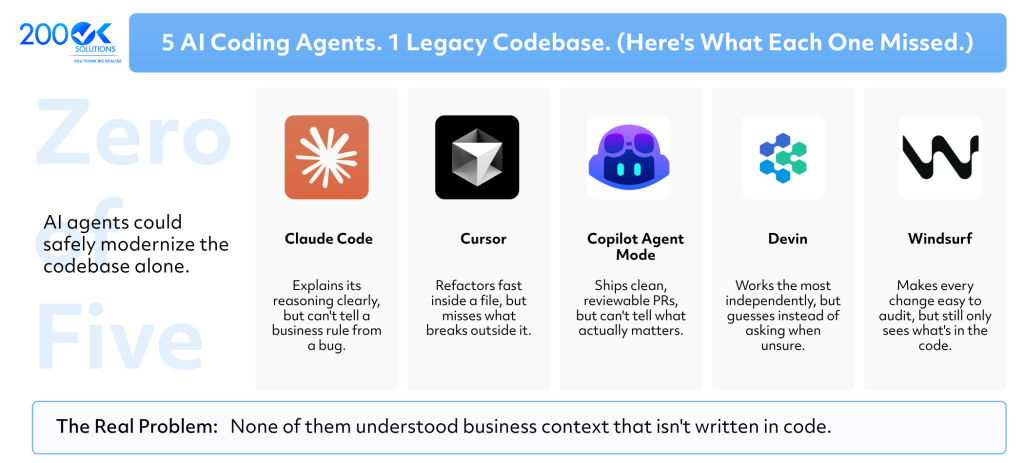
1. Claude Code : Strong Reasoning, Weak on Undocumented Business Rules
Claude Code built the most coherent migration plan of the five. It explained why it made each change, not just what it changed. It also flagged real risk areas, like unguarded SQL string concatenation and inconsistent error handling.
But it missed something important. The payment module had a hardcoded 3% discount with no comment attached. It looked like a bug, so Claude Code removed it. In reality, that adjustment came from a negotiated vendor contract. Nothing in the code signaled that intent, because the business context lived in a PDF, not the repo. This is the core failure across all five agents: code-level intelligence can’t see business-level intent.
2. Cursor : Excellent at Local Refactoring, Blind to System-Wide Ripple Effects
Cursor’s in-editor, file-by-file refactoring was fast and clean. It renamed variables well, restructured functions cleanly, and tightened types without breaking syntax.
However, it optimized one function in isolation and missed that four other places called it, each with different assumptions about the input format. Two of those call sites broke silently as a result. Cursor’s context window works well for a single file or feature. Legacy systems, though, fail at the seams between features and that’s exactly where Cursor’s strength stopped mattering.
3. GitHub Copilot Agent Mode : Good Incremental Changes, Poor Prioritization
Copilot Agent Mode fits naturally into existing PR workflows. It made small, defensible, easy-to-review changes throughout the module.
Still, it showed no sense of priority. It spent real effort cleaning up minor formatting and naming issues, yet left a critical unvalidated user-input path untouched in that same module. Without a human or a governing strategy telling it what matters most, it treated every code smell as equally urgent. For legacy risk management, that’s backwards.
4. Devin : Most Autonomous, Least Trustworthy on Ambiguity
Devin went furthest without supervision. It planned, wrote, and tested changes across multiple files without step-by-step prompting, which made for an impressive demo of autonomy.
But when it hit real ambiguity a config flag referenced in three places with contradictory logic, it guessed confidently instead of flagging the uncertainty. In a legacy system, a confident guess is more dangerous than a pause for clarification. Autonomy without calibrated uncertainty becomes a liability here, not a feature.
5. Windsurf : Great Developer Experience, Same Context Ceiling as the Rest
Windsurf tracked changes clearly, so reviewing what the AI did, and why, felt straightforward. That matters for auditability in legacy work.
Even so, Windsurf had no way to know that a “temporary” workaround from six years ago had quietly become load-bearing for a downstream finance reporting system. It’s a powerful code editor with AI built in. But it still reads code, not the organization behind it.
The Pattern Across All Five
Every agent excelled at the same thing: reading and transforming code. And every agent failed the same way: none of them understood the business logic that never made it into the code.
This isn’t a prompt-engineering problem. It’s a structural limit. AI coding agents work with what’s in the repository. Legacy systems, however, store their most critical knowledge outside the repository, in contracts, in old Slack threads, in the memory of employees who left years ago, in workarounds nobody documented because everyone just knew.
| Agent | Strength | Blind Spot |
|---|---|---|
| Claude Code | Reasoning and explaining changes | Undocumented business rules |
| Cursor | Local, in-file refactoring | Cross-system ripple effects |
| Copilot Agent Mode | Scoped, reviewable PRs | No sense of business priority |
| Devin | End-to-end autonomy | Guesses instead of flagging ambiguity |
| Windsurf | Auditability of AI changes | Same context ceiling as the rest |
Why This Matters More Than the Tool You Pick
Businesses evaluating AI coding agents often ask the wrong question: “Which agent is smartest?” A better question is: “Who translates our business context into something any agent can act on safely?”
AI agents execute well. But on their own, they can’t tell you which parts of a legacy system encode real business value and which parts are just accumulated cruft. That translation work mapping technical debt to business risk, then sequencing changes so the business keeps running while the system gets modernized is a transformation problem, not just a coding problem.
That’s the real gap between “using an AI coding tool” and intelligent business transformation: pairing AI-driven execution with a structured understanding of what your business actually depends on, so modernization moves fast without moving recklessly.
What Actually Works: A Layered Approach
This comparison points to a clear conclusion. The goal isn’t picking the single best agent. Instead, focus on these four steps:
- Document business context before you automate. Capture contract terms, compliance rules, and undocumented dependencies outside the code, so any agent can respect them.
- Match agents to the right job. Use reasoning-heavy planning for architecture decisions, local tools for fast refactoring, and PR-based agents for reviewable incremental changes. These aren’t competing options, they’re different stages of one pipeline.
- Keep humans at decision points, not just review points. Devin’s failure mode, confident guessing under ambiguity is preventable once the workflow escalates uncertainty instead of quietly resolving it.
- Prioritize by business risk, not code smell. An agent that polishes formatting while a payment validation bug sits untouched signals a process failure, not just a model limitation.
FAQ
Q. Can AI coding agents fully modernize a legacy codebase without human oversight?
No. Every agent in this test made at least one change that would have caused a real production issue if merged without review. Business-context oversight from a human is still essential.
Q. Which AI coding agent is best for legacy code?
A. There’s no single best option. Claude Code leads on planning and reasoning through changes. Cursor leads on fast, local refactoring. Copilot Agent Mode fits cleanly into existing PR workflows. Devin offers the most autonomy but the least reliability with ambiguous logic. Windsurf gives the clearest audit trail of what changed and why. Most real modernization projects benefit from combining more than one.
Q. Why do AI coding agents struggle with legacy systems specifically?
Legacy systems encode business rules outside the code itself, in contracts, institutional knowledge, and undocumented workarounds. Because agents can only reason about what’s in the repository, they consistently miss context that exists nowhere they can read.
Q. What should a business do before using AI agents on a legacy system?
Capture the undocumented business logic first. Document compliance requirements, contractual terms, and known workarounds so whichever agent you use has the context to avoid removing something that looks like a bug but isn’t.
200OK Solutions helps businesses run intelligent business transformation. We combine AI-driven execution with the business context legacy systems never put in writing, so modernization moves fast without breaking what the business depends on.
You may also like : Agentic AI Defined – Why This Type of AI Represents the Next Big Leap Forward