
Executive Summary
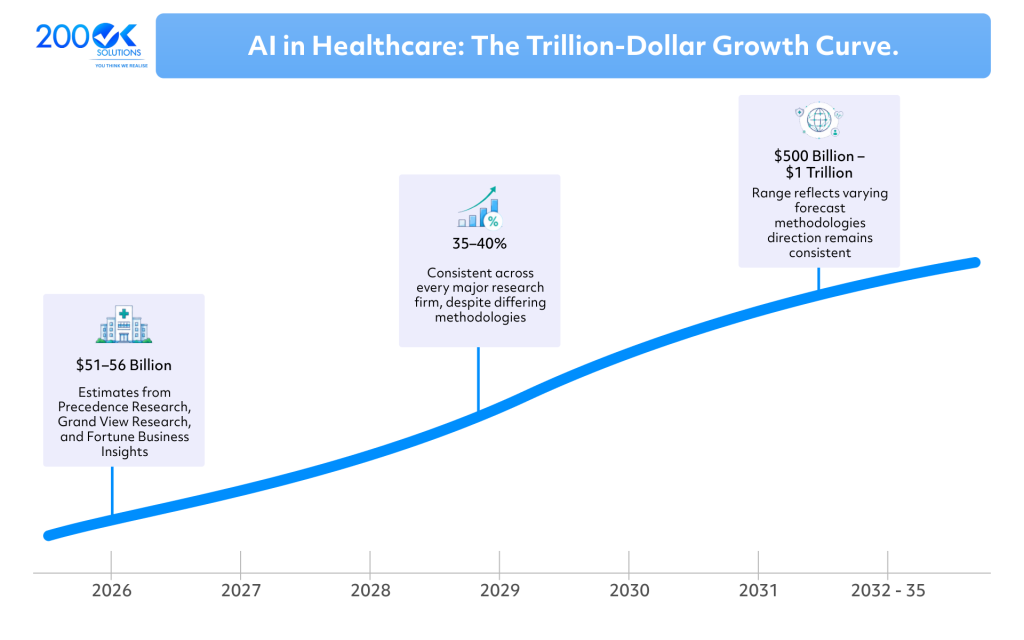
AI in healthcare has moved out of the pilot phase. By 2026, a majority of U.S. physicians use AI tools in some part of their workflow, hundreds of AI-enabled devices have FDA clearance, and the global AI in healthcare market has grown into the tens of billions of dollars, with most forecasts projecting 35–40% annual growth through the early 2030s. For CIOs and digital transformation leaders, the question is no longer whether to adopt AI in healthcare, it’s where to start, how to govern it, and who to build it with.
Quick Answer
AI in healthcare uses machine learning, natural language processing, and computer vision to support diagnosis, treatment, patient monitoring, and hospital operations. In 2026 it’s used most heavily in medical imaging, clinical documentation, predictive analytics, and administrative automation, with adoption now above 60% among U.S. physicians and hospitals.
What Is AI in Healthcare?
AI in healthcare isn’t one technology, it’s several, each with a different risk profile:
- Machine learning: risk scoring, fraud detection, demand forecasting
- Deep learning: the core of most medical imaging analysis
- Natural language processing: clinical documentation and AI scribes
- Computer vision: radiology, pathology, dermatology image analysis
- Generative AI / LLMs: summarization, patient communication, and increasingly, decision support
Treating “AI” as one procurement category, instead of distinct tools with different regulatory and liability weight is one of the most common strategic mistakes health systems make.
Why AI Is Transforming Healthcare
Three forces are converging:
workforce strain (documentation burden is now a retention issue, not just an efficiency one), data volume outpacing human review capacity (imaging and EHR data have grown faster than clinical staffing), and falling deployment cost (cloud infrastructure and FDA clearance pathways have matured). Market estimates from Precedence Research, Grand View Research, and Fortune Business Insights put the global AI in healthcare market at $51–56 billion in 2026, growing toward $500 billion–$1 trillion by the early-to-mid 2030s. Figures vary by methodology, but the direction is consistent across every major research firm.
Benefits of AI in Healthcare
| Benefit | In practice | Feels it first |
| Diagnostic speed & consistency | Imaging AI flags abnormalities for review | Radiology, pathology |
| Less documentation burden | AI scribes draft notes | Physicians, nurses |
| Earlier risk detection | Sepsis, deterioration, readmission models | ICU, care management |
| Administrative efficiency | Automated prior auth, claims, scheduling | Revenue cycle, ops |
| Accelerated research | AI-assisted molecule screening | Pharma, research hospitals |
Industry estimates place potential annual U.S. savings from AI at roughly $360 billion across administrative and clinical efficiency, a directional figure, not a precise one, since it depends on adoption assumptions still playing out.
Real-World Use Cases
- Mature: medical imaging analysis, clinical documentation, revenue cycle automation, triage chatbots
- Growing fast: predictive analytics, remote patient monitoring, ambient clinical intelligence
- Early: generative AI for clinical decision support, AI-assisted drug discovery
- Experimental: fully autonomous diagnosis or treatment planning without clinician review
Diagnostics & imaging: The FDA has cleared 340+ AI-enabled devices, concentrated in radiology, cardiology, and stroke/tumor detection. In practice, these tools function as a second reader, triaging worklists rather than issuing final reads, which is the model regulators and malpractice insurers currently accept.
Patient care: Chatbot triage, ambient documentation, and care navigation tools reduce friction between clinician and patient rather than replacing clinical judgment.
Drug discovery: One of the fastest-growing segments (21–40%+ CAGR estimates), used for molecule screening, target identification, and trial cohort matching. Longest ROI horizon in this list, but potentially the largest absolute value given traditional R&D costs.
Hospital operations: Predictive staffing, bed/capacity management, and supply chain forecasting typically deliver the fastest, most measurable ROI of any AI category, since the metrics are already tracked internally.
Predictive analytics: Sepsis early-warning, readmission risk, and chronic disease progression models convert reactive care into proactive care but only as good as the data feeding them.
Remote patient monitoring: AI filters signal from noise in continuous monitoring data, supporting reduced readmissions and lower-cost care settings. Virtual nursing assistants alone are estimated at roughly $20 billion in potential annual value.
Revenue cycle management: Automated coding, claims scrubbing, prior authorization, and denial prediction, often the easiest internal business case to build, since it doesn’t require clinical validation studies.
Cybersecurity: AI improves threat detection and incident response, but AI infrastructure itself is a new attack surface, model access to EHR data and risks like model inversion attacks need dedicated governance, not an afterthought.
Challenges and Risks
| Risk | Why it matters |
| Algorithmic bias | Non-representative training data creates clinical and legal exposure |
| Data privacy | Broad data access increases HIPAA and breach risk |
| Regulatory uncertainty | Rules are still evolving across jurisdictions |
| Clinician trust | Tools that don’t fit workflow get abandoned regardless of accuracy |
| Integration complexity | Legacy EHRs make interoperability harder than demos suggest |
| Liability ambiguity | Unclear who’s accountable when AI-assisted decisions cause harm |
| Model drift | Accuracy can degrade as populations and practices shift |
None of these are reasons to avoid AI in healthcare, they’re reasons to build governance in from day one instead of retrofitting it after a failure.
Regulatory and Compliance Considerations
In the U.S., AI-enabled medical devices need FDA clearance (340+ cleared to date, concentrated in radiology and cardiology), and any system touching patient data must comply with HIPAA. Internationally, the EU AI Act classifies most clinical AI as high-risk, adding transparency and oversight requirements relevant to any U.S. system with international vendors. State-level AI regulation is also expanding. Compliance can’t be a one-time procurement checkbox, it needs to be a continuous function while this regulatory landscape keeps shifting.
Future Trends: 2026 and Beyond
- Generative AI in healthcare is projected to grow from roughly $4.7B (2026) to nearly $40B (2035), expanding from documentation into clinical decision support
- Ambient clinical intelligence is moving from pilot to standard-of-care in leading systems
- Multimodal AI combining imaging, genomics, and clinical text is entering early clinical use
- AI governance functions, ethics committees, model monitoring, algorithmic audits are becoming standard structures, not one-off exercises
- Interoperability, not model quality, is increasingly the binding constraint on AI value
Best Practices for Adoption
- Start narrow, one workflow, one measurable outcome, not a broad “AI transformation”
- Involve clinicians early, not as a formality
- Build monitoring in from the start, not after deployment
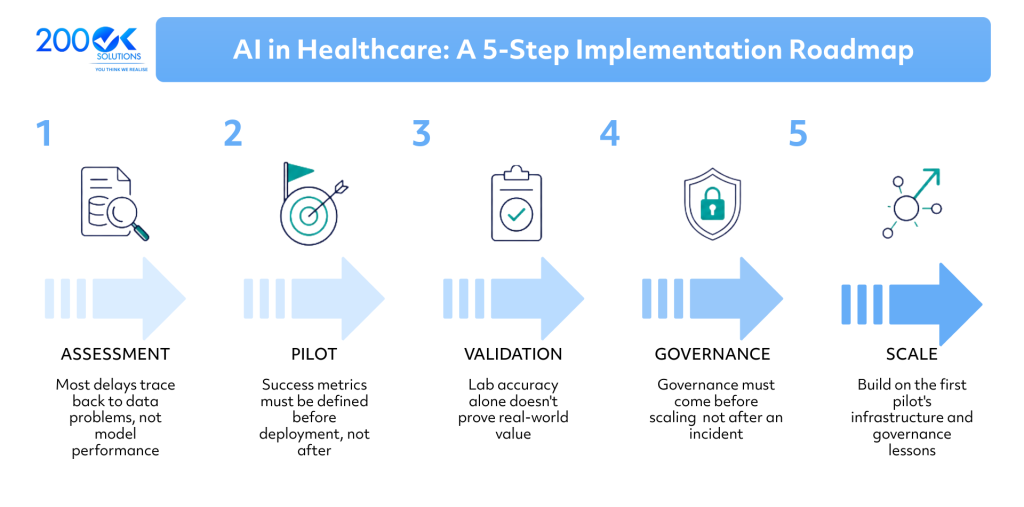
- Treat data infrastructure as the prerequisite, it determines outcomes more than model choice
- Establish governance before scale, not after an incident
- Plan for liability and audit trails explicitly before go-live
Common Mistakes
- Treating “AI” as one procurement category instead of tools with very different risk profiles
- Underestimating integration cost relative to license cost, EHR integration usually blows the budget, not the software
- Skipping change management, accurate tools still fail if clinicians don’t trust them
- No plan for post-launch model monitoring
- Chasing headline diagnostic use cases over operations/revenue cycle AI, which often delivers faster, more defensible ROI
Implementation Roadmap
Why the Right Technology Partner Matters
AI in healthcare projects fail more often from integration and governance gaps than from model quality, so the partner matters as much as the tool.
200OK Solutions works with healthcare organizations on the underlying capability to adopt AI safely: AI strategy grounded in operational priorities, cloud-native healthcare application development, intelligent automation, healthcare interoperability, platform engineering, secure, HIPAA-aligned software development, and digital transformation sequenced around what a health system can actually absorb.
The organizations getting real value from AI in healthcare aren’t the ones with the most sophisticated model, they’re the ones with the most disciplined implementation process.
Conclusion
AI in healthcare in 2026 is an operating reality, not a speculative bet. The organizations succeeding with it are disciplined about which use case, validated how, governed by whom, and built on what infrastructure, not the ones chasing every new capability. Get that sequence right, and AI in healthcare becomes a durable operational advantage rather than another initiative that stalls after the pilot.
Frequently Asked Questions
Q. What is AI in healthcare?
The use of machine learning, NLP, and computer vision to support diagnosis, treatment, patient monitoring, and hospital operations.
Q. How is AI currently used in healthcare?
Most widely in medical imaging, clinical documentation, predictive risk analytics, revenue cycle automation, and remote patient monitoring.
Q. Will AI replace doctors?
No, current tools are built for clinician oversight, and regulatory and liability structures assume a human in the loop.
Q. Is AI in healthcare regulated?
Yes, FDA clearance for AI-enabled devices in the U.S., HIPAA for patient data, and the EU AI Act classifying most clinical AI as high-risk internationally.
Q. What are the biggest risks?
Algorithmic bias, data privacy exposure, regulatory uncertainty, liability ambiguity, and model drift.
Q. How much does implementation cost?
Varies widely, but integration and workflow redesign, not licensing are typically the largest cost driver.
Q. What’s the difference between AI in medical imaging and diagnostic AI generally?
Imaging AI is a subset focused on X-rays, CT, MRI, and pathology images; diagnostic AI more broadly includes lab data and clinical notes.
Q. What’s generative AI’s role in healthcare?
Mainly documentation and administrative drafting today, expanding cautiously into clinical decision support.
Q. How does AI improve hospital operations?
Predictive staffing, capacity management, supply chain forecasting, and scheduling, usually the fastest-ROI category.
Q. What should a hospital do before adopting AI?
Assess data quality and interoperability, pick a narrow measurable pilot, involve clinicians early, and set up governance before scaling.
Q. How is AI used in drug discovery?
Molecule screening, target identification, trial cohort matching, and drug repurposing, compressing early-stage research timelines.
Q. What is AI in healthcare cybersecurity?
AI-driven threat detection and automated incident response, while also introducing new attack surfaces that need dedicated security governance.
You may also like : Healthcare Software: Build Fast, Stay Compliant