

This blogpost will tell you about what agentic AI is and how it works.
Agentic AI
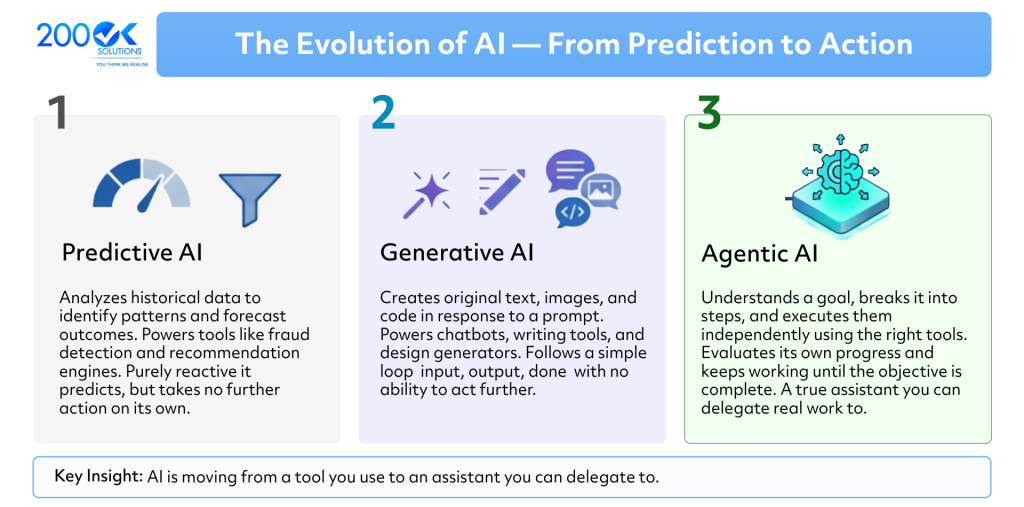
The AI models currently popularized, particularly the kind of chatbots most people have seen and interacted with, follow a very simple process: the user makes an input, the AI makes an output, and then nothing else happens. It does not have any idea about how it should go on to proceed from there, how it might validate itself, and whether it can make an impact in the physical world outside its text generation process.
Agentic AI works differently since an agent is:
-
- An AI that understands an objective rather than just a simple instruction
-
- One that can divide the objectives into several steps
-
- Capable of choosing the tools, APIs, or datasets needed for this purpose
-
- Able to execute all of the above steps by itself
-
- Capable of evaluating what it has done and readjusting accordingly
-
- Continually capable of doing the above until the objective has been accomplished
Agentic AI Working Mechanisms
Agentic systems usually consist of several key elements operating in concert:
1. Reasoning Engine (“brain”)
This is most often a huge language model responsible for making decisions, analyzing the goal, reasoning about the optimal course of action and making decisions regarding every step.
2. Planning and Task Decomposition
Rather than performing a complex task in one go, the agent will decompose a big goal into multiple small tasks. For instance, “organize a marketing campaign” could be divided into research, writing, scheduling, reporting tasks and others.
3. Tool Utilization
An agentic system may use external services, such as search engines, databases, code interpretation tools, APIs, software, and anything else for that matter.
4. Memory
The agents usually have short-term memory (context during task execution) and, sometimes, long-term memory (acquired learning over several sessions), which helps them remain consistent and grow over time.
5. Self-Checking of Output
One of the most important features of an intelligent agent is the possibility to validate the result of each action taken and decide on further steps: continue, revise the strategy, or clarify the task instructions instead of halting.
6. Coordination Among Several Agents
In case of complicated processes, several specialized agents, responsible for specific tasks (research, writing, proofreading) can interact and collaborate with each other, controlled by a single controller, like a team of specialists works on a project.
Advantages of Agentic AI
1. Real Automation, Not Assisted Automation
AI agents have the capacity to accomplish an entire workflow from start to finish, not just help perform one step. People are relieved of performing monotonous multistep processes such as data entry, report writing, or scheduling.
2. Higher Efficiency
Since the agent can operate independently after setting up a goal, teams can offload time-intensive tasks and get down to more valuable work.
3. Quick Decisions
The agent can collect information, analyze it, and take actions based on it instantly.
4. Scalability
One efficient agent can take care of many tasks or clients at the same time, which is hard to do in case of manual processes.
5. Consistency and Low Human Error Rate
Automated systems perform processes according to certain rules without much variation and human mistakes.
6. Adaptability
Agents are able to make decisions about actions in case of unusual situations, which makes them superior to traditional automated processes as soon as an event occurs which is not covered by the system’s rules.
7. Proper Use of People
Since the main task of human beings is creativity and decision making rather than process execution, agents can help to free up human resources.
Real-World Use Cases
Customer service: Agents that go beyond providing answers to FAQs by resolving issues involving checking the status of orders, initiating refunds, and updating their records.
Software development: Agents that can perform functions such as writing, testing, debugging, and deploying software without significant human involvement.
Research & Analysis: Agents that collect data from various sources and synthesize the data to generate structured reports.
Personal productivity: Agents that schedule appointments and write emails on one’s behalf.
Business operations: Agents that keep track of supply chains, identify any abnormalities, and act to address them.
The Road Ahead
Despite all the advancements made in agentic AI so far, there are still some hurdles, including reliability, safety issues, and alignment between agents and humans’ intent as AI systems become more autonomous. However, the trend is evident: AI moves from a tool to an assistant you can delegate work to.
And those who master how to design, launch and handle agentic AI agents will be much better positioned for success compared to their rivals, not because they will be substituting human thinking but will allow it to focus on tasks which require it.
You may also like : Digital Transformation Strategy: A Step-by-Step Framework for 2026