
A Databricks Consulting Partner helps organizations plan, implement, integrate, optimize, and scale their Databricks environment. The role goes well beyond installing software or configuring a workspace. It covers the full lifecycle of a data platform: from assessing what a business already has, to designing an architecture that will hold up under growth, to making sure the data flowing through that platform is trustworthy enough to power analytics and AI.
For CTOs, CIOs, and Heads of Data evaluating Databricks, this distinction matters. Databricks itself is a platform powerful, but not something that configures itself around a specific business’s data, systems, and goals. A consulting partner is the layer that connects the platform’s capabilities to a company’s actual data engineering needs, whether that means untangling a messy legacy warehouse, building real-time pipelines, or preparing data for machine learning.
This article explains what a Databricks Consulting Partner actually does, when a business needs one, and what to look for when choosing one.
What Is a Databricks Consulting Partner?
A Databricks Consulting Partner is a technology services company, certified or recognized by Databricks, that helps organizations design, build, and operate solutions on the Databricks platform. Databricks itself is a unified data and AI platform built around the lakehouse architecture, which combines the flexibility of a data lake with the structure and performance of a data warehouse.
Working with Databricks touches several connected disciplines:
- Data engineering : building the pipelines that move and transform data
- Analytics : turning processed data into dashboards and reports
- AI/ML : training and deploying models on clean, well-structured data
- Cloud infrastructure : running all of this reliably on AWS, Azure, or Google Cloud
It helps to separate three different things that often get blurred together:
- Using Databricks means a team has an account and is running notebooks or jobs on the platform.
- Implementing Databricks means the platform has been properly architected, connected to source systems, and configured for the organization’s workloads.
- Getting strategic value from Databricks means the platform is actively improving how the business makes decisions, reduces cost, or ships AI products, not just running jobs in the background.
A Databricks Consulting Partner is focused on that third outcome. Many organizations reach the first stage on their own. Fewer reach the third without outside expertise, simply because platform-specific architecture decisions are easy to get wrong the first time.
What Does a Databricks Consulting Partner Actually Do?
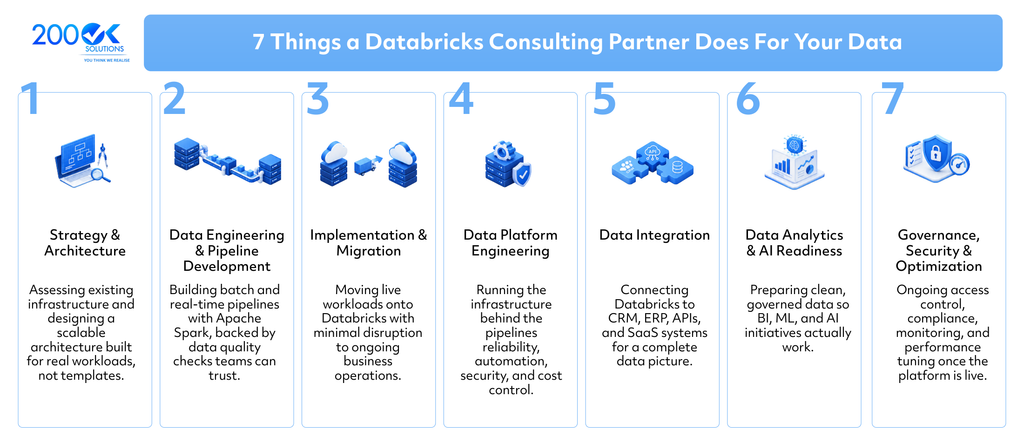
In direct terms: a Databricks Consulting Partner designs the architecture, builds and migrates the data pipelines, integrates the platform with existing business systems, and puts governance and optimization practices in place so the platform remains reliable and cost-effective over time.
That covers seven areas of responsibility in practice.
1. Databricks Strategy and Architecture
Before any implementation work starts, a partner typically assesses the existing data infrastructure, what systems generate data, where it currently lives, and where the biggest bottlenecks are. From there, the work moves into defining an architecture that fits the organization’s actual workloads, not a generic template.
This stage usually includes:
- Selecting the appropriate Databricks services for the use case
- Designing a scalable data platform that can grow with the business
- Planning how the platform sits within the broader cloud architecture
- Defining the data workflows that will run on top of it
This is where data engineering consulting earns its place early in a project, architecture decisions made at this stage are expensive to reverse later, so getting them right before implementation begins matters more than moving quickly.
2. Data Engineering and Pipeline Development
Once the architecture is defined, the actual pipeline work begins. This is the core of most Databricks engagements and covers both ETL (extract, transform, load) and ELT (extract, load, transform) patterns, depending on the workload.
Typical work includes:
- Building batch processing pipelines for scheduled data movement
- Building real-time or streaming pipelines where the business needs current data, not yesterday’s
- Writing Apache Spark jobs for large-scale data transformation
- Managing data ingestion from multiple source systems
- Establishing data quality checks so downstream reports and models can be trusted
Organizations that bring in data engineering consulting services at this stage are usually trying to solve a specific problem: pipelines that break under load, transformations that take too long to run, or ingestion processes that were never designed to handle current data volumes.
3. Databricks Implementation and Migration
Migration work is often the most operationally risky part of a Databricks engagement, because it usually involves moving live workloads without disrupting the business that depends on them.
A consulting partner typically supports:
- Moving legacy workloads off older warehouse or ETL tools
- Modernizing data platforms that have grown unwieldy over time
- Migrating existing data pipelines to run natively on Databricks
- Integrating systems that were never designed to talk to Databricks
- Reducing the operational risk that comes with large-scale migration
- Establishing infrastructure that will scale past the current project
This is one of the clearest points where generic data engineering solutions and Databricks-specific migration expertise diverge, moving data is the easy part; moving it without breaking downstream reports, models, and business processes is where experience matters.
4. Data Platform Engineering
Data platform engineering is the discipline of building and running the infrastructure that data engineering work depends on, not just the pipelines themselves, but everything that keeps them reliable, secure, and cost-efficient over time.
This includes:
- Infrastructure design that supports current and future scale
- Reliability practices so pipeline failures are caught early, not after they’ve caused downstream problems
- Automation of repetitive operational tasks
- Security controls around who can access what data
- Governance frameworks that keep the platform auditable
- Monitoring so issues are visible before they become incidents
- Cost optimization, since Databricks compute costs can grow quickly without active management
Good data platform engineering is what separates a platform that works well on day one from one that still works well two years and ten times the data volume later.
5. Data Integration
Databricks rarely operates as a standalone system. Most organizations need it connected to the business applications that generate and consume data, including:
- CRM systems
- ERP platforms
- Internal and third-party APIs
- SaaS applications
- Other business applications
- Additional cloud services within the broader estate
Integration work matters because a lakehouse is only as useful as the data that reaches it. A Databricks environment that isn’t connected to the systems where sales, operations, or finance data actually lives will always be working with an incomplete picture, regardless of how well the platform itself is architected.
6. Data Analytics and AI Readiness
A well-implemented Databricks environment supports business intelligence, advanced analytics, and machine learning workloads on the same underlying data. But it’s worth being direct about what this does and doesn’t guarantee.
Databricks does not automatically solve AI problems. What it provides is a platform capable of supporting AI initiatives, the actual outcome still depends on data quality, architecture decisions, and how the models are built and deployed. A Databricks Consulting Partner’s role here is preparing the data foundation: consistent structure, reliable pipelines, and governed access, so that BI tools, advanced analytics, and generative AI applications are working from data that’s actually fit for purpose.
Organizations that skip this groundwork often find that AI initiatives stall not because of the models, but because of the data feeding them.
7. Data Governance, Security and Optimization
The final area of ongoing responsibility covers how the platform is managed once it’s live.
This typically involves:
- Data governance frameworks defining who owns what data
- Access control so sensitive data is only visible to the right people
- Data quality monitoring to catch issues before they reach reports
- Security practices aligned with the organization’s broader policies
- Monitoring and alerting for platform health
- Compliance considerations relevant to the industry
- Cost management to keep compute and storage spend under control
- Performance optimization as data volumes and query complexity grow
When Does a Business Need a Databricks Consulting Partner?
A consulting partner tends to add the most value in specific, recognizable situations:
- Existing data infrastructure is difficult to scale
- A legacy data warehouse needs modernizing
- The business is planning a large-scale data migration
- Data pipelines have become complex and hard to maintain
- Data lives across multiple disconnected sources
- AI/ML initiatives are stalling due to weak data foundations
- Data quality issues are undermining trust in reports
- Cloud data modernization is a stated business priority
- The internal team lacks hands-on Databricks expertise
- An existing Databricks environment needs optimization rather than a rebuild
Not every organization needs external help for all of these, some can be handled internally with the right time and expertise. The pattern worth noticing is that most of these situations involve either unfamiliar territory (a first migration, a first AI initiative) or unsustainable complexity (pipelines nobody fully understands anymore).
What Are the Benefits of Working With a Databricks Consulting Partner?
The benefits of bringing in outside expertise generally fall into a few categories:
- Faster implementation, because the architecture decisions and common pitfalls have already been worked through elsewhere
- Better architecture, shaped by patterns that have held up across other Databricks deployments
- Scalable data infrastructure built to handle growth rather than requiring a rebuild in a year or two
- Improved data quality, through pipelines designed with validation built in
- Better integration across the systems that need to feed and consume the platform
- Reduced implementation risk, particularly during migrations
- Stronger governance, established from the start rather than retrofitted later
- Better performance, from pipelines and queries tuned for the actual workload
- More efficient cloud usage, avoiding the compute cost creep that untuned Databricks environments are prone to
- A data platform that’s actually ready for AI initiatives, not just technically running one
Databricks Consulting Partner vs. Traditional Data Engineering Company
Neither option is universally better, the right choice depends on the scope of work and how central Databricks is to the project. A general data engineering company or data engineering consultancy can offer broad capabilities across multiple platforms and tools, which is useful when Databricks is only part of a wider technology estate. A Databricks Consulting Partner typically brings deeper, platform-specific expertise and hands-on experience with Databricks’ architecture, tooling, and best practices.
| Area | Databricks Consulting Partner | Traditional Data Engineering Company |
| Databricks expertise | Platform-specific, deep | Varies, often general-purpose |
| Lakehouse architecture | Core specialization | May be one of several architectures used |
| Data pipelines | Built natively for Databricks/Spark | Built across various tools and platforms |
| Cloud integration | Familiar with Databricks on AWS, Azure, GCP | Broad cloud experience, less platform-specific |
| Migration experience | Databricks-specific migration patterns | General migration experience |
| Data platform engineering | Tuned to Databricks operational model | Platform-agnostic approach |
| Analytics | Native Databricks BI integration | Tool-dependent |
| AI/ML readiness | Aligned with Databricks ML/AI tooling | Depends on stack in use |
| Optimization | Databricks-specific cost/performance tuning | General optimization practices |
| Governance | Built around Unity Catalog and Databricks governance model | Governance approach varies by platform |
How a Databricks Consulting Partner Can Support Your Data Engineering Strategy
Databricks works best when it’s treated as part of a broader data strategy, not an isolated technology decision. A data engineering consultancy that understands both the platform and the organization’s wider data landscape can help ensure Databricks investments align with existing systems, data governance policies, and long-term architecture plans, rather than becoming another disconnected tool in the stack.
This matters because data engineering decisions rarely stay contained to one platform. Pipeline design, data quality standards, and governance policies need to be consistent whether data is moving through Databricks or another part of the estate.
Why Data Platform Engineering Matters for Databricks
Data platform engineering is what keeps a Databricks environment reliable long after the initial implementation is complete. Architecture decisions made early on directly affect how well the platform scales, how reliable it remains under load, and how much manual intervention it needs over time.
The core disciplines involved include:
- Architecture that anticipates future data volume and workload growth
- Automation that reduces manual, repetitive operational work
- Security controls embedded into the platform rather than added afterward
- Governance that stays enforceable as more teams and use cases are added
- Observability so problems are caught before they affect the business
- Cost management that keeps compute and storage spend proportionate to actual value delivered
Without this ongoing discipline, even a well-implemented Databricks environment tends to degrade, costs creep up, pipelines become harder to maintain, and trust in the data erodes.
How 200OK Solutions Supports Databricks and Data Engineering Initiatives
200OK Solutions is a Databricks Partner, working alongside the platform engineering, cloud-native architecture, and integration work the company has delivered since 2011. That existing foundation, helping organizations connect systems, modernize infrastructure, and build platforms that scale, extends naturally into Databricks-specific work.
In practice, this means supporting organizations across:
- Data engineering consulting for teams assessing or planning a Databricks environment
- Data engineering consulting services covering pipeline design, build, and migration
- Data engineering solutions for organizations modernizing legacy data infrastructure
- Data platform engineering focused on scalability, reliability, and long-term cost efficiency
- Enterprise integrations connecting Databricks to existing business systems
- Cloud-native architecture across AWS, Azure, and Google Cloud
- Data modernization for organizations moving off legacy warehouses
- AI and automation groundwork, built on properly architected data foundations
The approach centers on assessing an organization’s existing data infrastructure, designing an architecture suited to its actual requirements, and building a platform that holds up as data volume and complexity grow rather than applying the same template to every engagement.
How to Choose the Right Databricks Consulting Partner
A few criteria are worth checking before committing to a partner:
- Databricks expertise : direct, hands-on experience with the platform, not just familiarity
- Data engineering experience : a track record beyond Databricks-specific work
- Cloud expertise : experience across the cloud provider the organization actually uses
- Architecture capability : evidence of designing platforms that scale, not just configuring defaults
- Integration experience : familiarity connecting Databricks to CRM, ERP, and other business systems
- Security and governance knowledge : a clear approach to access control and compliance
- Migration experience : specifically with moving live workloads, not just greenfield builds
- Communication : the ability to explain technical decisions to non-technical stakeholders
- Understanding of business requirements : architecture recommendations grounded in the business problem, not just technical preference
- Long-term support capability : willingness to support the platform after go-live, not just through initial implementation
Frequently Asked Questions
Q. What does a Databricks Consulting Partner do?
A. A Databricks Consulting Partner helps organizations plan, implement, and optimize their Databricks environment. This covers architecture design, data pipeline development, migration, system integration, governance, and preparing data for analytics and AI. The goal is to help businesses get practical, ongoing value from the platform rather than just getting it running.
Q. Why do businesses need a Databricks Consulting Partner?
A. Businesses typically need a Databricks Consulting Partner when internal teams lack hands-on Databricks expertise, when a migration or modernization project carries significant operational risk, or when existing data infrastructure has become difficult to scale. A partner brings platform-specific experience that reduces the risk of costly early architecture mistakes.
Q. What services does a Databricks Consulting Partner provide?
A. Services typically include architecture and strategy, data pipeline development, platform implementation and migration, data platform engineering, system integration, analytics and AI readiness, and ongoing governance, security, and optimization support.
Q. How does Databricks help with data engineering?
A. Databricks provides a unified environment for building, running, and managing data pipelines using Apache Spark, combining data lake flexibility with data warehouse-style structure through its lakehouse architecture. This lets data engineering teams handle batch and real-time workloads within a single platform.
Q. What is Databricks data platform engineering?
A. Data platform engineering on Databricks involves designing and operating the infrastructure that supports data workloads, covering scalability, reliability, automation, security, governance, monitoring, and cost management. It’s the ongoing discipline that keeps a Databricks environment performing well as data volume and complexity grow.
Q. Can a Databricks Consulting Partner help migrate legacy data platforms?
A. Yes. Migration is a common part of Databricks consulting engagements, covering the move from legacy warehouses or ETL tools to Databricks. This includes migrating pipelines, integrating existing systems, and managing the process in a way that minimizes disruption to live business operations.
Q. What is the difference between Databricks consulting and data engineering consulting?
A. Databricks consulting focuses specifically on the Databricks platform, while data engineering consulting can span multiple platforms and tools. A Databricks Consulting Partner typically combines both, general data engineering expertise applied with platform-specific Databricks knowledge.
Q. How do I choose a Databricks Consulting Partner?
A. Look for hands-on Databricks expertise, broader data engineering and cloud experience, a track record with migrations and integrations, clear governance and security knowledge, and the ability to explain technical decisions in business terms. Long-term support capability matters as much as initial implementation skill.
Q. Can a Databricks Partner help with AI and machine learning?
A. Yes, but the value comes from preparing a reliable data foundation rather than the platform automatically solving AI problems. A Databricks Consulting Partner helps ensure data is clean, well-structured, and governed, which is a necessary condition for successful analytics, machine learning, and generative AI initiatives.
Q. What does a data engineering consultancy do?
A. A data engineering consultancy designs, builds, and manages the systems that move, transform, and store an organization’s data. This includes building pipelines, architecting data platforms, integrating business systems, and ensuring data is reliable enough to support analytics and AI initiatives.
Conclusion
A Databricks Consulting Partner supports an organization through the full lifecycle of a Databricks environment from initial architecture and strategy through pipeline development, migration, integration, and ongoing governance and optimization. Data engineering underpins all of it, since a Databricks environment is only as valuable as the pipelines and data quality behind it. Data platform engineering is what keeps that value sustainable over time, rather than degrading as data volume and complexity grow.
The right partner brings platform-specific expertise alongside broader data engineering experience, helping organizations avoid the early architecture mistakes that are expensive to unwind later. If your organization is evaluating Databricks, planning a migration, or looking to get more consistent value from an existing environment, it’s worth having a conversation about what a tailored approach could look like for your specific data landscape.
You may also like : OpenAI Astra and the Rise of Autonomous AI Agents