

The Confusion Is Real, And It’s Costing Teams Time
If you’ve searched “platform engineering vs DevOps” recently, you’re not alone. Engineering leaders, CTOs, and even seasoned developers are asking the same question: are these the same thing with different names, or something fundamentally different?
The short answer: they are related, but they are not the same. Treating them as interchangeable is one of the most common mistakes we see in growing engineering organisations and it leads to wasted hiring, duplicated tooling, and teams that constantly step on each other’s toes.
This post cuts through the noise. By the end, you’ll understand exactly what each discipline does, where they overlap, when to invest in one over the other, and what the salary and organisational realities look like.
What Is DevOps?
DevOps is a culture and set of practices that aims to break the wall between software development (Dev) and IT operations (Ops). The core idea: ship software faster and more reliably by having the people who write code also take responsibility for deploying and running it.
DevOps in practice looks like:
- Developers owning deployments, not throwing them “over the fence” to Ops
- CI/CD pipelines that automate testing and releases
- Shared on-call responsibilities
- Infrastructure-as-code (IaC) practices like Terraform or Ansible
- A mindset of “you build it, you run it”
DevOps is primarily about changing how people work together. It’s a cultural transformation as much as a technical one.
What Is Platform Engineering?
Platform Engineering is a dedicated engineering discipline that builds and maintains internal tools, infrastructure, and developer platforms, often called an Internal Developer Platform (IDP), so that the rest of your engineering teams can do their work faster, without having to reinvent the wheel every sprint.
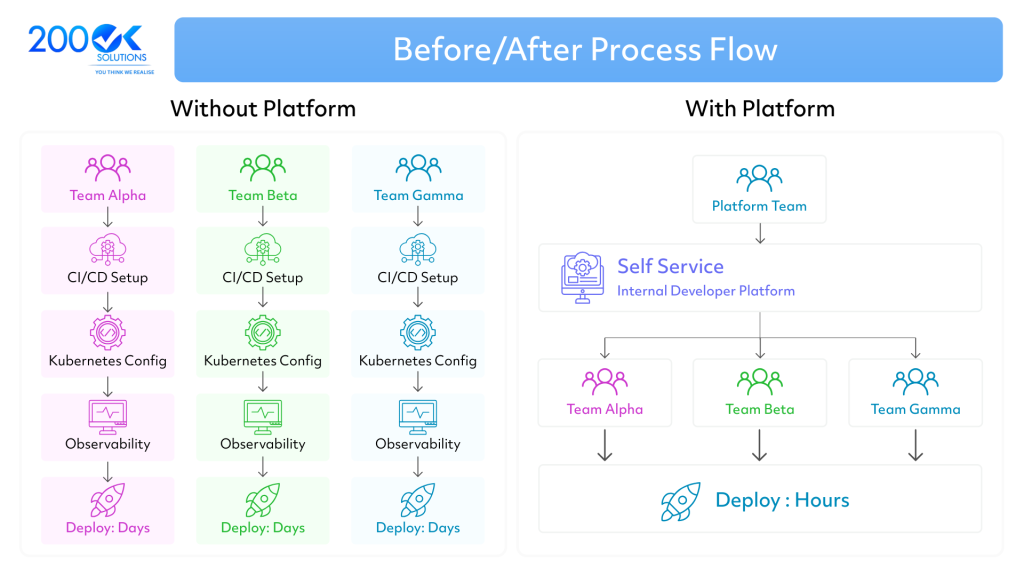
Think of it this way: instead of every developer team managing their own Kubernetes configs, CI pipelines, observability stacks, and cloud permissions, a platform engineering team builds a self-service platform that abstracts all of that away.
Platform engineering in practice looks like:
- Building and owning an Internal Developer Platform (IDP)
- Creating golden paths, opinionated, pre-configured workflows developers can follow
- Managing developer portals (Backstage is a common example)
- Owning shared infrastructure: Kubernetes clusters, service meshes, secrets management
- Reducing cognitive load on product engineering teams
- Treating internal developers as the “customer”
Platform engineering is primarily about reducing friction for developers at scale. It’s a product discipline applied inward.
The Fundamental Distinction: Philosophy vs Product
This is the clearest way to frame it:
| DevOps | Platform Engineering | |
| What it is | A culture and methodology | A dedicated team and product |
| Core goal | Shared ownership between Dev and Ops | Reduce developer cognitive load at scale |
| Output | Better collaboration, faster releases | A usable internal platform (the IDP) |
| Responsibility | Spread across all developers | Owned by a specific platform team |
| Scales well when | Teams are small to medium | Teams grow past ~50-100 engineers |
| Common tools | Jenkins, GitHub Actions, Ansible | Backstage, Crossplane, ArgoCD, Terraform |
| Relationship to SRE | Overlaps with SRE culture | Platform teams often include SRE functions |
The key insight: DevOps is a practice you adopt. Platform Engineering is a team you build.
Platform Engineering vs DevOps vs SRE, Where Does SRE Fit?
Since “platform engineering vs devops vs SRE” is one of the top questions people ask, let’s address it directly.
Site Reliability Engineering (SRE) is Google’s answer to running production systems reliably at scale. SREs use software engineering approaches to solve operations problems. They own things like SLOs (Service Level Objectives), error budgets, incident response, and reliability tooling.
Here’s how the three relate:
- DevOps is the cultural foundation, everyone owns reliability and deployment.
- SRE is one specific, opinionated implementation of DevOps practices focused on production reliability.
- Platform Engineering builds the infrastructure and tooling that both DevOps-practicing teams and SREs depend on.
In many organisations, platform teams include SRE functions. In others, SRE and platform engineering are separate but closely collaborating teams.
Organisational Structures: How Companies Actually Set This Up
This is where theory hits reality. How do companies organise these teams differently?
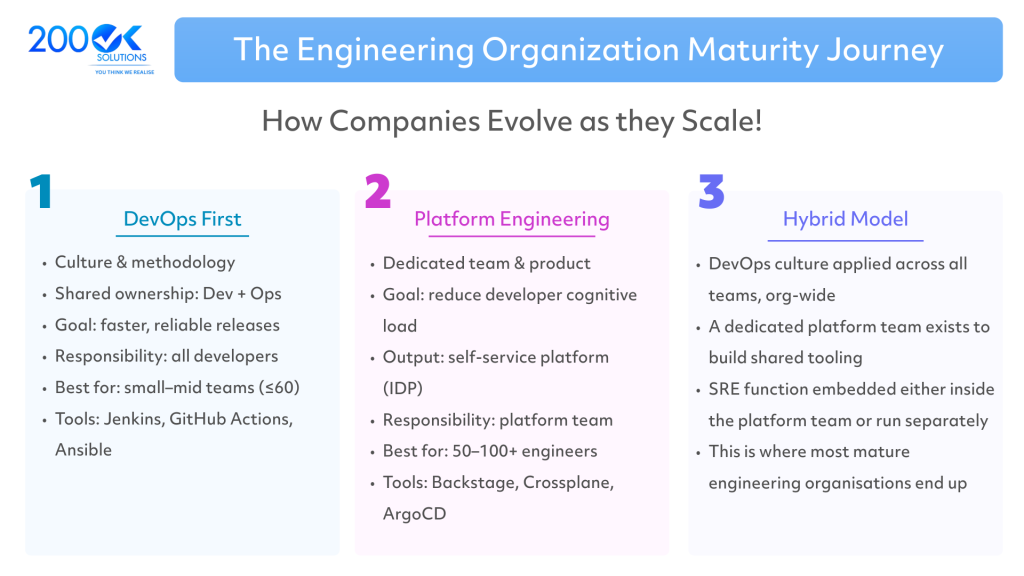
DevOps-first model (common in small to mid-size companies):
- No dedicated platform team
- Each product team owns their own CI/CD, infrastructure, and operations
- A small “DevOps team” sometimes exists but often becomes a bottleneck
- Works well up to around 30–60 engineers
Platform engineering model (common in scaling companies and enterprises):
- Dedicated platform team of 5–15 engineers serving 50–300+ developers
- Product teams self-serve infrastructure via the platform
- Platform team measures success by developer satisfaction and deployment frequency
- Works well when engineering org grows past the point where everyone can coordinate informally
Hybrid model (most common in practice):
- DevOps culture applied across all teams
- A platform team exists to build shared tooling
- SRE function embedded either in the platform team or separately
- This is the model most mature engineering organisations end up at
One important note: many companies say they’re doing “DevOps” but what they actually have is a DevOps team that acts as a gatekeeper, the opposite of what DevOps intends. Platform engineering solves this by making infrastructure genuinely self-service.
DevOps vs Platform Engineering : Salary Reality
“Platform engineering vs devops salary” is a top search, so let’s address it honestly.
It’s typically command higher salaries than generalist DevOps engineers, for one straightforward reason, the role requires both deep infrastructure knowledge and product thinking. You’re not just running pipelines; you’re designing systems that hundreds of developers depend on daily.
General market picture (US, 2024–2025):
- Mid-level DevOps Engineer: $110,000–$140,000
- Senior DevOps Engineer: $140,000–$175,000
- Mid-level Platform Engineer: $130,000–$160,000
- Senior Platform Engineer: $160,000–$210,000
- Platform Engineering Manager: $180,000–$240,000
UK market (relevant for 200OK clients):
- Senior DevOps: £70,000–£95,000
- Senior Platform Engineer: £85,000–£120,000
The gap is real. Platform engineers are harder to hire because the role is newer and the skill set is more specific. If you’re building a platform team, budget accordingly and factor in the time to hire.
Key Benefits of Shifting from DevOps to Platform Engineering
If your engineering team is growing and you’re feeling friction, here’s what a platform engineering investment actually buys you:
- Developer velocity at scale When every team manages their own infrastructure, you get inconsistency, repeated work, and slow onboarding. A platform with golden paths lets a new developer ship to production on day one.
- Reduced cognitive load Your product engineers should be thinking about business problems, not Kubernetes YAML. The platform abstracts away the complexity they shouldn’t have to deal with.
- Standardisation without mandates Instead of enforcing standards through policy, the platform makes the right way the easy way. Teams adopt it because it helps them, not because they’re forced to.
- Better security and compliance When infrastructure is centralised through a platform, you enforce security controls once, at the platform level, rather than hoping every team gets it right independently.
- Measurable developer experience Platform teams treat developers as customers and measure satisfaction (DORA metrics, developer NPS, deployment frequency). This gives leadership actual data on engineering health.
Common Questions From the Search Data
Based on what people are actually asking, here are direct answers:
Which companies offer platform engineering tools vs DevOps solutions?
The tooling landscape breaks down roughly like this:
- CI/CD (DevOps-oriented): GitHub Actions, GitLab CI, CircleCI, Jenkins
- IDP / Platform Engineering: Backstage (Spotify), Port, Cortex, Humanitec
- Infrastructure platforms: Crossplane, Pulumi, Terraform Cloud
- Kubernetes management: ArgoCD, Flux, Rancher
- Observability: Datadog, Grafana, Honeycomb
Many tools serve both disciplines. The difference is how they’re deployed and who owns them.
How do platform engineering platforms integrate with existing DevOps workflows?
This is the right question to ask before investing in a platform. The answer: good platform engineering doesn’t replace your existing DevOps practices, it codifies them. Your CI/CD pipelines, IaC scripts, and monitoring tools get wrapped into the platform as self-service capabilities. Teams keep their workflows; the platform just removes the friction.
What are the best cloud providers for building an internal developer platform?
All three major clouds are viable:
- AWS is the most mature ecosystem; best if you’re already AWS-native
- Azure has strong enterprise integrations and is often preferred for Microsoft-heavy shops
- GCP has strong Kubernetes-native tooling given Google’s SRE heritage
The honest answer: cloud provider matters less than your existing investments and team expertise. Don’t migrate clouds to build a platform.
Can you recommend consulting services for implementing platform engineering?
This is where we’d be remiss not to be direct: if you’re a UK business or global enterprise looking to build or mature a platform engineering capability, this is exactly what 200OK Solutions does. We’ve been doing this since 2011 across fintech, healthcare, hospitality, and public sector clients. We don’t sell you a product, we help you build the capability that fits your organisation.
When Should You Start Thinking About Platform Engineering?
Here are the clear signals your organisation is ready:
- Your engineering team has grown past 40–50 developers
- Different teams have different, incompatible approaches to deployment and infrastructure
- Onboarding a new developer takes more than a week to reach first deployment
- Your “DevOps team” has become a bottleneck rather than an enabler
- You’re spending significant time on compliance and security reviews at the team level
- Your DORA metrics (deployment frequency, lead time, change failure rate) are plateauing
If three or more of these apply to you, the question isn’t whether to invest in platform engineering, it’s how fast you can move.
What 200OK Solutions Does in This Space
We specialise in Platform Engineering and Enterprise Integrations as a core service. That means:
- Assessing your current state : understanding where your DevOps practices are working and where they’re creating drag
- Designing your Internal Developer Platform : architecture-led thinking to build something that scales with your organisation
- Integrating with your existing systems : connecting your cloud, CI/CD, security, and monitoring tooling into a coherent platform
- Building and transferring knowledge : we don’t just deliver a platform and leave; we make your team capable of owning it
We work with startups that need to get foundations right early, scale-ups that are hitting the ceiling of their current setup, and large enterprises that need to modernis ecomplex engineering ecosystems.
If you want a direct conversation about what this looks like for your organisation, get in touch here.
The Bottom Line
- DevOps is a cultural practice that makes development and operations work together. Every engineering organisation should be doing it.
- Platform Engineering is a specific team and product that takes DevOps principles and scales them through self-service infrastructure. Organisations above ~50 engineers should be thinking about it seriously.
- They are complementary, not competing. The best engineering organisations do both.
- The shift from DevOps-only to platform engineering is not a rebrand, it requires real investment in dedicated engineering talent, tooling, and product thinking applied internally.
The organisations getting this right are shipping faster, onboarding engineers more quickly, and spending less time on infrastructure firefighting. The ones that aren’t are watching their best engineers burn out managing complexity instead of building products.
200OK Solutions is a UK-based technology partner specialising in Intelligent Business Transformation, Platform Engineering, and Cloud-Native Architectures. We’ve delivered 200+ projects for enterprise clients since 2011.
You may also like : Port.io Deep Dive: Scorecards & Workflow Automation