
An MSP Partnership is a working relationship between a Managed Service Provider and a technology or engineering company that extends the MSP’s technical capability. Instead of hiring specialists in-house, the MSP accesses a partner’s cloud, AI, and software development expertise on demand, allowing it to deliver more services without increasing fixed headcount.
Key Takeaways
- An MSP partnership lets a Managed Service Provider add cloud, AI, and software capabilities without hiring full-time specialists.
- Common models include white-label delivery, offshore development, cloud partnerships, and AI/automation partnerships.
- The main benefits are faster delivery, lower fixed costs, and access to skills that are hard to hire directly.
- The right partner should offer proven technical expertise, strong communication, and a long-term collaborative approach, not just one-off project delivery.
Introduction
Managed Service Providers are under more pressure than at any point in the last decade. Clients no longer just want patched servers and monitored networks. Instead, they want cloud migrations, AI-driven automation, tighter cybersecurity, and modern software that keeps pace with their competitors.
As a result, this shift has widened the gap between what MSPs are expected to deliver and what most can realistically build in-house. Hiring cloud architects, AI engineers, and platform specialists takes time. In the UK’s competitive tech labour market, it’s also expensive, if you can find them at all.
This is where a well-structured MSP partnership becomes less of a nice-to-have and more of a survival strategy. In fact, the MSPs growing fastest right now aren’t the ones trying to do everything alone. Instead, they’re the ones who’ve found the right technology partner to extend their capability without extending their headcount.
So, this article breaks down what an MSP partnership actually looks like. It covers why it matters, the different models available, and how to choose a partner that adds real value, rather than just extra invoices.
What Is an MSP Partnership?
An MSP partnership is a formal working relationship between a Managed Service Provider and a technology or engineering company. Essentially, it extends the MSP’s capabilities. Instead of hiring full-time specialists for every new service line, the MSP taps into a partner’s existing expertise, delivery teams, and technical infrastructure.
These partnerships can take several forms. For example, some are purely transactional, where a partner is brought in for a single project. Others, however, are strategic and long-term. In these cases, the technology partner effectively becomes an extension of the MSP’s delivery team, working under the MSP’s brand.
Ultimately, the common thread is this: the MSP keeps the client relationship, while the partner supplies the technical depth needed to deliver on promises the MSP might not fulfil alone.
Why Do MSPs Need Technology Partners?
MSPs need technology partners because skills shortages, rising client expectations, and fast-moving technology make it impractical to build every capability in-house.
Skills Shortages Are Getting Worse, Not Better
Cloud engineers, AI specialists, and platform engineers are in short supply across the UK and globally. As a result, even well-funded MSPs struggle to compete with hyperscalers and tech giants for the same limited talent pool.
Client Expectations Keep Rising
Clients increasingly expect their MSP to be a one-stop shop. This means covering cybersecurity, cloud infrastructure, automation, and custom software, not just help desk support and network maintenance.
Hiring Specialised Engineers Is Slow and Costly
Recruiting a senior DevOps engineer or AI automation specialist can take months. Meanwhile, the opportunity that justified the hire may have already gone to a competitor.
Delivery Costs Are Hard to Control
Building an in-house team for every emerging technology means carrying fixed costs, even during quiet periods. Consequently, that’s a difficult economic model when client demand is unpredictable.
Scaling Teams Quickly Is Nearly Impossible Alone
When an MSP wins a large contract, it often needs to scale delivery capacity within weeks, not quarters. Unfortunately, in-house hiring simply can’t move that fast.
New Technologies Arrive Faster Than Internal Skills Can Adapt
AI automation, cloud-native architecture, and platform engineering are moving targets. Therefore, keeping an internal team current on all of them is a constant, expensive effort.
What Are the Benefits of an MSP Partnership?
The main benefits are access to specialised skills, flexible engineering capacity, faster delivery, lower fixed costs, and the ability to offer more services without hiring.
- Access to specialised technical expertise. Partnering gives MSPs immediate access to engineers with deep experience in cloud, AI, and platform engineering, without any ramp-up time.
- Flexible engineering capacity. Teams can scale up for a large project and scale down once it’s delivered, avoiding the long-term commitment of permanent hires.
- Faster project delivery. Because of established delivery processes and experienced teams, projects move from scoping to production faster than building capability from scratch.
- Reduced operational costs. Partnering avoids the overhead of recruitment, training, benefits, and idle bench time during slower periods.
- Ability to expand service offerings. With a capable delivery partner behind them, MSPs can confidently pitch cloud modernisation, AI automation, or custom software projects.
- Cloud and AI capabilities without the learning curve. Rather than upskilling internally over years, MSPs can offer AWS, Azure, and GCP solutions, or AI-powered automation, from day one.
- Better scalability. A strong technology partnership means the MSP’s growth isn’t capped by its internal headcount.
What Types of MSP Partnerships Are There?
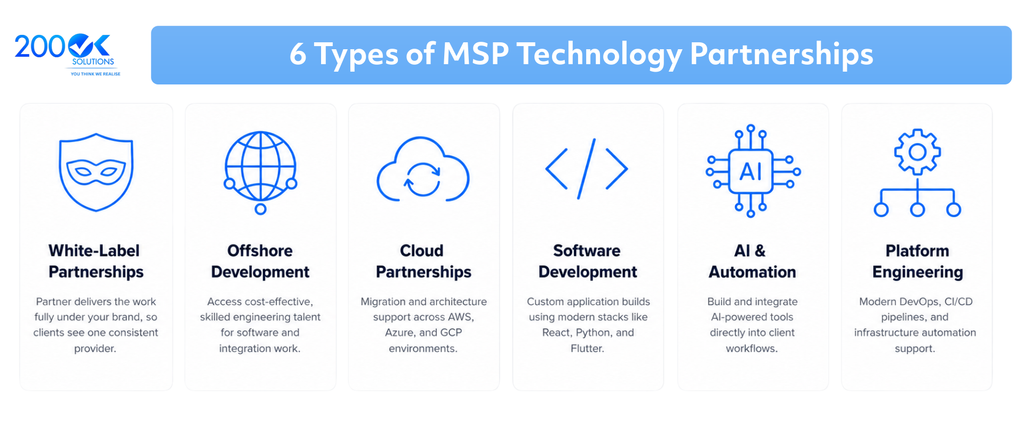
The main types are white-label technology partnerships, offshore development partnerships, cloud partnerships, software development partnerships, AI and automation partnerships, and platform engineering partnerships.
How Do You Choose the Right MSP Technology Partner?
Evaluate a technology partner on technical expertise, communication quality, scalability, security practices, enterprise experience, technology stack fit, and willingness to commit long-term.
- Technical expertise across relevant stacks. Check whether the partner has genuine, demonstrable experience in the technologies your clients need, such as cloud, AI, integrations, and modern development frameworks.
- Communication and collaboration. A partner that’s difficult to reach or slow to respond will damage your client relationships, not protect them. So, look for clear processes and responsive teams.
- Scalability. Can the partner ramp capacity up or down as your project pipeline changes? Often, this flexibility is the entire point of the partnership.
- Security practices. Since client data and infrastructure are involved, the partner’s security standards need to match or exceed your own commitments to clients.
- Experience with enterprise projects. A partner who has delivered enterprise-grade integrations and platforms will handle complexity more reliably than one used to smaller, simpler builds.
- Technology stack alignment. Make sure the partner’s core stack, including cloud platforms, programming languages, and frameworks, matches what your clients actually need.
- Long-term partnership approach. The best partnerships aren’t transactional. Instead, look for a partner interested in understanding your business, not just completing one project and moving on.
How 200OK Solutions Can Support MSP Partnerships
200OK Solutions works with MSPs and IT service providers that need dependable engineering capacity. This means avoiding the overhead of building it internally.
- Dedicated engineering teams. MSPs can access ring-fenced development teams that work as an extension of their own delivery capability, scaling up or down based on project demand.
- Custom software development. From internal tools to full client-facing products, 200OK Solutions builds software using React, Next.js, Python, PHP/Laravel, Flutter, and Go. This fits directly into an MSP’s service catalogue.
- Cloud-native solutions. With experience across AWS, Azure, and GCP, 200OK Solutions helps MSPs deliver credible cloud migration and modernisation projects.
- Platform engineering. This includes support with CI/CD pipelines, infrastructure automation, and DevOps practices, which MSPs can offer as part of a broader managed services package.
- Enterprise integrations. Connecting disparate systems, APIs, and platforms is often where projects stall. This is an area where dedicated integration expertise makes a measurable difference.
- AI automation. As client demand for AI-powered solutions grows, MSPs can bring 200OK Solutions in to design and implement automation, rather than building an AI team from scratch.
- Flexible technology delivery support. Whether it’s a single project or an ongoing partnership, the engagement model adapts to what the MSP actually needs.
Conclusion
MSPs that try to build every technical capability in-house are fighting an uphill battle. They face skills shortages, rising costs, and technology that changes faster than internal teams can adapt. However, a well-chosen MSP partnership solves that problem directly. It gives MSPs access to specialised expertise, flexible capacity, and faster delivery, without the risk of overextending their own teams.
Ultimately, the MSPs that will grow fastest over the next few years are those that treat technology partnerships as a core part of their strategy, not a stopgap. So, choosing the right partner, one with genuine technical depth, strong communication, and a long-term mindset, is what turns a partnership into a competitive advantage.
Frequently Asked Questions
1. What is the difference between an MSP partnership and simple outsourcing?
A. Outsourcing is typically a single task handed off with no ongoing relationship. An MSP partnership, by contrast, is a deeper, ongoing relationship where the partner becomes a consistent extension of the MSP’s delivery capability.
2. Do MSP partnerships work under the MSP’s own brand?
A. Yes, often they do. Many partnerships, particularly white-label arrangements, are structured so the client only ever sees the MSP’s brand, while the technology partner delivers the work behind the scenes.
3. Is an offshore development partnership reliable for UK-based MSPs?
A. Yes, when it’s managed well. With clear communication processes and overlapping working hours, offshore partnerships can be highly reliable and cost-effective. Many UK MSPs already rely on them for software development and cloud work.
4. How quickly can an MSP scale capacity through a technology partnership?
A. A strong technology partnership can typically bring additional engineering capacity online within weeks, compared to the months usually needed for in-house hiring. Exact timelines vary by partner and project scope.
5. What should an MSP look for first when evaluating a technology partner?
A. Technical expertise matched to actual client needs should come first. Communication and long-term collaboration fit matter just as much, since a technically strong partner who’s hard to work with will still create delivery problems.
You may also like : Best AI Chatbot for Your Business: ChatGPT vs Claude vs Gemini vs Copilot for Enterprise Work