
Every hotelier knows the feeling: rooms sitting empty on a Tuesday while a competitor down the street is fully booked at a higher rate. Or the opposite problem, rooms sold too cheap during a weekend that turned out to be in high demand. This is the daily balancing act of hospitality, and it’s exactly the problem that hotel revenue management software was built to solve.
For decades, hoteliers relied on gut instinct, spreadsheets, and yesterday’s occupancy numbers to set today’s prices. That approach doesn’t scale, and it definitely doesn’t compete with hotels that have already automated the process, often with hotel channel managers doing the heavy lifting across every distribution channel. If you’re still pricing rooms manually in 2026, you’re leaving revenue on the table every single night.
What Is Hotel Revenue Management Software?
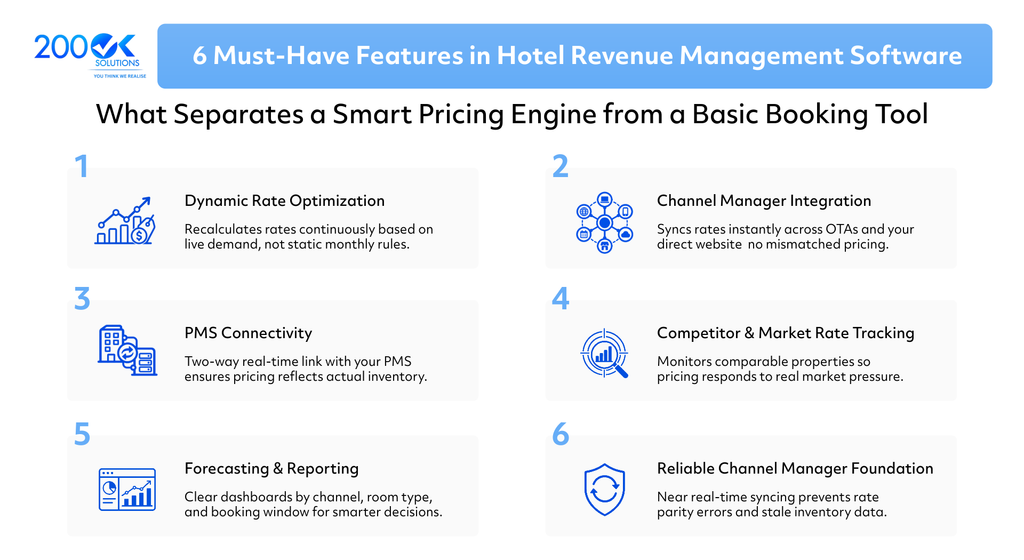
At its core, hotel revenue management software is a system that analyzes demand signals, historical booking data, local events, seasonality, competitor pricing, and real-time market conditions and recommends or automatically applies the optimal room rate. Instead of a front-desk manager manually adjusting prices once a week, a good hotel revenue management system adjusts continuously, often multiple times a day.
This is different from a basic hotel management system, which typically handles day-to-day operations like check-in, housekeeping, and guest records. Revenue management software is more specialized, it’s the layer that focuses purely on pricing strategy and profitability. That said, the two increasingly work together, and many modern hotel management software platforms now bundle revenue management as a core module rather than a separate tool.
Why Independent Hotels Can’t Afford to Skip It
Large hotel chains have used sophisticated hotel revenue management services for years, employing entire teams to run yield strategies across hundreds of properties. Independent hotels and small guest houses have historically been priced out of that level of sophistication but that gap has closed. Cloud-based hospitality management software has made enterprise-grade pricing intelligence affordable for a 20-room boutique hotel, not just a 500-room resort.
The numbers make the case on their own. Hotels using dynamic pricing through dedicated revenue management software typically see meaningful RevPAR (revenue per available room) gains within the first few months not because they’re charging more across the board, but because they’re charging the right price at the right time. That might mean lower rates during a slow midweek stretch to drive volume, and higher rates during a local festival or conference when demand spikes and guests are willing to pay more. This constant recalibration is the essence of good hotel revenue management: charging the right price to the right guest at the right moment.
Off-the-Shelf vs. Custom Hotel Revenue Management Software
Here’s where many hoteliers hit a wall. Generic, off-the-shelf platforms are built for the average hotel which means they’re built for no hotel in particular. A boutique property with a unique booking pattern, a resort with seasonal extremes, or a hotel group running multiple brands across different markets often finds that generic hotel management software forces compromises: workflows that don’t match how the team actually operates, integrations that don’t exist for a regional hotel booking system they rely on, or pricing logic that’s too rigid for their specific market.
This is exactly the gap that custom-built hotel revenue management software closes. Instead of adapting your operations to fit a vendor’s product roadmap, a purpose-built system is designed around your actual booking data, your actual hotel channel managers, and your actual hotel pms. It can integrate with the specific hotel reservation system you already run, apply pricing rules that reflect your real seasonality, and scale as you add properties without waiting on a third-party vendor to prioritize your feature request.
For hotel groups managing several properties, custom hospitality management software also solves a problem generic platforms handle poorly: centralized visibility with property-level flexibility. Each hotel can retain its own pricing nuances while ownership gets a consolidated view of performance across the whole portfolio something a one -size-fits-all hotel management system rarely delivers well. It’s also where disciplined hotel revenue management pays off most, since small pricing errors compound quickly across a multi-property portfolio.
How Revenue Management Software Fits Into Your Broader Tech Stack
It’s worth stressing that revenue management software doesn’t operate in isolation. The strongest hospitality tech stacks connect four pieces cleanly:
- A reliable hotel pms for day-to-day operations
- Hotel channel managers for distribution across OTAs and direct channels
- A hotel booking system on your own website for direct reservations (which typically carry better margins than OTA bookings)
- Revenue management software sitting on top, using data from all three to optimize pricing
Of these four, channel managers tend to be the most underestimated piece. A hotel can have brilliant pricing logic, but if the channel managers feeding it data are slow or unreliable, every downstream decision is built on stale numbers.
When these systems are stitched together properly, ideally through clean API integrations rather than manual exports and spreadsheets hoteliers get a single source of truth. When they’re not, you get double bookings, stale rates on third-party sites, and revenue managers spending hours reconciling numbers instead of making strategic decisions.
This is also where hotel marketing and revenue strategy start to overlap. A property running targeted promotions or seasonal campaigns needs its pricing engine and marketing calendar in sync, a discount code that isn’t reflected in your dynamic pricing model, or a marketing push that drives demand your revenue system doesn’t anticipate, both create friction that a well-integrated stack eliminates.
Getting Started: Build, Buy, or Customize?
If you’re a small property just starting to formalize your pricing strategy, an off-the-shelf hotel revenue management software tool can be a reasonable entry point. But as soon as your operation has any complexity, multiple properties, unusual demand patterns, existing hotel channel managers or channel managers that don’t play well with generic integrations, the calculus shifts toward custom development.
The right approach depends on where you are:
- Single independent property, standard needs: Existing SaaS hospitality software platforms can work well and get you live quickly.
- Growing hotel group or unusual operating model: Custom-built hotel revenue management software, integrated tightly with your existing hotel pms and hotel channel managers, usually pays for itself by avoiding the workarounds and lost revenue that come from forcing your business into someone else’s template.
- Complex, multi-brand or multi-region operations: A bespoke platform is often the only realistic way to get centralized reporting without sacrificing property-level pricing control.
The Bottom Line
Good hotel revenue management isn’t a one-time project, it’s an ongoing discipline that gets sharper the more data it has to work with. Filling rooms profitably isn’t about guesswork anymore, it’s about having the right data, connected systems, and pricing logic working together in real time. Hotel revenue management software is no longer a luxury reserved for large chains; it’s become table stakes for any property that wants to compete on more than just location and reputation.
Whether you choose an off-the-shelf platform or invest in a system custom-built around your hotel pms, channel managers, and booking workflows, the goal is the same: stop reacting to yesterday’s occupancy numbers and start pricing for tomorrow’s demand. That shift from static rates to intelligent, data-driven hotel revenue management is what separates hotels that merely survive from ones that consistently fill rooms at the right price.
You may also like : AI in Travel Booking: How Automation Is Reshaping Flights and Hospitality