
Enterprise AI agents have moved from demos to real workloads. They draft customer replies, update CRM records, reconcile invoices and flag anomalies in the ledger. But the moment an agent can act inside your business systems, the question changes. It is no longer “can it do the task?” but “can we trust it to do the task, every time, with proof?”
That is the promise of AI agent governance: giving enterprise AI agents the autonomy to be useful and the controls to be safe. This guide explains how to build governed AI agents across CRM, ERP, customer support and finance systems, and how to roll them out without losing control.
What is AI agent governance? AI agent governance is the set of permissions, guardrails, approval workflows and audit controls that define what an AI agent may do, when a human must approve, and how every action is recorded.
Why AI Agent Governance Is the Real Challenge for Enterprise AI
A chatbot answers questions. An enterprise AI agent takes actions: it reads data, makes decisions and writes back to systems of record. That difference creates new risks:
- Wrong actions at scale: An agent that misreads a pricing rule can update thousands of CRM records before anyone notices.
- Data exposure: Agents connected to ERP and finance data can surface information to people who should never see it.
- No accountability: If nobody can explain why an agent approved a refund, you cannot defend the decision to an auditor or a customer.
- Shadow agents: Teams spin up their own agents with their own credentials, outside IT’s view.
AI agent governance is not a brake on innovation. Done well, enterprise AI governance is what lets you move agents from a pilot into production, because the business can finally say yes with confidence.
The 5 Controls of an Enterprise AI Governance Framework
A workable AI governance framework for agents does not need to be a hundred-page policy. It needs five practical controls built into the agent itself:
1. Identity and Access Control
Every agent should have its own identity, never a shared admin login. Apply least-privilege rules: a support agent can read order history but cannot change payment terms; a finance agent can prepare a journal entry but cannot post it. Role-based access control for agents works exactly like it does for employees, and it is the foundation of AI agent security.
2. AI Agent Guardrails
Guardrails define what an agent may and may not do. They include input checks (blocking prompt injection and out-of-scope requests), output checks (no personal data in replies, no invented figures), and action limits such as refund caps, approval thresholds and restricted record types. Well-designed guardrails are specific and testable, not vague instructions in a prompt.
3. Human in the Loop
Human in the loop AI means a person reviews or approves the actions that carry real risk. The goal is not to review everything, that defeats the purpose of automation. Instead, route by risk: low-risk actions run automatically, medium-risk actions are sampled, and high-risk actions such as large payments or contract changes require explicit approval.
The table below shows how this routing works in practice:
| Action type | Example | Risk | Approval |
| Read-only lookup | Fetch an order status | Low | Automatic, logged |
| Reversible update | Edit a CRM contact field | Medium | Automatic, sampled review |
| Customer-facing or financial | Issue a refund above the cap | High | Human approval required |
| Hard to reverse | Change contract terms, post a journal entry | High | Human approval + second approver |
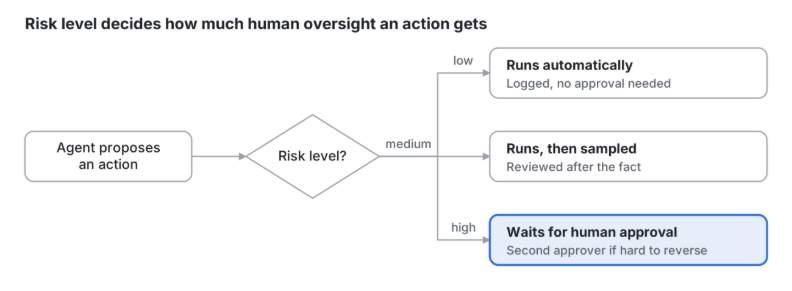
Risk level decides how much human oversight an action gets
4. Audit Trail
Log every step: the request, the data the agent retrieved, the tools it called, the decision and the outcome. A complete audit trail turns an opaque agent into something you can investigate, explain and improve. It is also the evidence regulators and internal audit teams will ask for particularly important in regulated sectors like financial services.
5. AI Agent Observability and Evaluation
You cannot govern what you cannot see. Track success rates, escalation rates, cost, latency and error patterns. Run regular evaluations against test cases, including adversarial ones, so you catch drift before customers do.
Choosing an AI Agent Platform Without Locking Yourself In
The market for an agentic AI platform is crowded, and it is tempting to pick the one with the best demo. Instead, evaluate any AI agent platform against your governance needs:
- Does it support per-agent identity and fine-grained permissions?
- Can you set approval workflows and action limits without custom code?
- Does it produce exportable logs for audit?
- Can it handle AI agent integration with your existing CRM, ERP and finance systems through standard APIs?
- Can you swap the underlying model without rebuilding everything?
Many enterprises find that off-the-shelf agentic AI platforms cover the common cases but fall short on specific processes and compliance rules. In those cases a custom-built layer, with governance designed around your workflows, is often the safer path.
AI Agent Orchestration and Integration Across Systems
The real value appears when agents work across systems, and that is also where governance gets hardest. AI agent orchestration coordinates multiple specialised agents so that a single business outcome such as resolving a billing dispute can touch support, CRM and finance without a human stitching it together.
Good AI agent integration follows four principles:
- Use APIs and a controlled tool layer: Agents should call approved tools, not scrape screens or hold raw database credentials.
- Separate reading from writing: Give agents broad read access where justified, but narrow, logged write access.
- Keep a single source of truth: Agents should update systems of record, not keep their own shadow copies.
- Design for failure: When an API times out or data conflicts, the agent should stop and escalate, not guess.
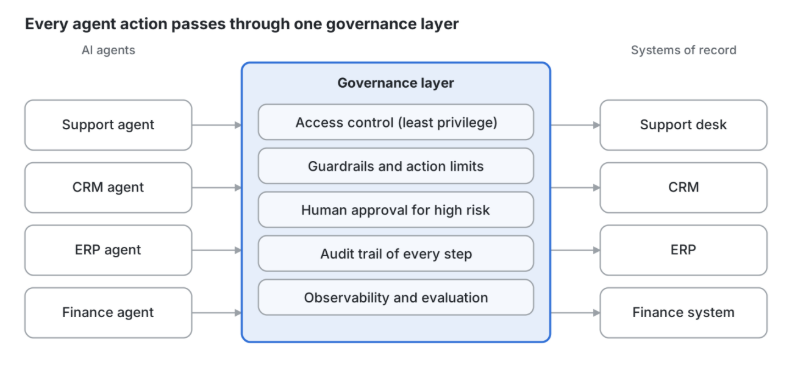
Every agent action passes through one governance layer
Governed Enterprise AI Agents in Action: CRM, ERP, Support and Finance
Each business system has distinct data sensitivities, compliance requirements and risk profiles. Here is how governed AI agents work across each one.
CRM: Governed AI Agents for Sales and Account Management
CRM agents can enrich leads from public sources, summarise account history before a call, draft personalised follow-ups and keep records clean by detecting duplicates and stale data.
Governance priorities for CRM agents:
- Field-level write permissions : specify exactly which fields an agent may update
- Consent and communication compliance : agents must respect GDPR opt-out flags and suppression lists before triggering any outreach
- Duplicate prevention : changes should be validated against existing records before writing
- Audit trail on every enrichment : log the source, the agent, the timestamp and the original value
A common starting point: a CRM agent that enriches new leads from LinkedIn and company data sources, flagging low-confidence matches for human review before the record is updated.
ERP: Governed AI Agents for Operations and Finance Data
In ERP, agents help with purchase order matching, inventory alerts, supplier query handling and exception triage. Because ERP data drives operations, procurement, logistics, payroll write access must be tightly scoped and every change reversible.
Governance priorities for ERP agents:
- Start with read and recommend : let agents surface anomalies and suggest actions; humans approve before any write
- Transaction value thresholds : automate routine, low-value transactions; escalate anything above a defined threshold
- Segregation of duties : the agent that flags a discrepancy should not be the one that corrects it
- Reversibility by design : prefer staging areas and reversible writes over direct record updates
A practical first use case: a purchase order matching agent that flags discrepancies between POs, delivery notes and invoices for AP team review, reducing manual processing time by 60–80% on routine matches.
Customer Support: Governed AI Customer Service Agents
The AI customer service agent is often the first agent businesses deploy. It can triage incoming tickets, suggest or draft answers, resolve common requests autonomously and hand over complex cases with full context, including conversation history, account status and previous resolutions.
Governance priorities for support agents:
- Approved knowledge sources only : agents must answer from documented policies, not improvise
- Escalation rules : define triggers for transferring to a human: angry tone, high-value customer, sensitive topic, repeated contacts
- Refund and credit limits : set hard caps; anything above requires human approval
- Response review sampling : review a percentage of automated responses weekly to catch drift early
Support agents typically deliver the fastest measurable ROI: resolution time drops, first-contact resolution improves, and agent capacity is freed for complex cases that genuinely need human judgement.
Finance: Governed AI Agents with the Strongest Controls
Finance has the lowest tolerance for error, so it needs the strongest controls. Agents can assist with invoice processing, reconciliation, expense review, anomaly detection and reporting. But financial agents must be designed with compliance built in, not bolted on.
Governance priorities for finance agents:
- Segregation of duties : the agent that prepares a payment should never be the one that approves it
- Immutable audit logs : every action recorded with a timestamp, agent ID and the approver who signed off
- Regulatory alignment : map agent actions to your obligations under SOX, UK FRC guidance, or sector-specific rules
- Human sign-off on anything material : no automated posting of journal entries above a materiality threshold
- Standards references : NIST AI RMF, ISO/IEC 42001, and the EU AI Act for high-risk system classification
A common early use case: an invoice processing agent that matches invoices to POs, extracts line items, flags exceptions and routes approved invoices for payment with a human approving any payment above a defined threshold.
One Workflow, Four Systems: An Illustrative Example
Consider a disputed invoice. An AI customer service agent receives the complaint. A CRM agent pulls the account and contract terms. An ERP agent checks the delivery record. A finance agent proposes a credit note. A human approves the credit, and the audit trail records every step. That is orchestration and governance working together, no human had to stitch the systems together, but a human made the final call where it mattered.
A Practical Rollout Roadmap for Enterprise AI Agents
Follow these six steps to move from pilot to production safely:
- Pick one narrow use case : Choose a process that is high-volume, well understood and low risk, such as ticket triage or invoice matching. Avoid multi-system workflows until governance is proven.
- Define the rules first : Document permissions, guardrails, approval thresholds and escalation paths before writing a line of code. Governance retrofitted after deployment rarely holds.
- Run in shadow mode : Let the agent recommend actions while humans decide, and compare results. Measure accuracy before granting any autonomy.
- Introduce limited autonomy : Automate the low-risk actions. Keep humans in the loop for the rest. Set explicit success criteria before expanding scope.
- Monitor and evaluate continuously : Review logs weekly, test edge cases monthly and tighten controls as you learn. Governance is an ongoing practice, not a one-time setup.
- Scale deliberately : Reuse the same governance layer for each new agent and system. The 5 Controls framework should be a template, not rebuilt from scratch each time.
Frequently Asked Questions
Q : What are governed AI agents?
A. Governed AI agents are agents that operate within defined permissions, guardrails, approval workflows and audit logging, so their actions are controlled, explainable and compliant. Governance is what separates an enterprise-ready agent from an experimental one.
Q : Do all agent actions need human approval?
A. No. Human in the loop AI should be risk-based. Routine, low-impact actions like fetching an order status or enriching a lead can run automatically. High-impact actions, such as issuing refunds above a cap or posting journal entries, need a human decision.
Q : Can one agent work across CRM, ERP, support and finance?
A. It is usually safer to use specialised agents with narrow permissions, coordinated through orchestration, than a single agent with broad access to everything. Narrow agents are easier to govern, audit and debug.
Q : What is the difference between AI governance and AI agent governance?
A. AI governance covers an organisation’s overall policies and risk management for all AI use. AI agent governance applies those rules specifically to systems that take actions, adding access control, approval workflows and action-level logging.
Q. How do you stop an AI agent from taking the wrong action?
A. Combine least-privilege access, action limits, human approval for high-risk actions and continuous monitoring. No single control is enough on its own, the 5 Controls framework works because all five operate together.
Q. What should an AI agent audit trail record?
A. The request, the data retrieved, the tools called, the decision, the outcome, and who approved it (if anyone). The trail should be tamper-evident and exportable for regulators and internal audit teams.
Q. Which compliance standards apply to governed AI agents?
A. The NIST AI RMF and ISO/IEC 42001 are the most common references. The EU AI Act adds legal requirements for high-risk AI systems, including agents that make decisions affecting individuals in employment, credit or public services.
Q. How long does it take to deploy a governed AI agent?
A. A well-scoped first agent, such as a support triage agent or invoice matching agent can reach shadow-mode testing in four to eight weeks. Full production deployment, with governance validated against real data, typically takes three to six months. Skipping the shadow-mode phase is the most common cause of failed deployments.
Conclusion
Enterprise AI agents will only earn a lasting place in your operations if people trust them. That trust comes from AI agent governance built in from day one: strong identity and access control, practical guardrails, human oversight where it matters, complete audit trails and constant monitoring.
Start small. Choose one process, prove the controls work, then scale across CRM, ERP, support and finance using the same governance layer.
At 200OK Solutions, we build bespoke software and intelligent business transformation solutions tailored to how your business actually runs, including governed AI agents designed around your CRM, ERP, support and finance systems. If you are planning your first agent or tightening controls on existing ones, we would be glad to talk.
You may also like : Meta Muse AI Agent Setup: How to Set Up Your Personal Agent Step by Step