
Introduction
The Model Context Protocol (MCP) is an open standard. It lets AI models connect to external tools, data sources and business systems using one common set of rules. Without it, every AI platform needs its own custom-built connector for every app. Anthropic released MCP in November 2024. Within about a year, it became the default way AI assistants like Claude, ChatGPT, Gemini and Copilot talk to the outside world.
Maybe you run a SaaS product. Maybe you manage an engineering team. Or maybe you’re just trying to work out whether “MCP” deserves a line item on next quarter’s roadmap. Either way, this guide covers what the protocol does, how it differs from a normal API, what changed in the 2026 specification update, and how to implement it without repeating mistakes other teams have already made.
Key Takeaways
- MCP standardises how AI models discover and use external tools, files and data. It replaces bespoke, one-off integrations.
- It solves the “M×N problem.” Without a shared protocol, connecting M AI applications to N tools requires up to M×N custom integrations. MCP reduces that to one integration per tool.
- Every major AI vendor now supports it, including Anthropic, OpenAI, Google, Microsoft and AWS.
- In December 2025, Anthropic donated MCP to the newly formed Agentic AI Foundation under the Linux Foundation. That made it vendor-neutral infrastructure, not one company’s product.
- The July 2026 specification (2026-07-28) moved MCP toward a stateless design. Some parts break compatibility with earlier servers.
- MCP doesn’t replace your API. It’s a layer that sits on top of it, built specifically for AI agents.
- Security is an active concern. Researchers have already logged incidents like cross-tenant data exposure in early MCP deployments. Governance needs to start on day one.
What Is the Model Context Protocol, in Plain Terms?
MCP is an open specification. It defines how an AI application (the “host”) connects to external systems (the “servers”) through a standard client. It gives AI models a consistent way to do three things:
- Access resources : read data from files, databases, APIs or any other external source.
- Call tools : take actions, such as searching the web, creating a support ticket, or running a query.
- Use prompts : apply predefined prompt templates with parameters supplied at runtime.
People often compare MCP to USB-C. Before USB-C, every device needed its own cable and adaptor. MCP does the same job for AI. One protocol, many tools, no bespoke wiring for each combination.
How MCP Works: Hosts, Clients and Servers
MCP has three moving parts:
- Host : the AI application itself, such as Claude, ChatGPT, an IDE like Cursor or VS Code, or a custom enterprise agent.
- Client : the piece embedded inside the host. It manages the connection to each server and speaks MCP’s JSON-RPC-based messaging format.
- Server : a lightweight adapter that exposes one external system’s data and actions (Slack, GitHub, a Postgres database, an internal CRM). Any MCP-compatible host can understand it.
Early MCP servers mostly ran over stdio on a developer’s own machine, or over HTTP+SSE for remote connections. As enterprises pushed MCP into production, the original stateful design started to strain under multi-client, cloud-scale traffic. That strain is the main reason the protocol got overhauled in mid-2026 (more on that below).
Why MCP Matters for Businesses
Before MCP, connecting an AI assistant to your product meant writing and maintaining a separate integration for every AI vendor you wanted to support. Multiply that across a growing number of AI platforms and internal tools, and the integration burden scales quadratically, not linearly.
MCP flips that. Build one MCP server for your product, and any MCP-compatible AI application can use it, present or future without further engineering work on your side. For a SaaS company, that has a direct commercial implication. If your product doesn’t expose an MCP server, AI agents effectively can’t “see” or act on your data. Increasingly, that means getting left out of AI-driven workflows altogether.
MCP vs API: What’s the Actual Difference?
This is one of the most common points of confusion, so it’s worth being precise.
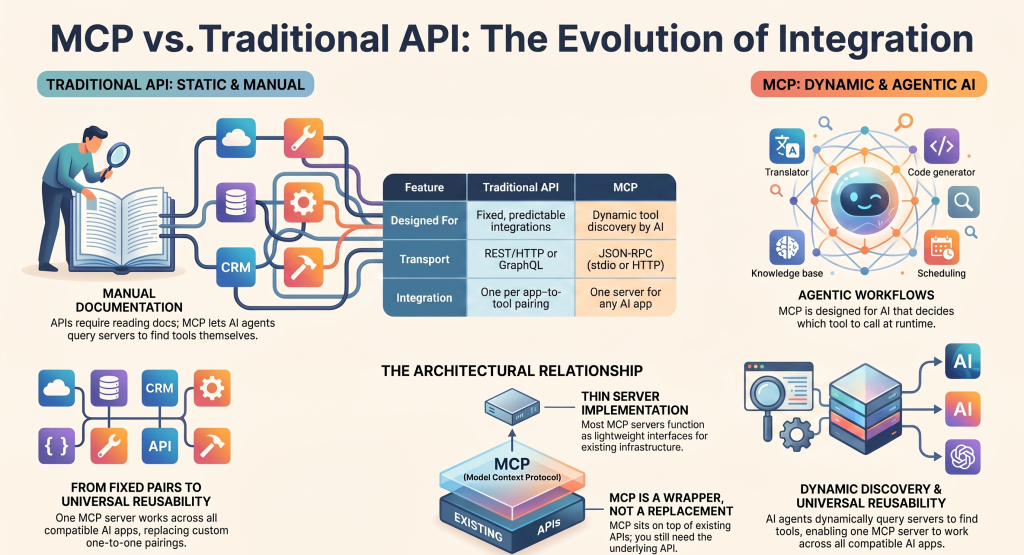
The short version: MCP servers are usually thin wrappers around an existing API. You still need the underlying API. MCP just gives AI agents a standard, self-describing way to find and use it.
The Adoption Timeline: How Fast MCP Actually Moved
Developer standards typically take years to reach industry-wide adoption. MCP moved unusually fast:
- November 2024 : Anthropic open-sources MCP with Python and TypeScript SDKs and pre-built servers for tools such as Google Drive, Slack, GitHub and Postgres.
- Early 2025 : OpenAI adopts MCP across its Agents SDK, Responses API and ChatGPT desktop app. This signals a cross-vendor standard, not an Anthropic-only feature.
- Mid-2025 : Google DeepMind and Microsoft add support. Microsoft integrates MCP into Copilot Studio.
- Late 2025 : AWS adds support. Monthly SDK downloads climb into the tens of millions.
- December 2025 : Anthropic donates MCP to the newly formed Agentic AI Foundation (AAIF) under the Linux Foundation. OpenAI and Block co-found the foundation alongside Anthropic. AWS, Google, Microsoft, Cloudflare and Bloomberg join as platinum members.
- By early-to-mid 2026 : MCP has native support across Claude, ChatGPT, Gemini, Microsoft Copilot, VS Code and Cursor. Monthly SDK downloads reach the tens of millions, with thousands of active public servers indexed across registries.
Pay attention to the Linux Foundation donation if you’re deciding whether to invest engineering time in MCP. It’s no longer a single vendor’s roadmap item. It’s vendor-neutral infrastructure with buy-in from Anthropic’s direct competitors.
The 2026-07-28 Specification: What Changed and Why It Matters
In July 2026, MCP’s maintainers finalised a major specification revision. It moved the protocol away from its original stateful design toward a stateless, cacheable and more web-like architecture. The goal: fix scaling problems that surfaced once MCP moved from single-user, laptop-based setups into multi-client, cloud-hosted enterprise deployments.
Here’s what it means in practice for teams running or planning MCP servers:
- Not fully backward-compatible : Servers built against earlier versions of the spec may need updates to work with the new stateless core.
- Better suited to cloud infrastructure : A stateless core means MCP servers can run on standard, horizontally scalable infrastructure without managing persistent sessions.
- New extensions, like “Tasks.” : This extension supports reliable, long-running agent operations, and was one of the first official additions to the updated spec.
- Major cloud vendors moved quickly : Providers such as AWS and Cloudflare had support for the new spec ready at, or shortly after, release.
If you’re building or maintaining an MCP server, budget time to review this revision before you scale a deployment. Building on the older stateful model now just creates avoidable rework later.
Security and Governance: The Part Teams Skip
MCP’s rapid adoption came with rapid growing pains. As the ecosystem scaled through late 2025 and early 2026, security researchers found a meaningful number of vulnerabilities in early MCP implementations. Real production incidents followed, including at least one documented case of cross-tenant data exposure tied to an MCP deployment.
None of this is a reason to avoid MCP. It’s a reason to treat it like any other piece of production infrastructure that touches customer data, not a weekend prototype you quietly ship to production. Before deploying an MCP server against real data:
- Apply the same authentication, authorisation and tenant-isolation review you’d apply to any customer-facing API.
- Limit each server’s exposed tools to the minimum needed. Don’t expose write access or destructive actions “just in case.”
- Log and monitor tool calls the way you’d monitor API traffic. An AI agent can call tools autonomously and in sequence.
- Review vendor MCP servers, not just your own, before connecting them to systems holding sensitive data. A third-party server is a third-party dependency with your data flowing through it.
How to Get Started: A Practical Implementation Framework
- Identify the use case first, not the protocol : Decide which workflow actually benefits from an AI agent dynamically choosing tools, internal support automation, data retrieval, ticket creation, before you build anything.
- Map it to your existing API : Most MCP servers are thin adapters over an API you already have. Confirm the underlying API has the authentication and rate-limiting you need before wrapping it.
- Build against the current specification : Use the latest MCP SDK (Python or TypeScript). Build against the 2026-07-28 spec rather than legacy stateful patterns, unless you have a specific reason not to.
- Scope tool permissions tightly : Expose only the actions the use case requires. Treat every exposed “tool” as an attack surface.
- Test with more than one host : Validate against at least two MCP-compatible clients, for example Claude and one other. That way you’re not accidentally building to one vendor’s quirks.
- Publish and monitor : If the server is customer-facing, register it appropriately, monitor usage, and plan for versioning it as the specification keeps evolving.
Common Mistakes to Avoid
- Treating MCP as an API replacement : It isn’t one. You still need a solid, well-documented underlying API.
- Skipping the security review because “it’s just internal” : Internal MCP servers still touch real data and can get chained into agentic workflows you didn’t anticipate.
- Building on the old stateful spec without a migration plan : The 2026-07-28 changes aren’t fully backward-compatible. Ignoring this creates technical debt immediately.
- Over-exposing tools : Giving an MCP server broad, unscoped access “to be safe” is the opposite of safe. It expands what an AI agent, or a compromised server, can do.
- Ignoring governance : MCP now sits under Linux Foundation stewardship, so expect the specification to keep evolving. Assign clear ownership for keeping servers current.
FAQs
Q. What is the Model Context Protocol (MCP)?
A. MCP is an open standard, originally released by Anthropic in November 2024. It defines how AI models connect to external tools, data sources and systems through a common client-server architecture.
Q. Is Model Context Protocol an API?
A. No. MCP is a protocol that typically sits on top of an existing API. It standardises how AI agents discover and call tools, but the underlying data access still usually happens through a regular API.
Q. How is MCP different from an API?
A. A traditional API is built for developers who already know exactly which endpoints they need. MCP is built for AI agents that need to discover available tools and decide, at runtime, which ones to use.
Q. Does ChatGPT use MCP?
A. Yes. OpenAI adopted MCP across its Agents SDK, Responses API and ChatGPT desktop app in early 2025, alongside Anthropic’s own Claude products.
Q. What is Microsoft’s involvement with Model Context Protocol?
A. Microsoft integrated MCP into Copilot Studio in 2025. It’s also a platinum member of the Agentic AI Foundation, the Linux Foundation body that now governs MCP.
Q. What are the limitations of MCP?
A. Key limitations include an evolving specification (the 2026-07-28 update isn’t fully backward-compatible with earlier servers), security risks tied to poorly scoped tool access, and the operational overhead of keeping servers current as the standard matures.
Q. Is MCP replacing APIs?
A. No. MCP servers are generally thin adapters over existing APIs. The API layer still does the underlying work; MCP standardises how AI agents find and use it.
Q. Why use MCP instead of building custom integrations?
A. Without a shared protocol, connecting multiple AI applications to multiple tools requires a custom integration for each pairing. MCP reduces that to one integration per tool, reusable across any MCP-compatible AI application.
Q. Who governs MCP now?
A. Since December 2025, the Agentic AI Foundation has governed MCP under the Linux Foundation. Anthropic, OpenAI and Block co-founded it, with AWS, Google, Microsoft, Cloudflare and Bloomberg as platinum members.
Q. Do I need to rebuild my MCP server for the 2026 update?
A. If your server was built against the earlier stateful specification, review the 2026-07-28 changes first. Some elements aren’t backward-compatible, so a migration review is worth doing before you scale further.
Conclusion
The Model Context Protocol went from an internal Anthropic experiment to vendor-neutral, Linux Foundation-governed infrastructure in under two years. That’s a genuinely unusual pace for a developer standard. For business leaders, the takeaway is simple: MCP doesn’t replace your API, but it does determine whether AI agents can find and use what your API already does. Teams that treat it as production infrastructure with proper scoping, monitoring and a plan for the evolving specification get real value out of it. Casual, early adopters are the ones running into the security and compatibility issues.
At 200OK Solutions, we work with product and engineering teams on exactly this kind of infrastructure decision. We help them assess where an MCP server fits their roadmap, build it against the current specification, and put security and governance controls in place before it touches production data. If you’re weighing up whether MCP belongs in your stack this quarter, that’s the conversation worth having before the build starts.
You may also like : AI Agent Statistics You Need to Know in 2026