
Choosing a technology stack for an enterprise application shapes how fast you scale, how easily you secure the system, how well it integrates with what you run, how fast your team ships, and what it costs to maintain over time.
CTOs evaluating enterprise application development weigh the same factors: scalability, security, integrations, development speed, cloud compatibility, maintenance, total cost of ownership, and hiring.
.NET, PHP, and Node.js are three of the most established options for enterprise-grade systems. Each has a legitimate claim to “enterprise-ready,” and each comes with real trade-offs. There is no single best enterprise technology stack, the right choice depends on the application’s requirements, your existing ecosystem, your team’s expertise, and your long-term goals.
What Is Enterprise Application Development?
Enterprise application development is the process of building software systems that run core business operations at scale handling complex workflows, integrated databases, internal and external APIs, role-based authentication, and strict security and compliance requirements.
These systems must stay available and performant under real production load, which means monitoring, alerting, and high-availability architecture are part of the spec from day one, the bar that separates it from standard web development.
What Makes a Technology Stack Suitable for Enterprise Applications?
- Scalability : grows with users, data, and volume without a rewrite
- Performance : holds up under sustained, high-concurrency load
- Security : built-in protections and compliance support
- Reliability : consistent uptime, predictable failure behavior
- Maintainability : stays manageable as the codebase grows
- Ecosystem maturity : libraries, frameworks, long-term support
- Integration capability : connects to your existing systems
- Cloud and DevOps support : compatible with modern infrastructure
- Developer availability : you can hire and retain talent
- Total cost of ownership : build cost plus years of running it
.NET, PHP, and Node.js satisfy these differently, which is why the right stack depends on your situation, not a universal ranking.
.NET for Enterprise Application Development
Modern ASP.NET Core is a common default for large, regulated enterprises, financial services, insurance, healthcare, government.
Strengths: strong typing catches errors early; deep native integration with Azure, Active Directory, SQL Server, Dynamics 365; strong built-in security tooling; proven scalability for large internal systems.
Limitations: integration advantages mostly apply if you’re already on Microsoft; more upfront complexity than lighter frameworks; senior .NET developers can be harder and pricier to hire.
PHP for Enterprise Applications
Modern PHP (8.x) with Laravel or Symfony is a different conversation than the “PHP isn’t serious” stereotype, it powers a meaningful share of large content platforms, e-commerce systems, and custom business applications.
Strengths: mature, well-documented frameworks support fast, structured development; strong fit as an enterprise application development platform for content and commerce systems; large developer pool; simple cloud deployment; generally lower infrastructure and hiring costs than .NET.
Limitations: code quality depends heavily on team discipline; custom enterprise application development in PHP at scale needs strong governance to avoid the technical debt behind PHP’s reputation problem; dependency management needs ongoing attention.
Node.js for Enterprise Applications
Node.js runs JavaScript/TypeScript server-side, and its event-driven, non-blocking model suits real-time, high-concurrency workloads and unified frontend/backend development.
Strengths: strong fit for API-heavy systems, real-time applications, and event-driven architectures; good fit for microservices and serverless; full stack enterprise application development gets more efficient when frontend and backend share JavaScript/ TypeScript; handles high concurrency well.
Limitations: not the natural choice for CPU-intensive processing, the single-threaded event loop is a real constraint; the pace of npm means dependency management needs vigilance; needs experienced engineering practices to avoid unstructured codebases.
.NET vs PHP vs Node.js: Detailed Comparison
Performance and Scalability
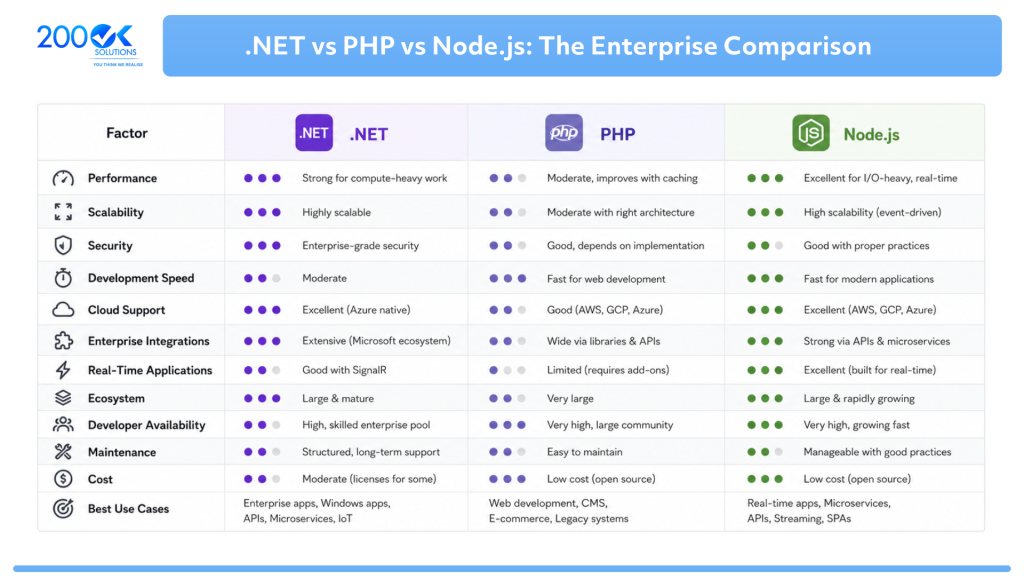
All three support horizontal and vertical scaling, caching, load balancing, and database optimization, architecture determines scalability more than the stack alone. .NET handles compute-heavy processing well due to its typed, compiled nature. Node.js excels at high-concurrency, I/O-bound workloads but is weaker for heavy computation. PHP scales well for content and commerce systems with strong caching. None is unconditionally “faster”, it depends on workload and implementation quality.
Security for Enterprise Applications
Secure enterprise application development is achievable on all three stacks, but each demands different discipline: strong authentication and authorization, encrypted data handling, secure API design, and rigorous dependency patching.
.NET ships with the most security tooling out of the box. PHP and Node.js can reach equivalent security, PHP by avoiding legacy vulnerabilities from outdated versions, Node.js through active npm dependency auditing. Ongoing monitoring and patching cadence matter more than the initial language choice.
Cloud and DevOps Compatibility
All three work well with AWS, Azure, and Google Cloud, and support Docker, Kubernetes, CI/CD, and Infrastructure as Code when properly engineered. .NET has a natural edge on Azure. PHP and Node.js are largely cloud-agnostic by default, simplifying multi-cloud strategy. All three support modern DevOps, the difference is how much tuning it takes to get there.
Development Speed, Hiring and Long-Term Maintenance
PHP and Node.js generally offer faster initial development, driven by mature frameworks and large package ecosystems. .NET’s structured approach is typically slower upfront but often reduces technical debt on large, long-running systems.
Developer availability varies by market. PHP and Node.js developers are generally more widely available; senior .NET developers with enterprise experience form a smaller pool. The practical question isn’t which stack has developers, it’s which has developers with the experience your project needs.
Enterprise Application Development Cost by Tech Stack
Cost is easy to misjudge because teams focus on build cost and underweight everything after. Real drivers: team size and seniority, integration complexity, infrastructure, compliance needs, ongoing maintenance, cloud usage, developer rates, and testing overhead.
The cheapest stack to build in isn’t always the cheapest to run for five or ten years. A PHP or Node.js system built quickly without strong standards can accumulate technical debt costlier to unwind than a more structured .NET build and over-engineering a simple content platform in .NET means paying for complexity you don’t need.
Which Tech Stack Is Best for Different Enterprise Scenarios?
These are guidelines based on typical fit, not universal rules.
.NET tends to fit: Microsoft-centric organizations, complex systems with heavy compute needs, regulated environments, large long-lifespan internal applications.
PHP/Laravel tends to fit: rapid business application development on a defined budget, content-heavy platforms and custom web applications, cost-conscious organizations, teams with existing PHP expertise.
Node.js tends to fit: API-heavy systems and microservices, real-time applications, event-driven systems with high concurrency, JavaScript/TypeScript-centric teams.
How to Choose a Tech Stack for Enterprise Applications
- What business problem are we solving?
- What scale do we realistically expect?
- What integrations are required?
- What security and compliance requirements apply?
- What does our existing technology ecosystem look like?
- What skills does our team already have?
- What cloud platform are we standardizing on?
- What is our expected maintenance horizon?
- What is the realistic total cost of ownership, not just build cost?
- How easily will this need to evolve over the next 3–5 years?
Answering these honestly, before getting attached to a specific technology separates a defensible architecture decision from a preference dressed up as strategy.
Final Verdict: .NET vs PHP vs Node.js
.NET brings a strong enterprise ecosystem, deep Microsoft integration, robust security tooling, and proven reliability for large-scale, compute-heavy, regulated systems. PHP delivers strong developer productivity, a mature web and commerce ecosystem, and cost-effective custom development. Node.js offers strong API development, real-time capability, and unified JavaScript/TypeScript development across the stack.
None of the three is the universal answer any vendor who says otherwise is selling their own specialization, not your best outcome. Architecture decisions and engineering discipline determine long-term success more than the language chosen: a well-architected PHP system will outperform a poorly-architected .NET system, and vice versa. The stack is a starting point. How well it’s built determines whether the application holds up.
At 200OK Solutions, we work across .NET, PHP, and Node.js, which means our stack recommendation for your project starts with your requirements, not with the technology we happen to specialize in. If you’re weighing this decision for an upcoming build, we’re happy to walk through your specific scale, integration, and compliance needs and help you land on the architecture that actually fits.
7. FAQ Section
Q. What is enterprise application development?
A. Enterprise application development is the process of building large-scale software systems that support core business operations, including complex workflows, database integrations, APIs, and strict security requirements. It differs from standard web development in its emphasis on reliability, compliance, and long-term maintainability under real production load.
Q. What is the best technology stack for enterprise applications?
A. There is no single best stack .NET, PHP, and Node.js each suit different scenarios. .NET fits regulated, Microsoft-centric organizations; PHP fits content and commerce-driven platforms; Node.js fits real-time, API-heavy systems. The right choice depends on your specific requirements, team, and budget.
Q. Is .NET better than PHP for enterprise applications?
A. Neither is universally better. .NET typically offers stronger built-in security and compliance tooling, making it well-suited to regulated industries. PHP often enables faster, more cost-effective development for content-driven or commerce-focused applications. The right choice depends on the use case.
Q. Is Node.js good for enterprise applications?
A. Yes, particularly for real-time and high-concurrency workloads such as live dashboards, messaging systems, and API-heavy architectures. It’s a weaker fit for CPU-intensive processing tasks, where compiled, typed languages tend to perform better.
Q. What are the most secure backend frameworks for enterprise software?
A. .NET generally provides the strongest out-of-the-box security tooling, but PHP and Node.js can both reach equivalent security levels with disciplined dependency management, secure coding practices, and regular patching. Security outcomes depend more on process than on stack choice alone.
Q. How do you choose a technology stack for an enterprise application?
A. Evaluate your business requirements, expected scale, integration needs, security and compliance obligations, existing technology ecosystem, team skills, and total cost of ownership, not just initial development speed or personal framework preference.
Q. What is the difference between .NET, PHP, and Node.js?
A. .NET is a structured, strongly-typed framework backed by Microsoft, well-suited to regulated enterprise systems. PHP is a widely-used scripting language with mature frameworks like Laravel, well-suited to content and commerce platforms. Node.js runs JavaScript/TypeScript server-side and excels at real-time, event-driven applications.
Q. Which tech stack is best for large-scale enterprise systems?
A. It depends on the workload. .NET tends to scale well for compute-heavy, compliance-driven systems. Node.js scales well for high-concurrency, real-time systems. PHP scales well for content and commerce platforms when paired with strong architecture and caching.
Q. Is PHP still used for enterprise applications in 2026?
A. Yes. Modern PHP (8.x) with frameworks like Laravel and Symfony continues to power significant enterprise content, commerce, and custom business applications, despite outdated perceptions of the language from a decade ago.
Q. What factors affect enterprise application development cost?
A. Key factors include team size and seniority, project complexity, number of integrations, security and compliance requirements, infrastructure and cloud costs, and long-term maintenance needs. The cheapest stack to build with isn’t always the cheapest to own over time.
You may also like : AI Agent Statistics You Need to Know in 2026