
A car buyer today submits inquiries to several dealerships before walking into one, researches for hours across devices, and increasingly turns to AI tools like ChatGPT to shortlist vehicles before contacting anyone. Dealerships, meanwhile, are still built around a model that assumes the customer walks in first and asks questions later.
That gap shows up in the numbers. Demand Local found leads contacted within five minutes close at roughly 32%, versus 12% for leads contacted 24 hours or later, yet the same research puts average dealership response time at 42 hours. That’s measurable lost revenue, and most dealerships know it, they simply don’t have staff to answer every enquiry in minutes, across every channel.
This is the problem AI agents are built to solve: not chatbots that answer FAQs, but software that can qualify a lead, check live inventory, propose a time slot, and hand a ready-to-buy customer to a salesperson without a human touching the first message. This article looks at what that means for retail automotive sales, service, and the back office and what has to be true operationally before any of it works.
What Is Retail Automotive?
Retail automotive is the business of selling and servicing vehicles directly to consumers, franchised new-car dealerships, independent used-car retailers, and multi-site dealer groups. It covers the full customer relationship: sales, financing and insurance (F&I), trade-ins, parts, and service, distinct from manufacturing or wholesale distribution. Margin increasingly comes from service and F&I rather than new-vehicle gross, which has compressed as pricing has become more transparent online.
Why Retail Automotive Is Becoming More AI-Driven
Roughly 95% of car shoppers now research online before contacting a dealer, spending close to 14 hours in that process. Cox Automotive’s 2026 research found 65% of shoppers want to complete some or most of the purchase online, yet only 43% of dealers offered every purchase step digitally as of 2024. AI agents are being deployed into that gap, not to replace the buying journey, but to keep pace with it.
Three forces are driving this: buyer expectations have moved past business hours; BDC and sales staffing hasn’t scaled with digital lead volume; and AI-powered search is a growing discovery channel, as shoppers increasingly ask ChatGPT or Google AI Overviews to compare models before running a traditional search.
AI Agents vs Traditional AI in Automotive Retail
These terms get used interchangeably in vendor marketing, but they describe different capability levels.
| Technology | What it does | Limitation |
| Generative AI | Drafts text | Doesn’t take action or check systems |
| Chatbot | Answers scripted questions | Breaks outside its script |
| Automation / rules | Fixed if-this-then-that triggers | Rigid; can’t handle deviation |
| AI agent | Holds a conversation, checks live CRM/DMS/inventory, completes multi-step tasks | Needs clean, integrated data |
A chatbot can tell a customer your hours. An AI agent can check whether a trim is in stock, confirm a trade-in value, and book a test drive into a salesperson’s calendar, as one conversation, not three disconnected systems.
7 AI Agent Use Cases in Retail Automotive
| Use case | Problem | AI agent does | Requires |
| Lead response | ~66% of leads get no 24-hour response; five-minute contact converts far better than one-hour+ | Responds in seconds, qualifies, books or hands off with context | Real-time CRM write access + live inventory |
| Follow up | Leads go cold from being forgotten, not lost on merit | Persistent, personalized follow-up across email/SMS/chat | CRM activity history |
| Vehicle recommendations | Shoppers don’t know exactly what they want; static search doesn’t narrow it | Asks budget/use case, matches live inventory | Live, accurate inventory feed |
| Appointment scheduling | Booking means a business-hours call | Checks real availability, books 24/7 | Two-way DMS calendar sync |
| Inventory intelligence | Pricing/stocking often run on gut feel | Flags which vehicles move vs. sit, and mispriced stock | Clean, current DMS/inventory data |
| Service automation | Scheduling and reminders are manual, inconsistent | Books service, sends reminders, answers status questions | DMS service history + bay availability |
| Retention | Dealerships go quiet after the sale | Times outreach around lease-end, trade equity, service milestones | Unified purchase + service history |
The pattern: benefit only materializes if the “requires” column is true. An agent on bad data doesn’t fail loudly, it gives customers confidently wrong answers.
The Data Problem Behind AI in Automotive Retail
Most dealerships run separate CRM, DMS, inventory, and website-lead systems, often from different vendors never designed to talk to each other. An AI agent layered on that fragmentation doesn’t fix it, it just answers customers faster with information that may already be wrong. Recommending a vehicle that isn’t in stock, or booking a slot a technician doesn’t have, damages trust faster than a slow human response would.
Before layering on AI, fix the foundation: a single source of truth for inventory synced in near real time; CRM/DMS integration so the agent and service advisor share one record; and data hygiene, since duplicate customers and stale lead statuses mislead an AI agent as easily as a human.
“Add AI” is the wrong framing. Dealerships getting results treat this as a data and integration project first, with AI as the interface on top.
How AI Can Improve the Automotive Retail Customer Experience
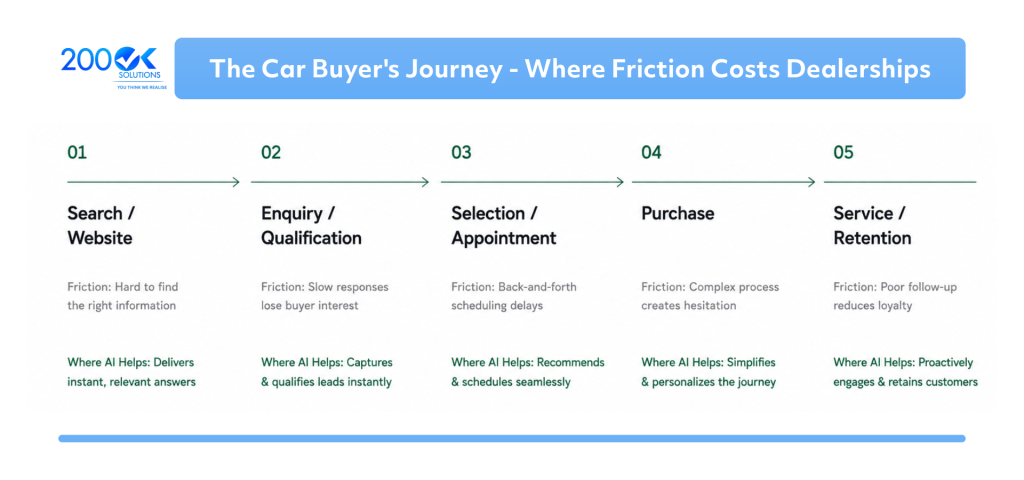
Mapped against the buyer journey, AI agents remove friction at specific points:
| Stage | Friction | Where AI helps |
| Search / website | Generic browsing, no direct answers | Structured content, conversational matching |
| Enquiry / qualification | Slow response, manual triage | Instant 24/7 response and qualifying |
| Selection / appointment | Static listings, phone-only booking | Inventory-aware picks, self-service booking |
| Purchase | Disconnected online/in-store steps | Continuity across channels |
| Service / retention | Manual reminders, silence post-sale | Automated reminders, timed re-engagement |
None of this replaces the salesperson or service advisor. It removes the repetitive, time-sensitive work that keeps a human from focusing on the parts of the interaction, negotiation, trust-building, technical explanation, that actually require one.
AI Search and the Future of Automotive Retail
A growing share of car buyers no longer start with a traditional Google search. A 2025 CarEdge survey found one in four car buyers had already used AI tools like ChatGPT to research or negotiate, with 40% of upcoming buyers planning to use AI next time. Separate 2026 research from Ekho found similar adoption, with AI acting as a growing “front door” for vehicle discovery.
A real caveat: Consumer Reports tested AI tools on car-shopping questions in 2026 and found meaningful errors, recommending discontinued models, mixing up model years, misidentifying vehicles. That’s the argument for publishing accurate, structured dealership content, AI tools pull from whatever’s available, and thin or outdated content raises the odds of a bad AI answer costing a customer before contact. This doesn’t replace SEO; it sits alongside it, since that same content now feeds AI answers as much as search rankings.
What Dealerships Need Before Implementing AI Agents
Checklist before signing an AI agent contract: accurate, deduplicated data; confirmed CRM/DMS API access; defined security boundaries around PII and payment data; governance rules on what the agent can decide versus must escalate; a tested human escalation path; KPIs set before launch, not measured retroactively; and the current process mapped end-to-end, automating a broken process just fails faster.
How to Measure AI ROI in Retail Automotive
Metrics that indicate whether an AI agent deployment is working:
| Metric | Why it matters |
| Lead response time | Clearest predictor of conversion in the data above |
| Lead conversion rate | Whether faster response is translating to deals |
| Appointment booking rate | Whether qualified leads convert to scheduled visits |
| Show rate | Whether booked appointments show up |
| Sales conversion | The end-to-end result |
| Cost per lead / sale | Whether AI is cutting acquisition cost, not just adding a fee |
| Service booking rate | Whether the higher-margin business is benefiting too |
| Customer retention | Whether re-engagement works long-term |
| Employee productivity | Whether staff are doing higher-value work |
Track these before and after deployment on the same basis, a vendor’s own “engagement” numbers aren’t a substitute for actual conversion and revenue data.
The Future of Retail Automotive Is AI-Assisted, Not AI-Replaced
This isn’t about removing people from the sales floor or service drive. It’s about removing repetitive, time-sensitive work, answering the first message at 11pm, chasing a fifth follow-up, so staff spend time where it matters: closing deals and solving real problems.
The dealerships getting this right aren’t the ones buying the flashiest AI product. They fixed data and integration first, then layered AI agents on a foundation that could support them.
FAQs
1. What are AI agents in automotive retail?
A. AI agents are software systems that can hold a conversation, check live dealership systems like CRM, DMS, and inventory, and complete multi-step tasks, such as qualifying a lead or booking an appointment without a human handling each step.
2. How is an AI agent different from a chatbot?
A. A chatbot answers pre-written questions from a script. An AI agent can check real data, make decisions within defined rules, and complete a task end-to-end, such as confirming inventory and booking a test drive in one conversation.
3. Can AI agents replace car salespeople?
A. No. AI agents handle repetitive, time-sensitive tasks like initial response and follow-up. Negotiation, trust-building, and complex customer needs still require a human salesperson or service advisor.
4. What data does a dealership need before using AI agents?
A. Clean, deduplicated customer records, real-time inventory data, and working CRM/DMS integration. Without these, an AI agent will act on inaccurate information, which damages customer trust faster than a slow response would.
5. How fast should a dealership respond to a lead?
A. Industry data shows leads contacted within five minutes convert at significantly higher rates than those contacted after 30 minutes or 24 hours. Faster response is one of the most consistently measurable factors in lead conversion.
6. How do dealerships measure AI agent ROI?
A. Key metrics include lead response time, lead conversion rate, appointment booking rate, show rate, cost per lead, cost per sale, service booking rate, and customer retention, tracked before and after deployment on the same basis.
7. Are car buyers actually using AI tools like ChatGPT to shop for vehicles?
A. Yes. Multiple 2025–2026 surveys found roughly a quarter of car buyers had used AI tools during vehicle research, with adoption expected to grow further among upcoming buyers.
8. What should dealerships do before implementing AI agents?
A. Confirm CRM/DMS integration and API access, clean up customer and inventory data, define governance rules for what the AI can decide versus escalate, and set clear KPIs before launch.
You may also like : AI Agent Statistics You Need to Know in 2026