
Most enterprises already automated the easy work years ago. What’s left, exception handling, judgment calls, multi-system workflows, unstructured data is where rule-based automation breaks down. AI agents, which reason over context, call APIs and tools, and execute multi-step tasks with human checkpoints, are now filling that gap. This article maps the platform landscape, the trade-offs, and how to choose without overcommitting.
Quick Answer: In 2026, the leading enterprise AI agent platforms are Microsoft Copilot Studio (Microsoft 365/Azure environments), Salesforce Agentforce (CRM-native workflows), ServiceNow AI Agents (IT/HR operations), Google Vertex AI Agent Builder / Gemini Enterprise, Amazon Bedrock AgentCore (cloud-native, framework-agnostic), IBM watsonx Orchestrate (regulated industries), UiPath (RPA-plus-agent hybrid), and Anthropic’s Claude and OpenAI’s models used as the reasoning layer inside these platforms or custom builds. There is no single “best” agent, the right choice depends on your existing systems, data, governance needs, and the workflows you’re automating.
What Are AI Agents for Enterprise Automation?
An AI agent perceives context (documents, tickets, data), reasons about what to do, calls tools or APIs, and executes multi-step actions, often with a human approving key steps. This differs from traditional automation, which follows fixed rules and breaks when inputs vary.
Example: An invoice-processing agent reads a PDF invoice, checks it against a purchase order in the ERP, flags discrepancies for a human, and posts approved invoices automatically, instead of a script that fails the moment a vendor changes their invoice format.
AI Agents vs Traditional Automation
| Capability | Traditional Automation | AI Agents |
| Rule-based workflows | Strong | Supported, but not required |
| Unstructured data | Weak | Strong |
| Decision-making | None (fixed logic) | Context-based reasoning |
| Adaptability | Low | Higher, within guardrails |
| API/tool usage | Predefined | Dynamic tool selection |
| Human intervention | Rare, exception-only | Built into workflow design |
| Multi-step workflows | Rigid sequences | Adaptive sequences |
| Scalability | High for stable processes | High, but needs governance |
Traditional automation (RPA, scripted workflows) is still the better choice for high-volume, stable, rule-based processes where predictability matters more than adaptability.
What Makes an AI Agent Enterprise-Ready?
Evaluate platforms against: security and identity management (SSO, RBAC), data privacy controls, governance and audit trails, observability into agent decisions, human-approval workflows, breadth of system integrations, reliability at scale, model flexibility (bring-your-own-model vs locked-in), deployment options (SaaS, private cloud, air-gapped), compliance tooling, and cost visibility.
Best AI Agents for Enterprise Automation in 2026
Microsoft Copilot Studio : Best for organizations standardized on Microsoft 365/Azure. Offers multi-agent orchestration, computer-using agents for legacy UI automation, and governance tied to Entra ID. Computer-using agents are now generally available, allowing agents to interact directly with websites and desktop applications through the UI. which helps automate systems that lack modern APIs. Consideration: value is strongest for existing Microsoft tenants.
Salesforce Agentforce : Best for CRM-native automation (sales, service, commerce). Runs on the Atlas Reasoning Engine with permissions tied to Salesforce’s existing role model. Consideration: strongest where Salesforce is already the system of record.
ServiceNow AI Agents : Best for IT operations and HR service delivery, with an AI Control Tower for cross-department governance. Consideration: most valuable for ServiceNow-centric ITSM/HRSM environments.
Google Vertex AI Agent Builder (Gemini Enterprise) : Best for Google Cloud-native teams. The platform bundles Agent Studio for low-code authoring, Agent Runtime, Memory Bank for persistent cross-session context, and governance primitives called Agent Identity and Agent Gateway. Consideration: strongest fit for BigQuery / Workspace invested organizations.
Amazon Bedrock AgentCore : Best for engineering teams wanting infrastructure flexibility.It exposes a serverless runtime that accepts any framework, model, or protocol, LangGraph, CrewAI, Strands, or custom code, wrapped with AWS-grade isolation, VPC networking, and CloudFormation. Consideration: requires more engineering effort than low-code builders.
IBM watsonx Orchestrate : Best for regulated industries (banking, insurance, healthcare, government) needing on-premises or air-gapped deployment and detailed compliance documentation. Consideration: more implementation-heavy than SaaS-first platforms.
UiPath : Best for enterprises extending existing RPA investments with agentic capabilities, combining deterministic bots with reasoning agents. Consideration: strongest where RPA is already embedded operationally.
Anthropic (Claude) and OpenAI models : Best as the reasoning layer inside the platforms above or custom-built agents, rather than as standalone enterprise agent platforms. Many hyperscaler platforms now offer model choice, including Claude, within their agent runtimes.
AI Agent Comparison Table
| Platform | Best For | Integrations | Governance | Best Fit |
| Microsoft Copilot Studio | M365/Azure workflows | Deep Microsoft ecosystem | Entra ID, Agent 365 control plane | Microsoft-standardized enterprises |
| Salesforce Agentforce | CRM/sales/service | Salesforce-native | Einstein Trust Layer | Salesforce-centric orgs |
| ServiceNow AI Agents | IT/HR operations | ServiceNow modules | AI Control Tower | ITSM/HRSM-heavy enterprises |
| Google Vertex AI Agent Builder | Data/ML-intensive work | Google Cloud, BigQuery | Agent Identity, Agent Gateway | Google Cloud-native teams |
| AWS Bedrock AgentCore | Custom agent engineering | Any framework/model | VPC, IAM, CloudFormation | AWS-native engineering teams |
| IBM watsonx Orchestrate | Regulated industries | 700+ connectors | On-prem/air-gapped compliance | Banking, healthcare, government |
| UiPath | RPA + agent hybrid | Existing RPA estate | Role-based controls | Orgs scaling from RPA |
Best AI Agents by Enterprise Use Case
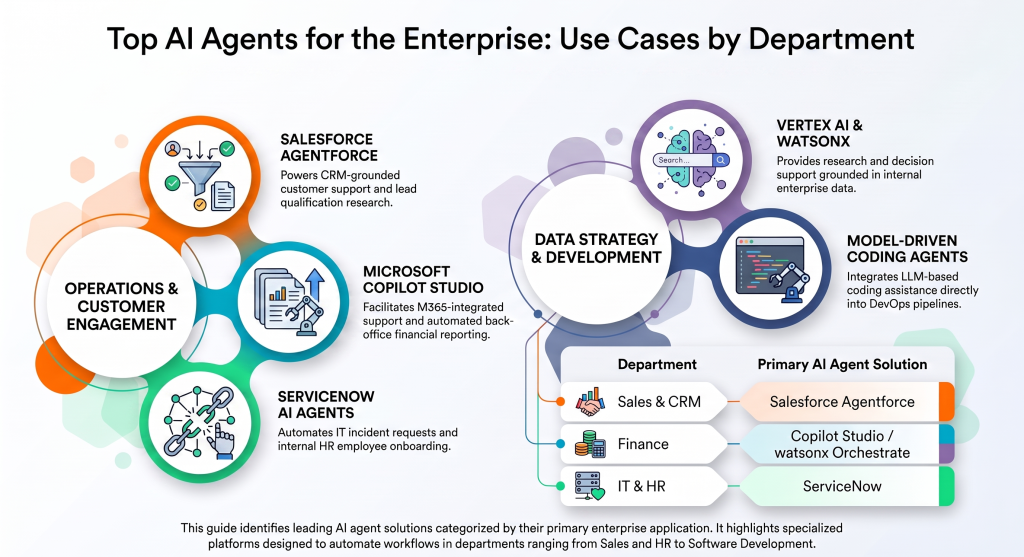
- Customer service: Salesforce Agentforce (CRM-grounded), Microsoft Copilot Studio (M365-integrated support).
- IT operations: ServiceNow AI Agents for incident and request automation.
- Sales & CRM: Agentforce for lead qualification, account research, and CRM updates.
- Finance & back office: Copilot Studio or watsonx Orchestrate for invoice processing, reconciliation, and reporting workflows.
- Software development: Model-driven coding agents (built on Claude, GPT, or similar) integrated into DevOps pipelines.
- HR & employee operations: ServiceNow for onboarding and internal knowledge queries.
- Enterprise data & knowledge: Vertex AI Agent Builder or watsonx for research and decision support grounded in enterprise data.
Integration, Architecture, and Security
Integration architecture, not the underlying model, usually determines whether an agent succeeds. Agents need reliable, permissioned access to CRM, ERP, HRMS, ITSM, data warehouses, and legacy applications.
Typical architecture: Business trigger → agent/orchestrator → reasoning layer (LLM) → tools/APIs → enterprise systems → data/knowledge layer → monitoring, governance, and human approval.
Key risks to mitigate: data leakage, excessive agent permissions, prompt injection, unauthorized actions, hallucinated outputs, and weak audit trails. Mitigate through scoped permissions, mandatory human approval for high-risk actions, logging every agent decision, and restricting which systems and data each agent can touch.
Cost, ROI, and Choosing a Platform
Costs come from model/API usage, platform licensing, integration development, infrastructure, monitoring, and human oversight, not just per-token pricing. Evaluate total cost of ownership against measurable ROI (time saved, error reduction, throughput) rather than list price alone.
Decision questions: What process are we automating? Does it require reasoning or just rules? What systems and data must the agent access? What level of autonomy is acceptable, and what approvals are required? How will actions be monitored, and how does this meet compliance requirements?
Build vs buy: Buy an established platform when your core systems (Salesforce, ServiceNow, Microsoft 365) already fit; customize when close but not exact; build custom when workflows are highly proprietary or performance-critical; use a hybrid approach when combining a platform’s governance with custom logic.
Implementation Roadmap
- Identify a high-friction, well-bounded workflow.
- Assess whether it genuinely needs reasoning versus fixed rules.
- Select the platform/model fitting your existing systems.
- Build the integrations to source systems.
- Add governance: permissions, logging, approval gates.
- Pilot with human oversight before scaling autonomy.
- Measure ROI against a defined baseline.
- Scale to adjacent workflows once proven.
The Future of Enterprise AI Agents
Expect continued movement toward multi-agent orchestration, agent-to-agent protocols, tighter RPA-AI convergence, and stronger observability and governance tooling as agents take on more autonomous, cross-system responsibility.
Final Verdict
There is no universal “best” AI agent platform. The right fit depends on your workflows, data, existing integrations, security posture, required autonomy, and expected ROI. Most enterprises will end up running more than one platform for different domains. An experienced technology partner can help assess which workflows are ready for agentic automation, design the integration architecture, and build the governance needed to move from pilot to production. 200OK Solutions works with enterprises on Intelligent Business Transformation and Platform Engineering & Enterprise Integrations to support this kind of evaluation and delivery.
FAQ
Q. What are the best AI agents for enterprise automation in 2026?
A. Leading platforms include Microsoft Copilot Studio, Salesforce Agentforce, ServiceNow AI Agents, Google Vertex AI Agent Builder, AWS Bedrock AgentCore, IBM watsonx Orchestrate, and UiPath. The best choice depends on your existing systems and governance needs, not a single universal ranking.
Q. What is an enterprise AI agent?
A. A system that perceives context, reasons about next steps, calls tools or APIs, and executes multi-step tasks, often with human approval at key points, rather than following fixed, rule-based logic.
Q. How do AI agents automate business processes?
A. They combine an LLM’s reasoning with access to enterprise tools and data, allowing them to interpret unstructured inputs, make decisions within defined boundaries, and carry out multi-step actions across systems.
Q. What is the difference between AI agents and traditional automation?
A. Traditional automation follows fixed rules and struggles with variation; AI agents reason over context and adapt, but require stronger governance because their behavior is less predictable.
Q. Are AI agents secure for enterprise use?
A. They can be, when deployed with scoped permissions, identity controls, audit logging, and human approval for high-risk actions. Risks like prompt injection and excessive permissions must be actively managed.
Q. How much do enterprise AI agents cost?
A. Costs vary by model usage, platform licensing, integration work, and oversight requirements. Enterprises should evaluate total cost of ownership and ROI rather than list pricing alone.
Q. Which AI agent is best for customer service?
A. Salesforce Agentforce for CRM-grounded service workflows, or Microsoft Copilot Studio where Microsoft 365 is the primary environment.
Q. Can AI agents integrate with ERP and CRM systems?
A. Yes. Most enterprise platforms offer connectors to major ERP, CRM, ITSM, and HRMS systems, though integration depth and effort vary by platform and system.
Q. Should enterprises build or buy AI agents?
A. Buy when existing platforms fit your core systems; build when workflows are highly proprietary; many enterprises use a hybrid of platform governance plus custom logic.
Q. How do companies measure AI agent ROI?
A. By comparing time saved, error reduction, and throughput improvements against total implementation and running costs, using a defined baseline from the pre-automation process.
You may also like : AI-Native Hotel CRM Custom Architecture: The Complete Enterprise Guide