
Most businesses no longer need convincing that AI matters. They need to know whether their organisation can actually run it.
By 2026, the conversation has shifted from “should we use AI?” to “why hasn’t this scaled?” The answer is rarely the AI model itself, it’s almost always the environment around it: the data it can access, the systems it connects to, the governance controlling it, and the people operating it.
This is the gap an AI readiness assessment is built to close. Instead of starting with a use case and hoping the technology stack keeps up, a proper AI readiness framework starts with an honest audit of strategy, data, infrastructure, security, people, and process, before serious investment is committed.
What Is an AI Readiness Assessment?
An AI readiness assessment is a structured evaluation of whether an organisation has the strategy, data, infrastructure, governance, security, people, and processes required to adopt and scale AI successfully. It combines a technology audit with a strategic review, because AI adoption fails for both reasons: unclear objectives and ownership, and weak data or infrastructure foundations.
A good assessment produces three outputs: a clear readiness picture, a prioritised list of gaps, and a sequenced roadmap from experimentation to production.
Why Businesses Need an AI Readiness Assessment Before Adopting AI
Skipping this step is the most common reason enterprise AI adoption stalls after the pilot stage:
- Avoids expensive failed initiatives : discovering data or integration problems after a six-month build costs far more than discovering them upfront
- Identifies infrastructure gaps : legacy systems and limited APIs often only surface once AI tries to connect to real data
- Improves data quality proactively : most AI use cases depend on accurate, accessible, governed data
- Surfaces security and compliance needs : access controls and audit trails should be designed in, not retrofitted
- Forces realistic use-case prioritisation : separating high-value, feasible ideas from ones that just sound compelling
- Clarifies capability gaps : whether internal teams can build and run AI, or where external expertise is needed
- Supports accurate cost estimation : giving sponsors a realistic view of effort before budget is committed, and a defensible basis for the wider AI adoption strategy
The 8 Key Dimensions of AI Readiness
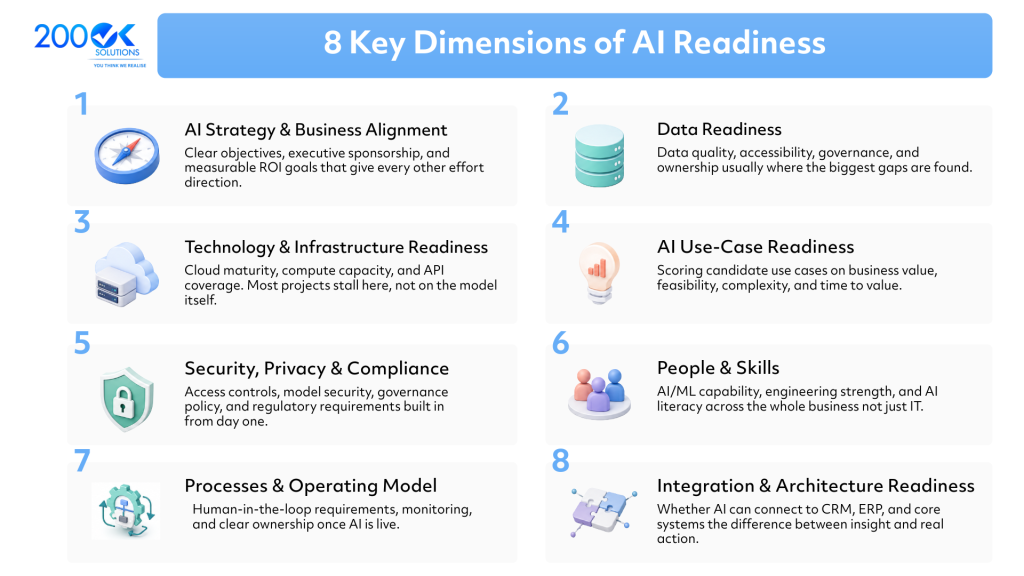
These dimensions form a dependency chain, not independent checkboxes:
AI Strategy → Data + Technology → Security + Governance → People + Processes → Integration → AI Use Cases → Pilot → Scale
Organisations that skip steps, launching use cases before governance exists, or scaling before integration is proven, end up rebuilding what should have been assessed the first time.
AI Readiness Assessment Checklist
Use this AI readiness checklist as a working internal tool for a first-pass AI readiness evaluation, it’s designed for a CTO, CIO, or technology leader to complete directly.
| Assessment Area | What to Check | Ready | Needs Improvement |
| Strategy | Documented business case and accountable sponsor? | ||
| Strategy | Use cases prioritised against business objectives? | ||
| Data | Is core data accurate and consistently maintained? | ||
| Data | Is there a defined data governance and ownership model? | ||
| Technology | Can core systems be accessed via API? | ||
| Technology | Are legacy constraints mapped? | ||
| Use Cases | Have candidates been scored for value and feasibility? | ||
| Security | Are access controls and an AI governance policy defined? | ||
| Security | Have third-party AI vendors been assessed? | ||
| People | Does the team have AI/ML engineering capability? | ||
| Processes | Is human-in-the-loop review defined for high-risk outputs? | ||
| Integration | Can priority use cases connect to CRM/ERP/core systems? |
How to Score Your AI Readiness
Score each of the eight dimensions from 1 (Not Ready) to 5 (AI-Ready), then average them, this stops one strong dimension masking a weak one. The result is a repeatable AI readiness evaluation you can track over time, not a one-off number.
| Average Score | Stage |
| 1.0 – 2.0 | AI Foundation Stage, fix fundamentals before any deployment |
| 2.1 – 3.0 | AI Developing Stage, building blocks exist but need strengthening |
| 3.1 – 4.0 | AI Ready Stage, ready for well-scoped pilots |
| 4.1 – 5.0 | AI Scaling Stage, ready to move proven pilots into production |
Common AI Readiness Gaps
These are the gaps most often found during enterprise AI readiness reviews: poor data quality, legacy applications with no API layer, disconnected CRM/ERP/finance systems, weak or absent governance, uncertainty about third-party AI data handling, unclear post-launch ownership, too many disconnected pilots, no measurable business case, and infrastructure that can’t scale past a proof of concept.
AI Readiness vs AI Maturity Assessment
| AI Readiness Assessment | AI Maturity Assessment | |
| Purpose | Is the organisation prepared to start? | How advanced is existing AI capability? |
| Timing | Before or at the start of adoption | After initiatives are already live |
| Output | Gap list and roadmap | Benchmark against an AI maturity model |
What Happens After the Assessment?
- Identify and consolidate gaps
- Prioritise use cases by value and complexity
- Build a sequenced roadmap
- Close data and infrastructure gaps
- Put security and governance in place
- Run a controlled pilot
- Measure impact against defined ROI metrics
- Scale what works
Together, these eight steps form the backbone of a realistic AI adoption strategy, sequenced by dependency, not enthusiasm.
A Quick Example
A mid-sized financial services firm (800 staff, 12-year-old core policy system) scored 2.75 overall, AI Developing Stage. Data was split across three disconnected systems, the core system had no API layer, and there was no internal AI engineering capability. Priority use case: an AI agent handling first-line policy and claims queries. Before deployment, the firm consolidated customer data, built an API layer over the legacy system, and defined a governance policy, then ran an 8-week pilot measured on resolution time and escalation rate.
Is Your Business Ready for AI?
These seven questions are a fast way of preparing a business for AI investment decisions before commissioning a full assessment:
- Can you name the specific metric your first AI use case should move?
- Is the required data accurate, accessible, and owned by someone?
- Can core systems be accessed programmatically?
- Is there a policy for AI access to sensitive data?
- Does anyone own AI systems once they’re live?
- Have use cases been scored against consistent criteria?
- Could a successful pilot actually scale, or would it need rebuilding?
Mostly yes → start a well-scoped pilot. Mixed, especially on data/integration → fix foundations first. Mostly no → run a full readiness assessment before further investment.
How 200OK Solutions Can Help
200OK Solutions works with technology and business leaders to close the gap between AI ambition and AI-ready infrastructure, assessing business AI readiness across the eight dimensions above before recommending an implementation path. Relevant capability includes AI automation and AI agents, enterprise integrations across CRM, ERP, DMS, HR and finance systems, cloud architecture and platform engineering, application and data modernisation, Microsoft Power Platform, and AWS, Azure and Google Cloud implementation, the practical building blocks of a working AI transformation strategy.
Before investing heavily in AI, assess whether your technology, data, infrastructure and operating model are ready to support it.
FAQ
Q. What is an AI readiness assessment?
A. A structured evaluation of whether an organisation has the strategy, data, infrastructure, governance, security, people, and processes needed to adopt and scale AI successfully.
Q. Why is it important?
A. It identifies gaps before significant budget is committed, reducing the risk of failed or unscalable AI projects.
Q. What does it include?
A. Strategy alignment, data readiness, infrastructure, use-case evaluation, security and compliance, people and skills, process design, and integration.
Q. How do you measure AI readiness?
A. By scoring each dimension 1–5 and averaging to place the organisation into a maturity stage.
Q. What’s the difference between readiness and maturity?
A, Readiness assesses whether you’re prepared to start; maturity measures how advanced existing AI capability already is.
Q. How long does an assessment take?
A. Typically two to six weeks for a mid-sized organisation, depending on scope.
Q. How can a company prepare for AI adoption?
A. Audit data quality and accessibility, map integration capability, define governance, and pick a small number of high-value, feasible use cases.
Q. What are the biggest adoption barriers?
A. Poor data quality, disconnected legacy systems, unclear governance and ownership, limited internal skills, and no measurable business case.
Q. How often should readiness be reassessed?
A. At least annually, or after major system changes, new regulation, or significant new use cases.
You may also like : AI in Healthcare : The 2026 Guide for Health IT Leaders