
AI-native hotel CRM custom architecture is a purpose-built guest management system where machine learning and large language models are embedded into the core data layer not bolted on as a feature, so every guest interaction, booking signal, and operational event is scored, predicted, and acted on in real time across the PMS, booking engine, and communication channels.
What Makes a CRM AI-Native Instead of AI-Enabled?
Vendor decks use these terms interchangeably. They’re not the same, and the difference determines what you can do with the system three years in.
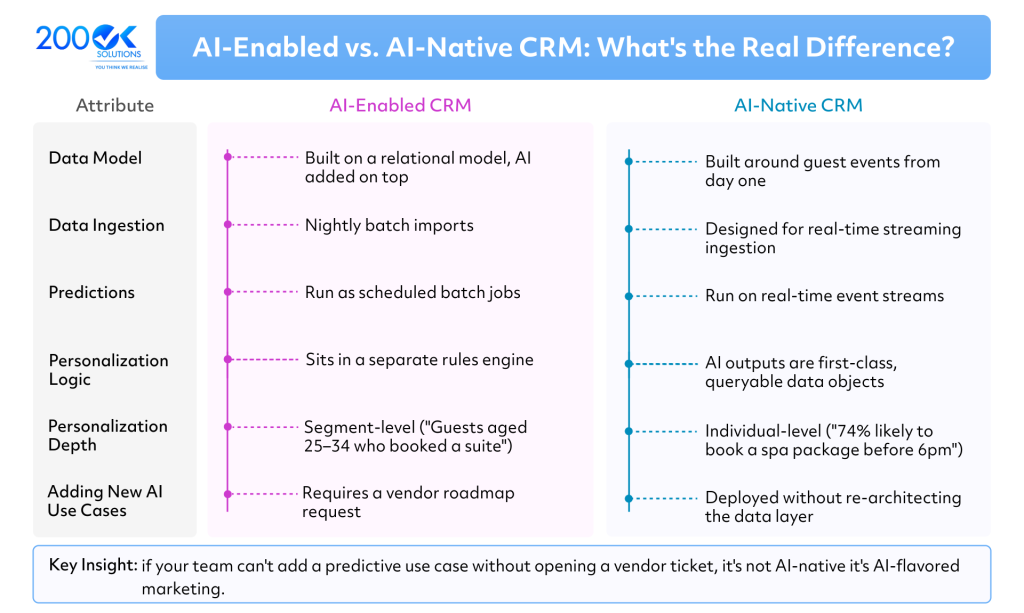
AI-enabled CRM: AI features are added on top of an existing relational data model. Predictions run as scheduled batch jobs. Personalization logic sits in a separate rules engine. Adding a new AI use case means a vendor roadmap request.
AI-native CRM: The data model is built around guest events from day one, designed for streaming ingestion. Predictions run on real-time event streams. AI outputs, propensity scores, next-best-action are first-class, queryable data objects. New models can be trained and deployed without re-architecting the data layer.
The practical test: if your team can’t add a predictive use case without opening a ticket with your CRM vendor, you don’t have an AI-native system, you have a CRM with AI-flavored marketing.
Why Traditional Hotel CRMs Are Becoming Obsolete
Three shifts have outpaced legacy CRM design:
- Guest data is continuous, not periodic. Guests interact through the app, website, WhatsApp, and in-property POS, often within one stay. A CRM built on nightly batch imports shows you where the guest was yesterday, not what they’re doing now.
- Personalization has moved from segment-level to individual-level. “Guests aged 25–34 who booked a suite” is a segment. “This guest is 74% likely to book a spa package if offered before 6pm” is a prediction and traditional rules engines can’t do it.
- Multi-property, multi-PMS portfolios have outgrown single-tenant CRM design. Groups running Oracle OPERA at some properties and Mews or Cloudbeds at others need a CRM that wasn’t built around one vendor’s data model. This is usually the point where custom architecture becomes cheaper than another SaaS subscription over five years.
Core Components of the Architecture
- Customer Data Platform (CDP) : resolves guest identity across channels into one golden record.
- Booking engine and PMS integration : real-time, not batch, sync of reservation and stay data.
- CRM layer : profile management, communication history, the interface staff use.
- AI recommendation engine : scores guests against offers, ranked by predicted relevance.
- Guest profile intelligence : derived attributes like lifetime value tier and price sensitivity.
- Real-time event streaming (typically Kafka) : carries guest events to every service that needs them.
- API gateway ; the governed entry point enforcing auth, rate limits, versioning.
- Identity management, loyalty engine, workflow automation, revenue intelligence : operational layers consuming the same event stream.
- Data warehouse and analytics layer : historical storage for model training, kept separate from the low-latency operational store.
How the Pieces Connect
Guest touchpoints (website, app, voice) generate events that flow through the API gateway into the event streaming layer, alongside operational events from the PMS, POS, and booking engine. Data updates the CRM core and simultaneously feeds AI models, which score each event against the guest’s history. Recommendations flow back out to guest-facing channels and staff tools. Everything writes to both the operational store (real-time personalization) and the data warehouse (analytics, model retraining), running on AWS, Azure, or Google Cloud with managed Kubernetes.
AI Capabilities
Predictive guest preferences, upselling and cross-selling, dynamic offers, sentiment analysis, guest segmentation, churn prediction, occupancy forecasting, revenue optimization, personalized messaging, smart concierge, voice AI, and AI agents that execute multi-step tasks rather than just generating recommendations for a human.
Most of these exist in AI-enabled SaaS CRMs too. What AI-native architecture adds is the ability to compose new capabilities from the same infrastructure, instead of buying a new module for each one.
Key Integrations
- PMS: Oracle OPERA, Cloudbeds, Mews, Stayntouch, Protel, each with different API maturity, which is usually the largest cost driver in a custom build.
- CRM/sales: Salesforce, HubSpot, Microsoft Dynamics.
- Payments: Stripe.
- Messaging: Twilio, WhatsApp Business API.
- Analytics: Power BI, Snowflake.
- Cloud: AWS, Azure, Google Cloud.
Buy vs. Build
| Factor | SaaS | Custom |
| Time to deploy | Faster | Slower |
| Customization ceiling | Limited to vendor roadmap | Unlimited |
| Multi-PMS portfolio fit | Often needs workarounds | Designed for it |
| 5-year cost at scale | Often higher (per-property licensing) | Typically lower |
| Best fit | Single property, small groups | Multi-property enterprise |
Security and Compliance
GDPR governs consent and guest data rights for any group with European guests, treat it as an architecture requirement, not a pre-launch audit item.
PCI DSS applies wherever the system touches card data; tokenizing payments reduces audit scope. Regional regimes like CCPA and country-specific data localization rules also apply depending on where guests and properties are based. HIPAA does not apply to hotel CRM unless the property operates an on-site medical facility.
Implementation Timeline
- Discovery and data architecture: 6–10 weeks
- Core platform build: 4–6 months
- AI capability rollout: 3–5 months, often overlapping with the build phase, starting with one or two use cases
- Portfolio expansion: ongoing
For a mid-size group (10–30 properties, 2–3 PMS vendors), realistic timeline to first production use case is 9–14 months. Anyone promising a full enterprise AI-native CRM in under six months is describing SaaS configuration, not custom architecture.
Cost Drivers
PMS integration maturity, number of properties in initial scope, breadth of AI capability at launch, data migration effort, and team composition (in-house vs. outsourced). Request a phased cost breakdown, not a lump sum.
Common Mistakes and Best Practices
The recurring failure is treating AI as a feature to add later instead of a factor in the initial data architecture, this forces a rebuild once real use cases get prioritized. Close behind: integrating PMS at the reporting layer instead of the transactional layer, launching too many AI use cases before production data validates accuracy, and underestimating identity resolution across systems that were never built to share a guest ID.
The fix: design the unified guest data model before selecting AI tooling, start with one or two measurable use cases, treat GDPR and PCI DSS as architecture requirements from day one, and involve front desk and revenue teams in the design phase, adoption failure is usually a design failure, not a training failure.
Future Trends
Agentic AI moving from recommendation to autonomous execution within defined guardrails. Voice interfaces becoming a primary guest touchpoint. Tighter integration between CRM and revenue management. The Model Context Protocol (MCP) standardizing how AI agents connect to hotel systems, and increased regulatory scrutiny on AI-driven personalization, particularly in the EU.
Bottom line: the technical risk in these builds is almost never the AI models, it’s PMS integration complexity and guest identity resolution. Budget and timeline accordingly, and start with one or two AI use cases you can validate with real data before expanding scope.
You may also like : MCP Servers for Enterprise: A Practical Build Guide (2026)