
Introduction
Every day, businesses receive thousands of support tickets, reviews, and survey responses. Hidden in that feedback are valuable insights about customer satisfaction, recurring issues, and opportunities for improvement.
Reading a few comments manually is easy; analyzing tens of thousands is not. At that scale, teams can miss patterns, make inconsistent judgments, or simply run out of time.
This is where AI sentiment analysis helps. It analyzes unstructured text and estimates whether the sentiment is positive, negative, or neutral, helping teams identify where their attention is needed most.
However, sentiment analysis is not a substitute for human judgment. It works best as a decision-support tool, a first pass that surfaces trends and highlights feedback worth investigating further. Understanding this distinction is essential to using AI sentiment analysis effectively and responsibly.
What Sentiment Analysis Actually Measures
- Sentiment analysis classifies text into categories such as positive, negative, or neutral, and some systems also recognize mixed sentiment.
- Modern AI models determine sentiment by analyzing patterns in language, tone, and context learned from vast amounts of text data.
- These models do not measure emotions directly; they estimate the most likely sentiment based on patterns they have encountered before.
- Context is critical phrases like “not bad” and “bad” contain similar words but convey very different meanings.
- Sentiment is ultimately an interpretation, not an objective fact, so AI provides consistency at scale but cannot guarantee perfect correctness.
Why Sentiment Labels Are Not Enough
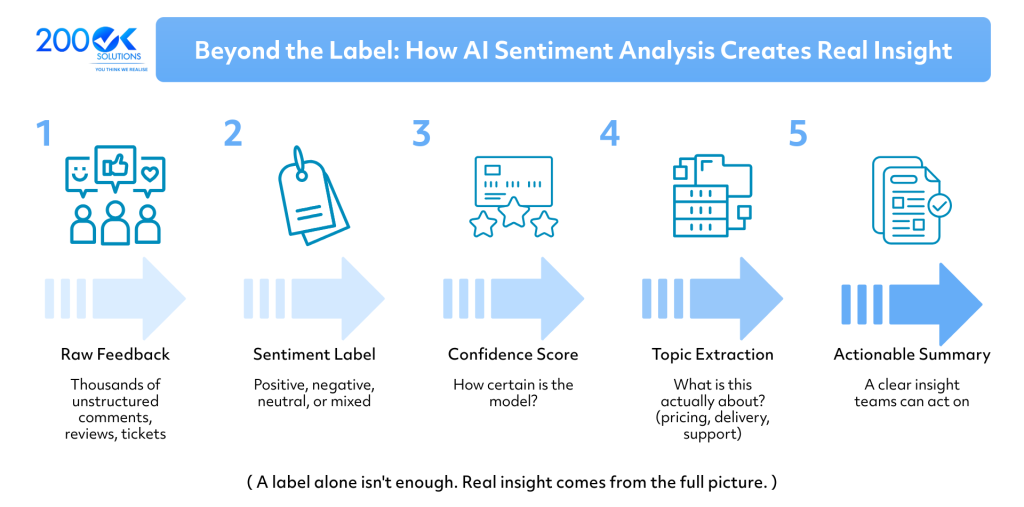
- A sentiment label alone provides limited value because it doesn’t explain what the customer is happy or unhappy about.
- Confidence scores add important context, helping distinguish between uncertain predictions and highly confident classifications.
- Topic extraction identifies recurring themes, such as pricing, delivery, or support-making large volumes of feedback easier to understand and prioritize.
- Short summaries turn lengthy comments into quick, actionable insights, transforming a simple sentiment label into a meaningful feedback briefing.
Where AI Sentiment Analysis Works Well
- Sentiment analysis excels at identifying large-scale patterns, prioritizing negative feedback, and tracking how customer sentiment changes over time.
- By grouping recurring topics and surfacing key issues, it gives support and product teams a meaningful starting point instead of asking them to sift through thousands of comments manually.
Where It Struggles
- Sentiment analysis struggles with sarcasm, irony, and mixed emotions because these often depend on tone and context that text alone cannot fully convey.
- Cultural differences and domain-specific language can lead to misinterpretations, as words and expressions may carry different meanings across communities and regions.
- Model confidence should not be confused with accuracy a highly confident prediction can still be wrong, especially when conversational context is missing or training biases influence the result.
Responsible Real-World Use
- Sentiment analysis should support human decision-making, not replace it. High impact actions involving employees or customers should always include human review, especially when decisions are based on uncertain or low-confidence predictions.
- Responsible use requires protecting customer privacy, testing with real-world data, and continuously monitoring errors, bias, costs, and model changes. Ambiguous or low-confidence cases should be flagged for manual review rather than accepted at face value.
Implementation
- For implementation, look for the attached document.
Conclusion
AI sentiment analysis is genuinely useful for organizations trying to make sense of feedback at scale. It surfaces patterns, prioritizes urgent issues, and tracks change over time in ways manual review simply can’t match for volume. But it is a signal, not a verdict, a starting point for investigation, not the final word on what a customer meant or felt.
AI sentiment analysis becomes genuinely useful when we treat its output as evidence to investigate, not as a final verdict.
You may also like: Building AI-Powered Laravel Apps with Prism PHP