
Here is a gap worth noticing. In Kaseya’s 2026 State of the MSP report, 48% of providers named AI and automation as the top client need, yet only 13% earn meaningful revenue from it. At the same time, the share struggling to hire skilled technicians rose from 9% to 16% in a year. Clients want more, and your team cannot grow fast enough to deliver it.
A managed service provider business can close that gap without a bigger payroll. The path is automation first, then outsourcing and partnerships for coverage. This guide walks through each step and ends with a 90-day plan.
Why Hiring Alone Cannot Keep Up
A new technician brings salary, tools, and training months before a new service earns its first invoice. The service is also unproven, so you are betting payroll on an assumption. Most managed service provider business models depend on steady recurring margin, and early payroll cuts straight into it.
Capacity that scales up and down is safer. The steps below add capacity in ways that track the contracts you have actually signed.
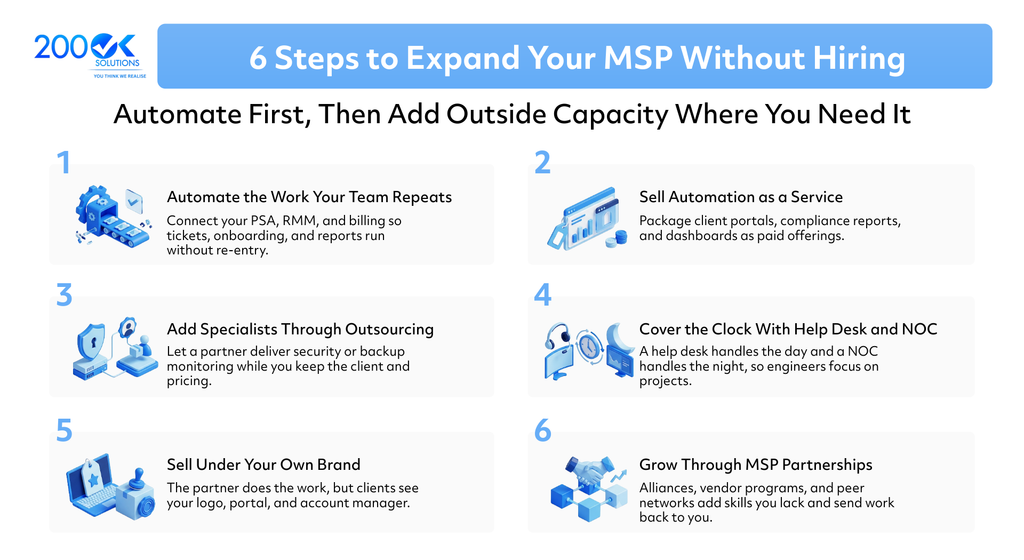
Step 1: Automate the Work Your Team Repeats
Automation is the cheapest capacity you will ever add. The same Kaseya report found that 53% of providers already use AI to automate ticketing, patching, and monitoring, and they report faster first responses and less burnout.
Most providers still lose hours every week to tasks software could handle: onboarding users, turning alerts into tickets, building monthly reports, and chasing invoices. Off-the-shelf tools rarely match how your business actually runs, which is where custom software helps. A tailored integration can connect your PSA, RMM, billing system, and client portal so data flows without re-entry. Common builds include:
- Ticket creation and routing based on alert severity
- Self-service client portals for requests, approvals, and reports
- Onboarding workflows that set up accounts and licenses in minutes
- Dashboards showing profit per client and per service
The math is simple. If automation saves each of eight technicians ten hours a month, you gain the capacity of two engineers without a salary. At 200OK Solutions, we build bespoke software for exactly this kind of problem, designed around how your team already works rather than a packaged product.
An illustrative example: a provider whose technicians create around 30 tickets by hand each day from monitoring alerts could route them automatically by severity and client. The team stops copying data between systems, response times drop, and the saved hours go to billable project work. Your numbers will differ, but the pattern holds.
Step 2: Turn Automation Into a Service You Sell
Remember the 13% figure. Most providers use automation internally but never package it. You can do better by selling what you built: a client portal, automated compliance reporting, or a monthly dashboard that proves your value. Each one adds revenue from work your team already performs, which is the purest way for a managed service provider business to grow without hiring.
Step 3: Add Specialists Through Outsourced Managed Services
Some work needs deep skills or constant coverage, such as security operations or backup monitoring. Outsourced managed services let a specialist team deliver it while you keep the client relationship, contract, and pricing.
Here is an illustrative example. If a partner charges $6 per endpoint each month and you sell the service at $12, then 500 endpoints under this model produce $3,000 in monthly gross margin with no new salary. These figures are examples, so use your own pricing.
Check four things when choosing a partner: response times that match your client promises, documented ticket handoff, pricing that survives your markup, and security practices that meet client standards.
Step 4: Cover the Clock With Help Desk and NOC Support
Coverage is where growth hurts. An MSP outsourced help desk answers calls, chats, and emails, fixes common issues, and escalates anything complex to your engineers. When you sign a client with 80 users, the arrangement simply extends instead of forcing a rushed hire.
Overnight monitoring is the offer most small providers avoid. MSP NOC services handle alert triage, patch windows, and first-line remediation, so your engineers only see incidents that need judgment.
Both models depend on clear scope. With either model, decide in writing who owns each alert type, who speaks to the client, and when to escalate. Good runbooks make outsourcing work; vague ones make it painful.
Together they form a simple model: an MSP outsourced help desk handles the day, MSP NOC services handle the night, and your engineers handle projects and client strategy.
Step 5: Sell Under Your Own Brand With White Label Managed Services
White label managed services go one step further. The partner delivers the work, but clients see your logo, your portal, and your account manager. This is how a five-person company can offer a service desk, a NOC, and security operations.
Follow four rules:
- Own the relationship by joining client calls
- Set partner service levels stricter than the ones you promise
- Document every process so you are never locked in to one vendor
- Review performance monthly using real ticket data
Step 6: Grow Through MSP Partnerships
Some capabilities do not need to be bought at all. MSP partnerships give you access to skills you lack, and often send work back your way. Useful forms include specialist alliances for compliance or cloud migration, vendor programs with training and referral income, and peer networks of non-competing providers.
Strong partnerships also improve your sales, because a partner who vouches for you opens doors that cold outreach cannot. Treat them as a growth channel, not only a way to fill a technical gap.
Security: The Difference Between MSSP and MSP
Clients ask about security constantly, and Kaseya’s survey ranks it among the top client needs after automation. It helps to understand the difference between MSSP and MSP. A traditional MSP manages infrastructure, devices, and user support, while a managed security service provider specializes in threat detection and response.
You do not need to become an MSSP. Partner with one, resell its service, and present a combined package. Knowing where MSP and MSSP offerings overlap helps you price correctly and set honest expectations.
Is Outsourcing Just Hiring in Disguise?
Fair question. Outsourcing still costs money, but it differs in three ways. There is no recruiting or training lag, the cost scales with contracts, and you can switch providers if quality drops. That is why it suits a growing MSP better than payroll, as long as automation has already removed the repetitive work.
A 90-Day Plan
- Days 1 to 30: Track where technicians spend time for two weeks, then automate ticket routing, onboarding, and reporting.
- Days 31 to 60: Add an MSP outsourced help desk if tier-one volume crowds out project work, or MSP NOC services if you want 24/7 coverage.
- Days 61 to 90: Launch one new service through white label managed services or outsourced managed services, and open two partnerships that cover your weakest areas.
Test each offer with a few friendly clients first, and price it so margin holds after your partner’s fee.
Mistakes to Avoid
- Reselling what you cannot support. If a partner fails, the client blames you, so keep enough knowledge to step in.
- Weak contracts. Your agreements for outsourced managed services should match the commitments you make to clients.
- Skipping vetting. Every partner touching client systems becomes part of your risk, so vet outside providers like a new employee.
- Launching too much at once. Add one service at a time, whether it is a white label offer or a new automation.
- Outsourcing before automating. Fix repetitive work first, so you pay outside teams only for tasks that need people.
Quick Answers
Q. What is MSP outsourcing?
A. MSP outsourcing means handing part of your delivery, such as the help desk or monitoring, to a specialist team while you keep the client relationship.
Q. Are white label managed services the same as reselling?
A. Not quite. White label managed services are delivered under your brand, while reselling usually leaves the vendor’s name visible.
Q. Which comes first, an MSP outsourced help desk or MSP NOC services?
A. Start where senior staff lose the most time. Ticket overload points to the help desk, while monitoring gaps point to the NOC.
Q. Does the difference between MSSP and MSP affect pricing?
A. Yes. Security operations carry higher costs and higher margins, so price them separately.
Q. Do outsourced managed services hurt margins?
A. Not if you price in the partner’s fee and keep automation working for you.
Q. Can MSP partnerships replace hiring?
A. They fill specific skill gaps and work best alongside automation.
Final Thoughts
Automation, outsourcing, and smart partnerships let a managed service provider business offer a bigger menu without a bigger payroll. Start with the work your team repeats, then add outside capacity where you need it. If you want to build the systems that make this growth possible, talk to 200OK Solutions. We design custom software that helps providers scale without adding headcount.
You may also like : MSP Shared Responsibility Matrix