
Search “hotel management software” today and you’ll land on the same handful of review sites, HotelTechReport, Capterra, Software Advice, Cloudbeds, ranking the same dozen vendors against each other. That’s useful if you’re a single-property owner shopping for a subscription. It’s close to useless if you’re a hospitality technology leader or multi-property group asking a harder question: buy an off-the-shelf platform, integrate and modernize what you already run, or build something custom?
That decision not “which vendor has the best reviews”, determines whether your technology stack scales with your portfolio or quietly becomes the thing holding it back. This guide lays out a practical framework for making that call in 2026, along with a real case study from over a decade of hands-on platform work in the space.
What “hotel management software” actually covers in 2026
“Hotel management software” has become a catch-all term, and that vagueness is part of why buying decisions go wrong. Before deciding how to acquire a system, you need to be precise about what you’re acquiring, the category now spans property management, distribution, and demand-side tools that used to be sold, and evaluated, separately.
PMS vs. channel manager vs. booking engine vs. revenue management, where the lines blur
A property management system (PMS) is the operational core: reservations, housekeeping, folios, guest profiles. A channel manager pushes inventory and rates to OTAs and GDS partners. A booking engine captures direct reservations on the property’s own site. A revenue management layer sets pricing based on demand signals.
In 2026, most vendors bundle several of these under one “hotel management platform” label, making apples-to-apples comparison difficult. A property comparing a standalone PMS to a bundled suite isn’t comparing like for like, it’s comparing a component to a stack. Before evaluating any hotel operating system, map out exactly which of these four functions you’re solving for, and which you already own and don’t want to replace. That mapping alone reframes the buy/build/integrate question in the terms that actually matter: not “which platform,” but “which functions need to change.”
The real decision hospitality groups face: buy, build, or integrate
Once the scope is clear, three paths remain, each fitting a different kind of organization.
| Buy (off-the-shelf PMS) | Integrate / modernize | Build (custom) | |
| Best fit | Single properties or small groups with standard operating models | Established groups with a working system that’s aging or fragmented | Multi-brand portfolios or unique operating models generic PMS can’t express |
| Time to value | Fast, weeks to months | Moderate, phased rollout | Slow, full product buildout |
| Total cost of ownership | Predictable, but scales with property count | Depends on existing integration debt | Highest upfront, lowest per-property drag at scale |
| Flexibility | Limited to vendor roadmap | High, you control the connective layer | Full control |
| Risk | Vendor lock-in, feature ceiling | Requires integration discipline | Execution and maintenance risk on you |
When an off-the-shelf PMS is the right call
If you’re operating a small number of properties with reasonably standard workflows, a mature hospitality management software subscription is almost always the right answer. The economics of custom development don’t make sense until property volume or operational complexity justifies the build cost. Buying gets you a supported, continuously updated system without carrying engineering overhead you don’t need yet.
When integration/modernization of an existing system beats a rip-and-replace
Most established hospitality groups aren’t starting from zero, they have a PMS already, plus a channel manager, a booking engine, and point solutions bolted on over the years. A full rip-and-replace is expensive and disruptive to front-desk operations, and often unnecessary. What actually needs solving is usually the connective tissue: the APIs and data flows that have accumulated technical debt as the portfolio grew. Modernizing that layer, rather than replacing the systems it connects, frequently delivers more value per dollar than a full migration, with far less operational risk.
When custom development makes sense (multi-brand portfolios, unique operating models)
Custom development earns its cost when an organization’s operating model doesn’t fit what commercial PMS vendors build for: multi-brand portfolios with different service models per brand, proprietary loyalty or distribution logic, or transaction volume beyond what a generic system was architected for. The bar is high, custom development only pays off when forcing a unique business into a generic system costs more in workarounds and lost differentiation than the build itself.
Case study: 12+ years modernizing a global hospitality platform
Frameworks are easier to trust when they’re grounded in a real, sustained engagement rather than a hypothetical. 200OK Solutions has spent more than 12 years as a direct technology partner across TravelTripper, Pegasus, and Cendyn, three names for what has, through consolidation, become one of the hospitality industry’s central booking and revenue technology platforms.
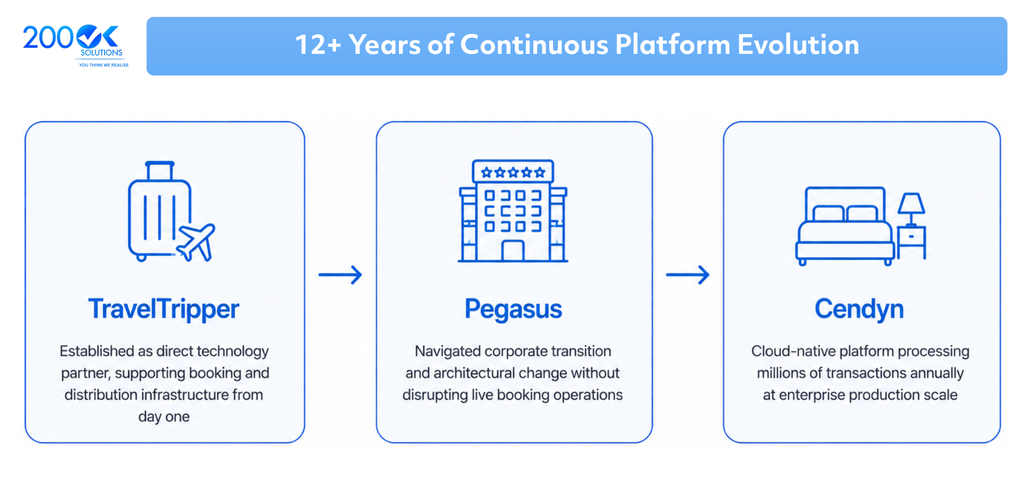
From TravelTripper to Pegasus & Cendyn, evolving through three corporate transitions
Corporate transitions, acquisitions, rebrands, platform consolidations are exactly the moments where hospitality technology stacks tend to break or accumulate integration debt. Supporting the same platform continuously through TravelTripper’s operation, its transition into Pegasus, and its subsequent integration under Cendyn meant navigating repeated architectural and organizational change without disrupting the booking and distribution infrastructure hotel groups depended on in production. That continuity, rather than a single point-in-time project is the part of this relationship hardest for a competitor to replicate, and the clearest evidence of what sustained modernization work looks like in this industry.
Supporting a cloud-native architecture processing millions of transactions annually
The technical scope has spanned cloud-native infrastructure supporting a platform that processes millions of booking and distribution transactions annually, well above what a standard off-the-shelf PMS deployment needs to handle. That scale is instructive for the framework above: it’s precisely the volume threshold where integration and modernization work, done over years rather than as a single migration event, outperforms both a generic buy and a one-time custom build.
A practical evaluation framework for hospitality technology leaders
Whichever path a property or portfolio leans toward, the same three questions should shape the decision.
Total cost of ownership over 5+ years
Sticker price and monthly subscription fees are the least useful numbers here. What matters is the five-year total: per-property licensing that scales with portfolio growth, integration and customization costs, staff training, and the cost of eventually migrating off a system that no longer fits. A build or modernization path often looks more expensive in year one and cheaper by year four; a buy path is usually the reverse.
Integration debt and data silos
Every additional point solution, a separate channel manager, a bolted-on revenue tool, a legacy booking engine nobody wants to touch, adds integration debt, which shows up as data silos: guest profiles, rate data, and reservation records that don’t reconcile cleanly across systems. Audit how much of this debt already exists before choosing a path. A clean environment can often justify a straightforward buy; a fragmented one usually needs integration work regardless of which PMS sits at the center.
Scalability across a growing property portfolio
A system that works well for five properties can become a liability at fifty. Evaluate how each option buy, integrate, or build, behaves as property count, transaction volume, and brand complexity grow. This is where cloud-native architecture and API-first design matter more than feature checklists: a platform that scales horizontally avoids the forced re-platforming that hits many hospitality groups mid-growth.
How 200OK Solutions helps hospitality groups get this right
Hospitality technology leaders don’t need another vendor comparison chart, they need a partner who has lived through the buy/build/integrate decision at scale, across corporate transitions, at production transaction volumes most PMS deployments never approach. That’s the work 200OK Solutions has done continuously for over 12 years across the TravelTripper, Pegasus, and Cendyn platform lineage, and it’s the same discipline applied to every hospitality group’s platform engineering and enterprise integration work today. If your organization is weighing this decision, that experience, not a generic vendor recommendation is the starting point worth bringing to the table.
FAQ
Q. What’s the difference between a hotel PMS and hotel management software?
A. A hotel PMS is one component, the system handling reservations, housekeeping, and guest folios. “Hotel management software” is the broader, often-bundled category that can also include channel management, booking engines, and revenue management. Knowing which one you need to replace comes before comparing vendors.
Q. Is it cheaper to buy a PMS or build a custom hotel operating system?
A. Buying is cheaper upfront and faster, fitting most single properties and small groups. Custom builds cost more initially but can be cheaper over 5+ years for large, complex portfolios once per-property licensing fees are factored in. The right comparison is total cost of ownership, not sticker price.
Q. When should a hospitality group integrate instead of replacing its PMS?
A. Integration usually beats a rip-and-replace when the core PMS still works but is surrounded by disconnected point solutions, a separate channel manager, booking engine, or legacy tools that don’t share data cleanly. Modernizing that layer often resolves the actual pain at a fraction of a full migration’s cost and disruption.
Q. What size hotel portfolio justifies custom hotel management software development?
A. Custom development tends to fit multi-brand portfolios, proprietary loyalty or distribution logic, or transaction volumes that outgrow commercial PMS platforms, not a specific property count on its own. If a generic system requires constant workarounds, that’s the stronger signal than size alone.
Q. How does 200OK Solutions help with hotel PMS integration and modernization?
A. 200OK Solutions has served as a direct technology partner across the TravelTripper, Pegasus, and Cendyn platform lineage for over 12 years, supporting cloud-native architecture processing millions of transactions annually through multiple corporate transitions, experience that applies directly to other hospitality groups facing the same buy, build, or integrate decision.
You may also like : AI in Travel Booking: How Automation Is Reshaping Flights and Hospitality