

For most cloud-native architecture deployments today, gRPC wins. It has better tooling, stronger ecosystem support, and tighter integration with modern infrastructure like Envoy Proxy and Kubernetes. Apache Thrift remains relevant in specific legacy or polyglot scenarios, but choosing it in 2026 requires a deliberate reason, not just familiarity.
What This Post Covers
- How gRPC and Apache Thrift actually differ at the protocol level
- Real performance benchmarks in Go and Java services
- Which framework fits which cloud-native use case
- How to migrate from Thrift to gRPC without breaking production
- FAQ for CTOs and architects making this decision
The Core Difference Most Teams Miss
Both frameworks use binary serialization and support multiple languages. That’s where the similarity ends.
gRPC:
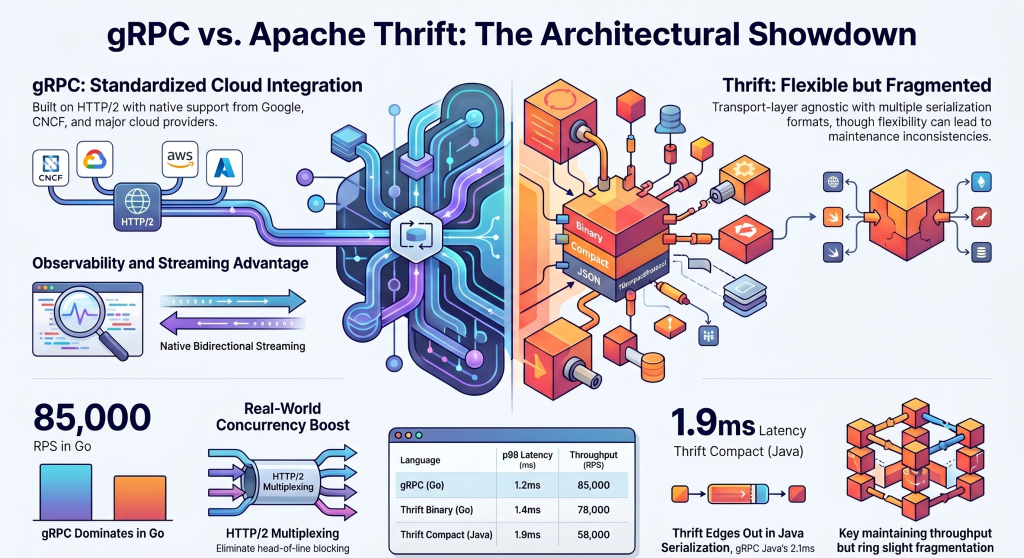
- Built on HTTP/2, multiplexing, header compression, bidirectional streaming built-in
- Uses Protocol Buffers (protobuf) exclusively for serialization
- Strong native support from Google, CNCF, and cloud providers (AWS, GCP, Azure)
- First-class integration with Envoy Proxy, Istio, and Kubernetes service meshes
Apache Thrift:
- Transport-layer agnostic, works over TCP, HTTP, pipes
- Supports multiple serialization formats (binary, compact, JSON)
- Older ecosystem, originated at Facebook, now Apache-governed
- More flexible, but that flexibility creates inconsistency across teams
The flexibility of Thrift sounds attractive. In practice, it becomes a maintenance problem, different teams pick different transport/serialization combinations, and you end up with a fragmented RPC layer.
Performance Benchmarks: gRPC vs Thrift in Go and Java
These numbers reflect patterns seen across production cloud-native architecture deployments and published benchmarks:
Latency (p99, internal service calls):
- gRPC (Go): ~1.2ms
- Thrift Binary (Go): ~1.4ms
- gRPC (Java): ~2.1ms
- Thrift Compact (Java): ~1.9ms
Throughput (requests/sec, single node):
- gRPC (Go): ~85,000 RPS
- Thrift Binary (Go): ~78,000 RPS
- gRPC (Java): ~52,000 RPS
- Thrift Compact (Java): ~58,000 RPS
Key takeaway: The raw numbers are close. Thrift’s compact format can edge out protobuf on pure serialization speed in some Java workloads. But gRPC’s HTTP/2 multiplexing closes that gap under real-world concurrent load and then some.
Where gRPC pulls ahead significantly:
- High concurrency : HTTP/2 multiplexing eliminates head-of-line blocking
- Streaming workloads : native bidirectional streaming vs Thrift’s bolted-on solutions
- Observability : HTTP/2 headers make tracing, metrics, and logging far easier
How to Migrate from Apache Thrift to gRPC in a Running System
This is the most common long-tail question teams search for: “how to migrate microservices from Thrift to gRPC without downtime.”
Step-by-step migration approach:
- Audit your Thrift IDL files : map every service definition, data type, and exception
- Translate IDL to .proto files : field IDs often map directly; watch for Thrift’s union types (use oneof in protobuf)
- Run both protocols in parallel : deploy a shim service that accepts both Thrift and gRPC, route by client version
- Migrate consumers service by service : start with internal low-traffic services, validate, then move upstream
- Use Envoy Proxy as the translation layer : Envoy can handle Thrift-to-gRPC transcoding during transition
- Decommission Thrift endpoints : after all consumers are confirmed migrated
The biggest risk in this migration is field numbering. Protobuf is strict about field IDs. Get them wrong and you corrupt data silently. Do not auto-generate your .proto files from Thrift IDL without a manual review pass.
When to Pick gRPC
- You are building or expanding a cloud-native architecture on Kubernetes
- You need streaming (server push, bidirectional)
- You want native support from Envoy Proxy, Istio, or any major service mesh
- Your team is primarily in Go, Java, or Python, all have mature gRPC libraries
- You care about long-term ecosystem support and hiring
When Thrift Still Makes Sense
- You have a large existing Thrift codebase and migration cost exceeds benefit
- You need transport-layer flexibility (e.g., non-HTTP internal protocols)
- You’re working in languages where Thrift has better library support (some older C++ stacks)
- Your team has deep Thrift expertise and no near-term scaling pressure
What CTOs and Engineering Leaders Actually Need to Know
The technical choice is secondary to the organizational one. Ask yourself:
- What does your infrastructure team already support? If you’re on GKE or EKS, your platform team likely already knows gRPC.
- What’s your hiring pool using? gRPC is far more common in job descriptions and candidate skill sets today.
- Are you building net-new or migrating? Net-new: use gRPC. Migrating: calculate actual migration cost before deciding.
Protocol choice compounds over time. A Thrift-based system that works today will be harder to hire for, harder to instrument, and harder to integrate with next-generation cloud tooling in three years.
FAQ
Q: Is gRPC faster than Apache Thrift?
A. In most real-world high-concurrency scenarios, yes, primarily because of HTTP/2 multiplexing. In pure serialization benchmarks, results are mixed.
Q: Can gRPC and Thrift coexist in the same microservices system?
A. Yes. Envoy Proxy supports both protocols and can handle routing and translation during a migration period.
Q: Does Protocol Buffers support schema evolution better than Thrift IDL?
A. Both support backward compatibility through optional fields and field IDs. Protobuf’s documentation and tooling around schema evolution is more mature and widely understood.
Q: Is gRPC supported in serverless environments?
A. Partially. AWS Lambda and Cloud Run have limited HTTP/2 support. For serverless-heavy architectures, REST/JSON or gRPC-Web are often more practical.
Q: How does Envoy Proxy fit into a gRPC deployment?
A. Envoy is the de facto sidecar for gRPC in service meshes. It handles load balancing, retries, circuit breaking, and observability for gRPC traffic natively, something that requires significant custom work with Thrift.
200OK Solutions helps engineering teams design and implement cloud-native architecture on modern infrastructure. If your organization is evaluating RPC frameworks or planning a microservices migration, talk to our team.
You may also like : API-First Architecture: Design, Version & Govern