
Most growing companies don’t have a data problem in the abstract. They have four reports that disagree, a CRM the sales team has quietly stopped trusting, and a spreadsheet that one person maintains and nobody else understands.
The usual reaction is to buy a dashboard tool or an AI product. That upgrades the presentation layer while the foundation stays broken. The numbers are still wrong, just wrong faster and in better fonts. The real fix sits underneath, and it’s called data engineering.
This guide explains what data engineering is, how it turns scattered data into business intelligence, and how a growing company can approach it without overbuilding.
What Is Data Engineering?
Data engineering is the work of building the systems that collect, move, store and clean your data so people can rely on it. Analytics answers questions, while data engineering makes sure the data behind those answers is complete, consistent and traceable.
It’s less visible than a dashboard, and it’s rarely what anyone wants to buy. But it almost always decides whether everything above it works. Dashboards built on a weak foundation produce confident answers that happen to be wrong. That’s why data engineering is a business foundation problem, not an IT project.
Signs You Need Data Engineering
Most organisations reach this point for one of a handful of reasons:
- Reporting nobody trusts : The numbers disagree and no one can trace why.
- A single point of failure : One person prepares the same data by hand every week, and the process leaves when they do.
- Ticket-driven analysis : Analysts can’t answer their own questions without raising a request.
- Rising cloud costs : Your data bill grows faster than the value you get from it.
- A system reaching end of life : An ERP or CRM replacement is already committed.
- A stalled AI or analytics project : The data won’t support what you’re trying to do.
These are symptoms, not specifications. A good data engineering partner starts by working out which part of the foundation is actually causing the problem.
The Six Pillars of Data Engineering
Data engineering covers six connected areas. Most projects start in one and expand as the foundation improves.
1. Data Strategy and Architecture
Before anything is built, you need a map of what data exists, where it lives and how it should be structured and related. The aim is an architecture that matches how your business actually operates, not a generic diagram from a vendor deck.
2. Data Integration and Pipelines
Data integration means getting data out of source systems such as applications, databases, APIs, SaaS platforms and files, and bringing it together. Data pipelines then move it automatically.
If you’re wondering what ETL is, it stands for extract, transform, load: pull data from the source, clean and reshape it, then load it where it’s needed. ELT does the same in a different order. Whichever you choose, a good pipeline has orchestration, error handling, testing and monitoring built in from the start. Skipping that is how teams end up adding yet another point-to-point connection to a growing pile.
3. Data Platforms and Warehousing
This is where cleaned data lives. Data warehousing, whether in a warehouse, lake or lakehouse, should be designed around how the data will actually be used (more on choosing below).
4. Data Modernisation and Migration
Legacy databases, CRMs, ERPs and file systems eventually have to move. A safe migration agrees reconciliation rules before a single record moves, uses a phased cutover and keeps a rollback option at every checkpoint.
5. Data Quality and Governance
Validation, cleansing, deduplication and reconciliation rules, with automated monitoring so the system catches issues rather than a person reading a report. Lineage and metadata mean any number can be traced back to its source.
6. Analytics and AI Readiness
Business intelligence, machine learning and generative AI all depend on curated, trustworthy datasets. Sometimes the honest answer is that your data can’t yet support the use case you have in mind, and finding that out early saves a lot of money.
Data Warehouse, Data Lake or Lakehouse?
The data lake vs data warehouse question is the decision companies most often get wrong, usually by buying the most capable option rather than the right one.
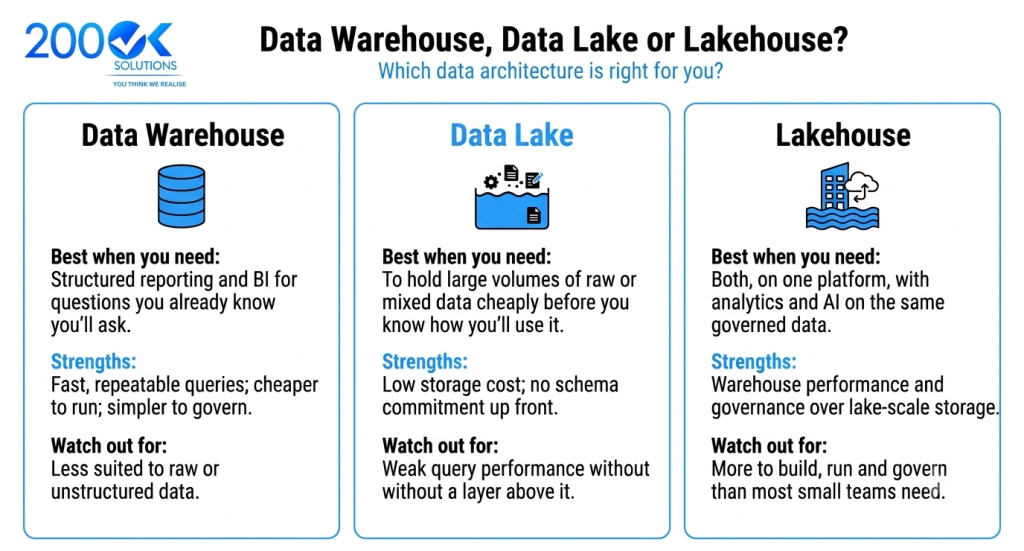
For many growing companies, a cloud data warehouse is the right starting point. Lakehouse platforms such as Databricks make sense where the workload justifies one, and that includes AI-heavy use cases. A good data engineering partner will tell you honestly if your volumes don’t justify the larger option, because a warehouse costs less to build, run and govern.
From Scattered Data to Business Intelligence
Business intelligence is what leaders actually want: reliable dashboards and reports that help them decide what to do next. Here’s how data engineering gets you there:
- Sources : your CRM, accounting, marketing, product and operations systems hold the raw data.
- Integration and pipelines : automated data pipelines extract, clean and combine it.
- Platform : a warehouse or lakehouse stores one validated source of truth.
- Governance : quality rules, lineage and access controls keep it trustworthy.
- BI layer: tools such as Power BI present the results.
The most common mistake is skipping steps two to four, connecting a BI tool straight to a dozen systems and then wondering why the numbers don’t match. Data engineering is what makes the dashboard worth trusting.
A Practical Approach: Prototype, Assess, Design, Build
Growing companies don’t need a huge programme to get value. A staged approach keeps risk and cost visible.
Prototype (days to two weeks, optional) : Before committing to a platform, build a working prototype of your highest-value use case on free tooling, using a sample of your real data. You get your own data in the target shape, plus an evidence-based answer on whether the platform you were considering is the right one.
Assess (two to four weeks) : Review what data you hold, where it lives, what condition it’s in and which business questions it can’t currently answer. The output is a current-state view, a source system inventory and a data quality report.
Design (two to four weeks) : Produce the target architecture, the tooling decisions and the delivery sequence, with cost implications stated before anything is committed.
Build and operate (six to twelve weeks to the first increment) : Deliver in usable stages rather than one big reveal at the end, with monitoring, alerting and documentation, either handed over to your team or run for you.
Timelines and cost depend on four things: the number of source systems (integrating five is harder than five times one, because the rules have to resolve conflicts between them), the condition of the data, the platform you choose, and who operates it afterwards.
Common Data Engineering Mistakes
- Buying the presentation layer first : A new dashboard or AI tool won’t fix a broken foundation.
- Committing to a platform before testing it : Prove the use case on your own data rather than a vendor demo.
- Ignoring running costs : Model storage and compute against your real usage, and monitor spend, so cost is a design decision rather than a quarterly surprise.
- Leaving process knowledge in one person’s head : Automate the pipeline and document the transformation logic.
- Treating governance as an afterthought : Security, residency and access controls should be designed in from the first phase.
Security and Compliance: UK GDPR and Beyond
Regulated data needs the same protection inside a pipeline as it has at rest. For UK and US businesses, that means applying UK GDPR obligations to data in transit, not just to source and target systems, and agreeing data residency before data moves between environments. It also means encryption in transit and at rest, role-based access controls, retention policies and audit trails. If your data engineering project touches personal or regulated data, build these in from day one.
Frequently Asked Questions
Q. What is the difference between data engineering and data analytics?
A. Data engineering builds the systems that collect, move, store and clean data. Analytics uses that data to answer questions, and it depends entirely on the engineering being done properly first.
Q. Do we need to clean our data before starting?
A. No. Duplicates, gaps and inconsistent formats are normally found during assessment and fixed before they reach the platform.
Q. How long does a data engineering project take?
A. A prototype takes days to a couple of weeks, an assessment two to four weeks, and the first useful increment typically follows within six to twelve weeks.
Q. Will a Databricks partner always recommend Databricks?
A. It shouldn’t. The right platform depends on your workload and budget, and sometimes a conventional warehouse is the better choice.
How 200OK Solutions Can Help
200OK Solutions designs, builds and modernises the data foundation underneath your business, covering architecture, integration, platforms, migration, quality and governance. We work across Azure, AWS and Google Cloud, and as a Databricks partner we build lakehouse platforms where the workload justifies one. We resell none of the tools we use, so the platform is chosen for your workload and budget rather than for our margin.
If you’re not sure where to start, tell us the question your business keeps failing to answer with confidence. We’ll prototype it on your own data before you commit to a platform, a licence or a programme.

Written By