

Healthcare organizations are recovering 8–15% in supply chain costs through procurement consolidation, without reducing patient care quality. For CEOs, COOs, and CTOs navigating razor-thin margins, intelligent procurement transformation is now the highest-ROI operational lever available.
Why Healthcare Boards Are Rethinking Procurement Right Now
Margins in healthcare have never been thinner. Labor costs are up. Reimbursement rates are flat. And yet, most health systems are still running fragmented procurement models, dozens of vendors, siloed contracts, and zero spend visibility across departments.
This is where intelligent business transformation changes the game.
Procurement consolidation is not about cutting corners. It is about eliminating the invisible waste that accumulates when purchasing decisions are decentralized, uncoordinated, and disconnected from real-time financial data.
The result? Boards are finding meaningful margin often millions of dollars annually without touching clinical staffing, patient services, or care quality.
What Is Procurement Consolidation in Healthcare?
Procurement consolidation is the strategic process of unifying purchasing activities across departments, facilities, or business units into a coordinated, data-driven system.
In healthcare, this typically involves:
- Vendor rationalization : reducing the total number of suppliers to negotiate better pricing and terms
- Contract standardization : aligning purchasing agreements across facilities under unified terms
- Spend analytics : using intelligent platforms to identify duplication, maverick spending, and savings opportunities
- GPO integration : aligning with Group Purchasing Organizations for category-level leverage
- Demand forecasting : using AI-driven tools to reduce over-ordering and inventory waste
For a CFO or COO asking “how to reduce supply chain costs in a hospital system without affecting patient outcomes”, this is the structured answer.
Where the Margin Actually Comes From
Boards often underestimate how much value is buried in procurement data. Here is where intelligent transformation surfaces it:
1. Duplicate Vendor Elimination
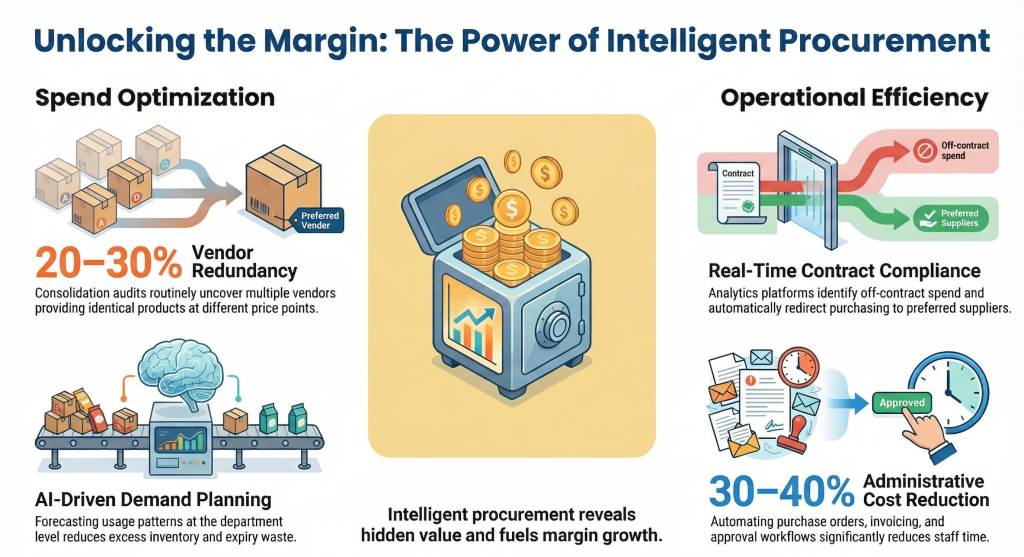
Large health systems frequently pay multiple vendors for identical or near-identical products, often at different price points. Consolidation audits routinely uncover 20–30% vendor redundancy.
2. Contract Compliance Gaps
Negotiated contracts mean nothing if departments buy off-contract. Analytics platforms identify non-compliant spend in real time, allowing procurement teams to redirect purchasing to preferred suppliers automatically.
3. Inventory Carrying Costs
Overstocking medical supplies ties up capital and creates expiry waste. AI-driven demand planning reduces excess inventory by forecasting usage patterns at the department level.
4. Administrative Overhead Reduction
Manual purchase orders, invoice reconciliation, and approval workflows consume significant staff time. Automating these processes through intelligent procurement platforms reduces administrative cost by 30–40% in most implementations.
How Healthcare CTOs Are Enabling This Transformation
The technology layer matters enormously. CTOs leading procurement transformation initiatives are typically focused on three integration priorities:
- ERP and EHR connectivity : linking procurement platforms directly to clinical systems so purchasing aligns with actual patient volume and care protocols
- Real-time spend dashboards : giving executive teams visibility across every cost center, not just end-of-month reports
- Supplier portal automation : reducing manual touchpoints in the procure-to-pay cycle through API-connected vendor systems
This is intelligent business transformation in its most practical form, not technology for its own sake, but technology that directly improves financial outcomes.
Procurement Consolidation and Financial Technology: The Hidden Connection
Here is what many healthcare executives miss: the principles driving procurement transformation are the same principles powering the broader fintech revolution.
Fintech, short for financial technology refers to the use of digital tools and data platforms to optimize financial processes. The fintech meaning, at its core, is about making financial operations faster, smarter, and more transparent.
The same fintech infrastructure that transformed banking and payments is now embedded in enterprise procurement. When a health system implements intelligent spend analytics, automated invoice matching, or AI-driven contract management, they are deploying financial technology inside their operations.
Understanding what fintech is, and recognizing that fintechs are no longer just consumer banking apps, helps healthcare boards frame procurement transformation as a financial modernization initiative, not just a supply chain project. That framing matters when making the case to boards and investment committees.
How to Build a Procurement Consolidation Roadmap in Healthcare
For executive teams ready to move, here is a practical sequence:
- Conduct a full spend diagnostic : map all current vendors, contracts, and purchasing volumes across every facility
- Identify consolidation opportunities : flag duplicate vendors, off-contract spend, and high-variance categories
- Prioritize by savings potential : focus initial consolidation on the top 20% of spend categories that drive 80% of cost
- Select an intelligent procurement platform : ensure it integrates with your existing ERP and clinical systems
- Establish governance and compliance protocols : define approved vendor lists and automated compliance triggers
- Track outcomes against financial baselines : measure savings against pre-consolidation benchmarks quarterly
Frequently Asked Questions
Q. Does procurement consolidation reduce care quality?
A. No. Consolidation targets administrative and supply chain inefficiency, not clinical resources. Patient care quality is unaffected when the process is structured correctly.
Q. How long does procurement consolidation take in a hospital system?
A. Most health systems see measurable savings within 6–12 months of implementation, with full transformation typically completing over 18–24 months.
Q. What is the typical ROI on healthcare procurement consolidation?
A. Most implementations return 8–15% on total addressable spend, with administrative automation delivering additional savings of 30–40% on processing costs.
The Bottom Line for Healthcare Decision-Makers
Boards are not finding margin by cutting care. They are finding it by transforming the operational and financial infrastructure that surrounds care delivery.
Procurement consolidation, powered by intelligent business transformation is the clearest path to sustainable margin improvement available to healthcare executives today.
At 200ok Solutions, we help healthcare organizations move from fragmented purchasing to intelligent, data-driven procurement delivering measurable financial outcomes without compromising what matters most.
You may also like: Why Patient Flow Inefficiency Is Your Largest Unaddressed Revenue Leak