

Most digital transformation initiatives in the public sector fail to deliver promised savings because organisations digitise broken processes instead of redesigning them. They purchase technology, but never build the structural conditions required for it to create value, streamlined workflows, integrated data, and empowered decision-makers.
The Promise vs. The Reality
Governments and public agencies invest billions in digital transformation every year. The pitch is always compelling: faster services, lower operational costs, better citizen outcomes. Yet study after study shows that a majority of large-scale public sector IT projects run over budget, under-deliver on savings, or leadership quietly abandons them.
This is not primarily a technology problem. It is a structural one.
Why Digital Investments Consistently Disappoint in the Public Sector
1. Digitising the Wrong Thing
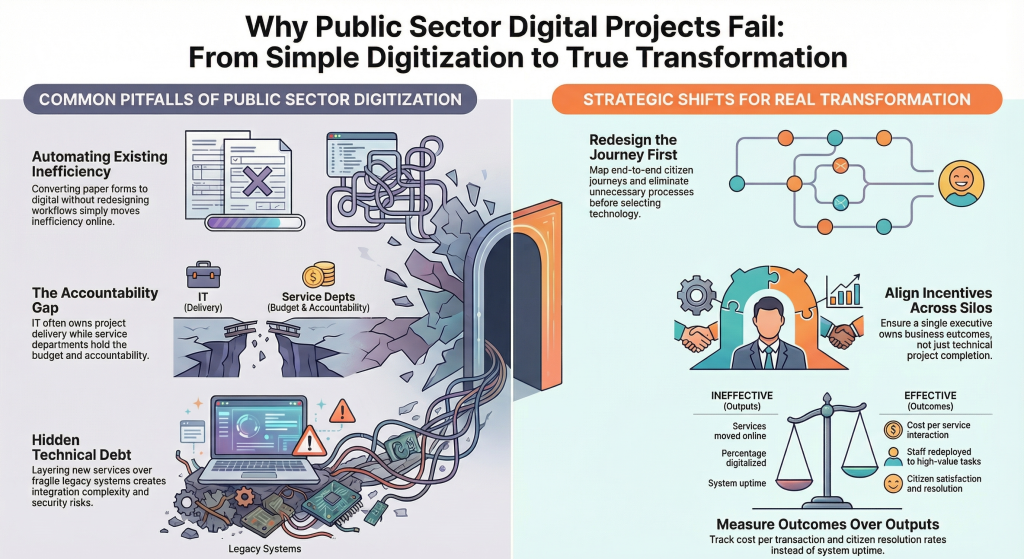
Public sector leaders most commonly make the mistake of automating existing processes rather than questioning whether those processes should exist at all.
When a team converts a legacy paper form into a digital form without redesigning the underlying approval workflow, they have not transformed anything, they have just moved the inefficiency online. Maintenance costs grow. The citizen experience barely improves. The anticipated savings never arrive.
What intelligent business transformation demands instead:
- Map the end-to-end citizen or service journey before selecting technology
- Identify where processes can be eliminated, not just digitised
- Define business outcomes, cost per transaction, resolution time, error rate — before procurement begins
2. Fragmented Ownership and Misaligned Incentives
In most public organisations, IT departments own digital projects while service departments hold the budget and accountability. This structural disconnect creates a fundamental problem: the people delivering the technology are not the people accountable for the business outcome.
A CTO can deliver a platform on time and on budget. But if the COO’s team has not changed how they work, if HR has not updated job roles, and if the CEO has not tied performance metrics to adoption, the investment stalls.
Decision-makers must ask:
- Who owns the business outcome, not just the technology delivery?
- Do incentives align across IT, operations, and finance?
- Does a single accountable executive own transformation results, not just project completion?
3. Legacy Infrastructure Treated as a Constraint Instead of a Risk
Public sector organisations routinely build new digital services on top of ageing core systems, treating legacy infrastructure as an immovable constraint. This approach accumulates what technologists call “technical debt” and it costs extraordinarily.
Each new system layered over a legacy core creates integration complexity, data inconsistency, and security risk. Services appear digital on the surface but remain operationally fragile underneath.
The structural fix does not always require full replacement. But it demands an honest assessment: how much do we pay annually to maintain systems that actively prevent transformation? When leaders calculate that number honestly, it almost always justifies a more decisive modernisation roadmap.
4. Measuring Outputs Instead of Outcomes
Public sector digital programmes typically track delivery outputs: number of services moved online, percentage of transactions digitalised, system uptime. These metrics are easy to report, and nearly useless for understanding business value.
The questions that actually matter are harder:
- Did the cost per service interaction decrease?
- Did staff redeploy to higher-value activities after automation?
- Did citizen satisfaction and resolution rates improve?
- Did the organisation make faster, better-informed decisions?
When organisations do not redesign measurement frameworks alongside the technology, they lose the evidence trail that justifies further investment, and lose confidence in transformation altogether.
What Structural Change Actually Looks Like
Organisations that achieve sustainable savings from digital transformation share several characteristics:
- Outcome-first design: Leaders define and own business outcomes before selecting any technology
- Integrated governance: IT, operations, finance, and HR share joint accountability for transformation results
- Phased modernisation: Teams retire legacy systems on a structured schedule, not preserve them indefinitely
- Continuous measurement: Real-time dashboards track business metrics — not just project milestones
- External expertise applied to internal problems: Intelligent transformation partners bring both the methodology and the accountability to drive results
The Role of Intelligent Business Transformation
At 200OK Solutions, we build our approach to intelligent business transformation around one principle: technology should serve business outcomes, not the other way around.
We work with public sector leaders, CEOs, CTOs, COOs, and Directors to diagnose where structural barriers block value, redesign operating models before deploying technology, and build measurement frameworks that demonstrate genuine return on investment.
If your digital programme has delivered capability without delivering savings, the problem almost certainly lies not in the technology you chose but in the structural conditions in which you deployed it.
Frequently Asked Questions
Q. Why do digital transformation projects in the public sector fail?
A. The primary reasons include digitising broken processes without redesigning them, fragmented ownership between IT and operations, legacy infrastructure constraints, and measuring outputs instead of business outcomes.
Q. How long does it take for digital public services to deliver savings?
A. Well-structured programmes typically show measurable operational savings within 12–24 months. Projects without clear outcome ownership and baseline measurement rarely demonstrate savings at any horizon.
Q. What is intelligent business transformation in the public sector?
A. It is an approach that combines process redesign, technology modernisation, and governance restructuring to deliver measurable business outcomes, rather than treating digital delivery as an end in itself.
Q. How can public sector leaders ensure digital investments deliver ROI?
A. Define outcome metrics before procurement, assign cross-functional accountability, retire legacy systems on a planned schedule, and measure business results, not just technology deployment.
You may also like: How Public Sector Leaders Are Redesigning Service Models Under Fiscal Constraint