


Most public sector organisations are sitting on untapped productivity gains of 20–40%, not from hiring more staff or cutting budgets, but from intelligent business transformation. This article explains what that means, why it matters now, and how decision-makers in public sector roles can act on it.
What Is the Public Sector Productivity Problem?
If you’ve searched “what is public sector” or “public sector meaning” recently, you’ll find definitions focused on government-funded services: healthcare, education, local councils, emergency services. Rarely mentioned, however, is the growing pressure these organisations face to deliver more with less.
Public sector jobs have always demanded efficiency. Today’s landscape, rising citizen expectations, budget constraints, and post-pandemic backlogs, means that doing things the old way is no longer viable.
The organisations pulling ahead aren’t the ones hiring faster. They’re the ones transforming smarter.
Why Most Transformation Efforts Fall Short
Here’s the uncomfortable truth: most public sector transformation projects focus on technology as the goal, not the means. New systems get implemented, legacy processes get digitised, but the underlying way of working stays the same, and outcomes don’t improve.
This is the gap that intelligent business transformation addresses.
Unlike traditional IT projects, intelligent transformation starts with the business outcome, reduced processing times, improved citizen satisfaction, better resource allocation and works backwards to identify the right combination of people, process, and technology.
For CTOs, CEOs, and COOs in public sector organisations, this distinction is critical. You’re not buying software. You’re investing in a better result.
What Is the Third Sector’s Role And What Can the Public Sector Learn From It?
Interestingly, searches for “what is the third sector” are rising alongside public sector queries. That’s because the boundary between public, private, and third sector is increasingly blurred and the most innovative public sector leaders are borrowing transformation models from both.
Operating under long-standing resource constraints, the third sector (charities, social enterprises, and non-profits) has mastered outcome-driven delivery: measuring success not by activity, but by impact.
That’s exactly the mindset shift public sector organisations need to make and intelligent transformation makes it operationally possible.
How to Capture the Productivity Dividend: A Practical Framework
Below is a step-by-step approach that public sector decision-makers can use to begin capturing measurable productivity gains through intelligent business transformation.
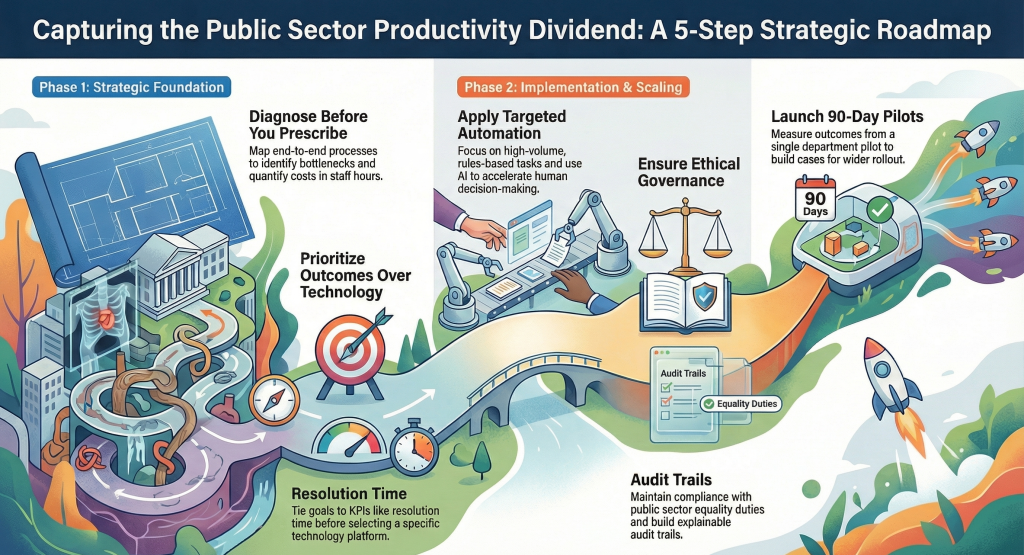
1 : Diagnose Before You Prescribe
- Map your current processes end-to-end
- Identify where manual handoffs, duplicate data entry, or approval bottlenecks exist
- Quantify the cost of delay in staff hours, citizen wait times, or compliance risk
2 : Define the Business Outcome First
- Ask: what does success look like in 12 months?
- Tie transformation goals to KPIs that matter: case resolution time, cost per transaction, staff utilisation
- Avoid technology-first thinking, the platform follows the outcome, not the other way around
3 : Apply Intelligent Automation Where It Matters Most
- Focus automation on high-volume, rules-based tasks (claims processing, document verification, scheduling)
- Use AI-assisted decision support, not to replace human judgment, but to accelerate it
- Integrate across systems so data flows without manual re-entry
4 : Govern in Line With the Public Sector Equality Duty
- Ensure any AI or automated process complies with the public sector equality duty
- Build audit trails and explainability into automated decisions
- Engage affected staff and communities early, transformation done to people fails; done with them, it sticks
5 : Measure, Iterate, Scale
- Start with a contained pilot, one service, one department
- Measure outcomes against baseline within 90 days
- Use results to build the business case for wider rollout
What About Procurement? Understanding the Ley Contratos Sector Público
For organisations operating across European frameworks or working with Spanish public bodies, compliance with the ley contratos sector público (public sector contracts law) is non-negotiable. Intelligent transformation partners need to understand procurement regulations, not just technology.
At 200OK Solutions, our approach to intelligent business transformation is built around compliance-first delivery. Whether navigating UK procurement frameworks or cross-border public sector contracts, transformation should never create regulatory risk.
Public Sector Resourcing: The Hidden Cost of the Status Quo
Public sector resourcing is one of the fastest-growing search queries in this space and for good reason. Recruitment is harder, retention is harder, and the assumption that you can hire your way to better outcomes is rapidly fading.
Intelligent transformation doesn’t replace your people. Instead, it gives them back time hours currently consumed by repetitive tasks, chasing approvals, and manually reconciling data so they can focus on work that genuinely requires human expertise.
That’s the productivity dividend. And most public sector organisations haven’t collected it yet.
Frequently Asked Questions
Q. What is intelligent business transformation in the public sector?
A. It is a structured approach to improving public sector outcomes by redesigning processes, applying automation and AI, and aligning technology investment to measurable service improvements, rather than technology adoption for its own sake.
Q. How does the public sector equality duty apply to AI transformation?
A. Any automated process used in public sector decision-making must comply with the Equality Act 2010. This means assessing whether AI tools could introduce bias and ensuring decisions remain explainable and challengeable.
Q. What is the difference between public sector and private sector transformation?
A. Private sector transformation is typically driven by profit and speed. Public sector transformation must balance efficiency with accountability, inclusivity, and public trust, making the governance layer of any transformation programme especially important.
Q. How do I start a transformation programme with limited budget?
A. Start small, measure fast. A focused 90-day pilot on a single high-volume process can generate enough evidence to justify wider investment and demonstrates clear momentum to senior stakeholders.
Ready to capture your productivity dividend? Visit 200oksolutions.com to speak with our public sector transformation team.
You may also like: Why Digital Public Services Fail to Deliver Expected Savings And the Structural Reasons Behind It