

Hospitality businesses can no longer manage profitability through occupancy rates alone. Rising labour costs, energy volatility, and supply chain disruption have fundamentally broken the traditional P&L model. To protect operating margin, hotel and hospitality leaders must adopt an intelligent, data-driven financial framework that rebalances cost structures in real time, not quarterly.
Why the Old Hospitality P&L Model Is Failing Decision-Makers
For decades, hospitality finance ran on a simple logic: fill rooms, drive RevPAR, watch margin follow. That model assumed relatively stable labour costs, predictable energy bills, and reliable supplier pricing.
None of those assumptions hold today.
Consider what senior leaders are navigating simultaneously:
- Labour costs up 18–25% across key markets since 2021, with ongoing wage pressure in F&B, housekeeping, and front office
- Energy expenditure consuming 6–10% of total revenue at many full-service properties, double pre-pandemic norms
- Supply chain volatility driving food and beverage costs above 32% of F&B revenue at mid-scale and above properties
- Guest expectations that have not decreased despite every one of these pressures
The result: properties running at 75–80% occupancy are reporting operating margins 8–12 points lower than equivalent performance five years ago. Occupancy is no longer a reliable proxy for financial health.
How to Rebuild the Hospitality P&L for a High-Cost Environment
Rebuilding profitability requires restructuring how your business measures, monitors, and manages cost, at the department level, not just the P&L summary line.
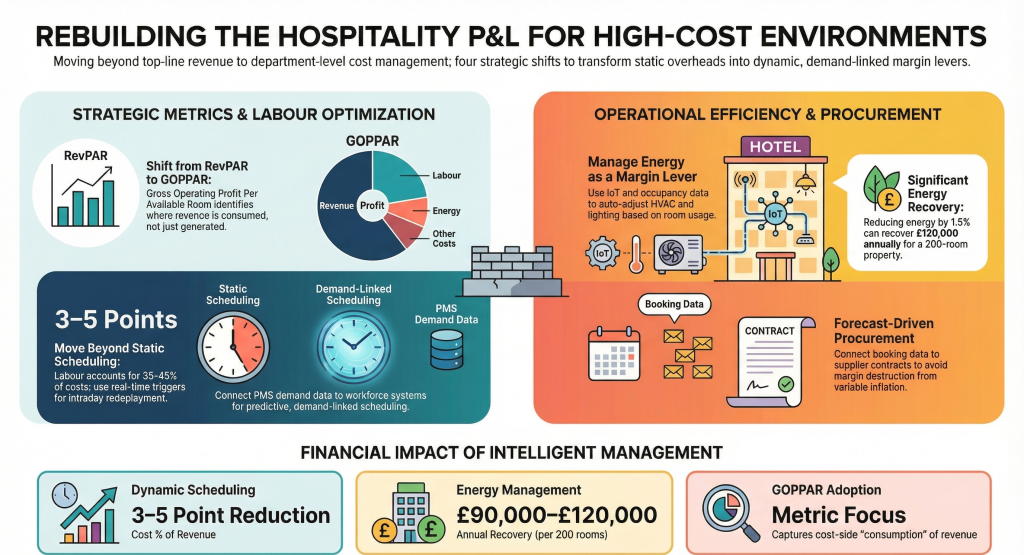
1. Shift the Primary KPI from RevPAR to GOPPAR
Gross Operating Profit Per Available Room (GOPPAR) captures what RevPAR never could: the cost side of the equation. Properties that have made this shift are better positioned to identify where revenue is being generated versus where it is being consumed.
Practical steps:
- Integrate GOPPAR into weekly leadership reporting, not just monthly reviews
- Break GOPPAR down by department: rooms, F&B, spa, events
- Benchmark against competitive set using STR or equivalent data
2. Implement Dynamic Labour Scheduling Tied to Demand Signals
Labour is typically 35–45% of total operating costs in full-service hospitality. Static scheduling, built on historical patterns, cannot respond to the real-time demand volatility that has defined the post-pandemic market.
Intelligent business transformation here means connecting your PMS demand data to workforce management systems, enabling:
- Predictive scheduling 10–14 days out based on booking pace
- Real-time redeployment triggers when occupancy shifts intraday
- Department-level labour cost visibility against actual revenue generated
Properties using demand-linked scheduling report reductions in labour cost as a percentage of revenue of 3–5 points, without reducing service quality.
3. Treat Energy as a Managed Cost Centre, Not a Fixed Overhead
Many hospitality operators still treat energy as an uncontrollable line item. That thinking is expensive. Energy management, when driven by occupancy data and IoT integration, becomes a direct margin lever.
What intelligent energy management looks like in practice:
- HVAC and lighting systems that auto-adjust based on real-time room occupancy
- Energy dashboards visible to operations leadership daily
- Automated alerts when consumption deviates from demand-adjusted benchmarks
- Solar, storage, or demand-response contracts reviewed against actual usage profiles
A 200-room property reducing energy cost by just 1.5% of revenue recovers £90,000–£120,000 annually at typical ADR levels.
4. Restructure Procurement Around Demand Forecasting, Not Purchase History
Supply chain decisions in hospitality are still largely driven by habit and supplier relationships. In a volatile cost environment, this is margin destruction in slow motion.
Intelligent procurement connects your booking data, menu engineering analysis, and supplier contracts into a unified demand signal. This enables:
- Variable order volumes tied to forecasted covers and occupancy
- Faster identification of cost-per-dish inflation before it hits the P&L
- Strategic consolidation of supplier relationships to access volume pricing
The Operating Model That Ties It Together
The common thread across each of these interventions is the same: replacing static, periodic financial management with continuous, data-connected decision-making.
This is what intelligent business transformation means in a hospitality context. Not technology for its own sake, but building the operational architecture that lets your CFO, COO, and department heads act on margin signals in hours, not weeks.
Properties that have rebuilt their financial model around this architecture share a consistent profile:
- Operating margins 6–10 points higher than comp set averages
- Faster response to cost shocks without service compromise
- Greater confidence in forward financial planning despite market volatility
Frequently Asked Questions
How do I reduce labour costs in a hotel without affecting guest experience?
By connecting scheduling to real-time demand signals rather than fixed rosters. Intelligent workforce management reduces idle labour cost while ensuring coverage aligns with actual guest activity, protecting service quality while recovering margin.
What is GOPPAR and why does it matter more than RevPAR now?
GOPPAR (Gross Operating Profit Per Available Room) measures profitability after operating costs, unlike RevPAR which only captures revenue. In a high-cost environment, GOPPAR gives leadership a true picture of financial performance.
How can hospitality businesses manage energy costs more effectively?
Through IoT-connected building management systems that tie energy consumption to real-time occupancy data, reducing waste in unoccupied rooms and common areas while maintaining guest comfort standards.
The hospitality P&L was built for a different cost environment. Rebuilding it, through intelligent systems, connected data, and outcome-focused leadership, is not a future priority. For operators under margin pressure today, it is the most urgent commercial decision on the table.
Ready to rebuild your hospitality financial model? Explore how 200OK Solutions delivers intelligent business transformation for hospitality leaders.
You may also like: The Hidden Cost of Guest Retention Gaps in Hospitality