

Slow retailers lose margin not because they lack data, but because they act on it too late. In today’s retail environment, the window between a consumer signal and a profitable commercial response has compressed from weeks to hours. Retailers who close that gap protect margin. Those who don’t, discount their way to survival.
Why Retail Decision Speed Is Now a Margin Issue
Speed used to be a supply chain problem. Today, however, it’s a decision-making problem.
Consumer behavior shifts faster than most retail planning cycles. A product category can spike on social platforms overnight, trigger competitor stockpiling by morning, and face price compression by afternoon. If your merchandising, pricing, and inventory teams still work off last week’s reports, you’re not competing, you’re reacting after the opportunity has passed.
The retailers winning right now share one trait: they’ve transformed how fast decisions move from signal to action.
The Real Cost of Slow Commercial Response
When decision-making lags behind consumer signals, the damage shows up in three places:
- Margin erosion through reactive discounting : Demand shifts go undetected early enough, so overstock builds and clearance becomes the only exit.
- Lost full-price sell-through windows : High-demand moments pass because replenishment decisions move too slowly.
- Competitor capture of intent : Customers who signal interest find alternatives before your team can respond.
As a result, slow response cycles quietly cost mid-to-large format retailers 3–8% in recoverable gross margin annually, not through a single crisis, but through thousands of small, delayed decisions.
How Intelligent Business Transformation Closes the Gap
Intelligent business transformation, the kind that actually moves the margin needle, is not about deploying technology for its own sake. Instead, it’s about redesigning how commercial decisions get made, by whom, and how fast.
Here’s what that looks like in practice:
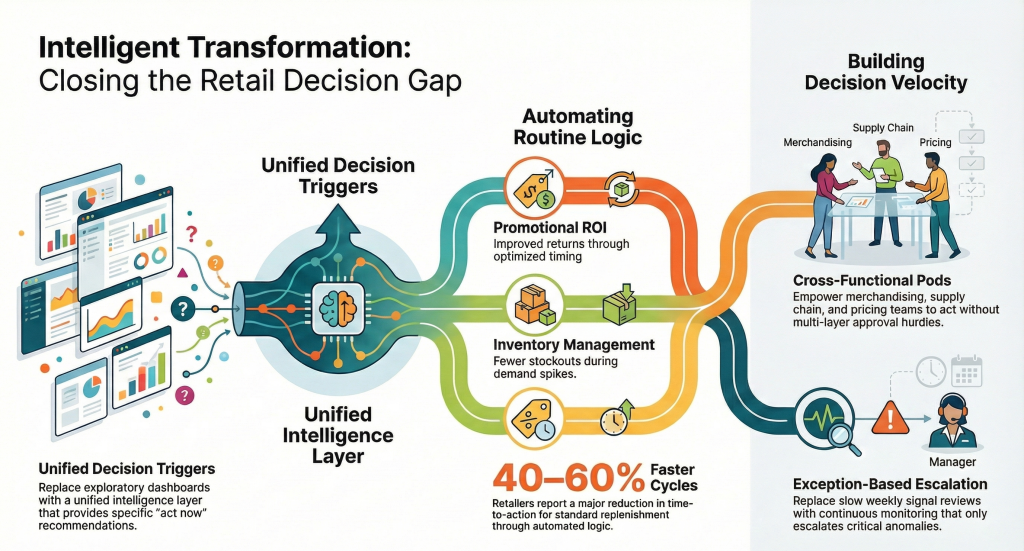
1. Unifying Consumer Signal Sources Into a Single Decision Layer
Most retailers already have the signals, POS data, e-commerce behavior, social listening, supplier lead times, and regional demand patterns. The problem, however, is that these signals live in separate systems, reviewed by separate teams, on separate schedules.
Transformation starts by collapsing these into a unified intelligence layer that surfaces actionable insight in near real-time, not a dashboard to explore, but a decision trigger that tells a category manager: act now, here’s why, here’s the recommended move.
2. Automating Routine Commercial Decisions
Not every decision needs a meeting. For example, replenishment thresholds, promotional price adjustments within pre-approved bands, and markdown timing on slow-moving SKUs can all run on rules-based or AI-assisted logic. This directly frees senior decision-makers to focus on higher-order strategy.
Retailers who automate routine decisions report:
- 40–60% reduction in time-to-action on standard replenishment cycles
- Fewer stockouts during demand spikes
- Improved promotional ROI through better timing
3. Building Decision Velocity Into Team Structure
Technology alone doesn’t close the window. Equally important is organizational design. Retailers with fast commercial response typically operate with:
- Cross-functional pods (merchandising + supply chain + pricing) empowered to act without multi-layer approval
- Pre-agreed decision frameworks that define who owns what at each signal threshold
- Continuous monitoring with exception-based escalation replacing slow weekly signal reviews
How to Accelerate Retail Decision-Making: A Practical Framework
For retail CTOs, COOs, and CEOs looking to operationalize decision speed, here is a structured starting point:
- Audit your current signal-to-action lag : Map how long it takes from a detectable consumer shift to an executed commercial response across pricing, inventory, and promotions.
- Identify your highest-cost delay points : Specifically, where does the process stall? Data aggregation, cross-team alignment, or approval chains?
- Prioritize one automation win : Pick the highest-volume, lowest-risk decision type and automate it within 90 days. Then prove the model before scaling.
- Integrate intelligence at the point of decision : Ensure that whoever makes commercial calls has synthesized signal data available in the same workflow, not buried in a separate reporting tool.
- Redefine speed as a KPI : Measure time-to-commercial-response alongside margin and sell-through. Then make it visible at the leadership level.
What Retailers Get Wrong About Transformation
Most retail transformation projects focus on the wrong outcome, they optimize for better reporting rather than faster action. A sharper dashboard that a team still reviews on Friday morning, for instance, doesn’t help anyone respond to a Thursday evening demand spike.
Intelligent business transformation, done right, is outcome-first: the goal is protected margin through faster, better-calibrated commercial decisions, not better data for its own sake. Furthermore, the retailers who treat decision velocity as a core capability consistently outperform those who treat it as a side effect of their technology stack.
Frequently Asked Questions
Q. How quickly can retailers realistically improve decision-making speed?
A. With the right transformation approach, most mid-size retailers see measurable improvement in signal-to-action lag within 60–90 days of targeted process and technology changes, particularly in replenishment and promotional decisions.
Q. What technology do retailers need to close the consumer signal gap?
A. The foundation is data integration across POS, e-commerce, and supply chain systems, combined with an intelligent layer that surfaces prioritized, actionable recommendations. Importantly, this doesn’t always require a full platform replacement, often, connecting existing systems more intelligently is enough to start.
Q. How does decision-making speed protect retail margin specifically?
A. Faster decisions reduce overstock accumulation, increase full-price sell-through during demand peaks, and allow more precise promotional timing, each of which directly protects gross margin without requiring top-line growth.
The window is shrinking. Retailers who treat decision velocity as a strategic capability, not a technology project, consistently protect margin in an environment where every signal is also an opportunity for a faster competitor. Ultimately, the gap between signal and response is where margin is won or lost.
200OK Solutions helps retailers close the gap between consumer signal and commercial response through intelligent business transformation. Explore what’s possible at 200oksolutions.com
You may also like: How Retail Leaders Are Protecting Margins Amid Demand Volatility