

Hospitality brands routinely lose 20–40% of repeat guest potential, not through bad service, but through invisible retention gaps. Disconnected data systems, absent post-stay engagement, and the failure to spot at-risk guests early are the real culprits. Intelligent business transformation closes these gaps. It unifies guest intelligence across your entire stack, enabling decisions that protect and grow lifetime guest value.
The Revenue You Can’t See Leaving
Hospitality executives often point to loyalty programs and satisfaction scores when asked about retention. Repeat booking rates get measured. What rarely gets tracked, however, is the gap between a guest who could have returned, and didn’t.
This is the silent erosion of lifetime value. It’s not a dramatic churn event. Instead, it’s a slow, distributed drift that never appears on a single dashboard. Think of the guest who stayed three times in two years and then simply stopped. Or the corporate traveller whose bookings quietly shifted to a competitor.
The numbers behind this are significant:
- Acquiring a new guest costs 5× more than retaining an existing one
- 67% of churned guests show detectable behavioural signals at least 60 days before leaving
- A 5% retention improvement can increase guest lifetime value by 25–95%, depending on ADR and property type
Data fragmentation and disconnected systems are the core problem — not strategy. Without a unified intelligence layer, these patterns remain invisible until the opportunity is gone.
Where Hospitality Retention Gaps Actually Form
Understanding how to reduce guest churn in hospitality starts with knowing where the gaps originate. Most hospitality brands operate across a patchwork of systems, PMS, CRM, OTA channels, loyalty platforms, F&B POS, and guest feedback tools, that rarely communicate in real time. This fragmentation creates predictable blind spots:
- No single guest identity: A guest who books via OTA, then direct, is often treated as two different people, losing continuity of preference and history.
- Post-stay silence: The 30–90 day window after checkout is the highest-intent re-engagement period. Most brands leave it unused.
- Transactional loyalty programs: Points-based systems reward frequency but miss what the guest actually values, making the programme feel hollow.
- No churn prediction: Most properties measure retention retrospectively, they know a guest left, but not why, or when it could have been prevented.
- Silos between properties: For multi-property brands, a guest’s experience at one location rarely informs their welcome at another.
“The most dangerous hospitality churn looks like satisfaction, a guest who rated their stay 8 out of 10 and never came back.”
How to Calculate the True Cost of Retention Gaps in Your Hotel Business
Quantifying lifetime value loss is the first step before any transformation investment. Here is the framework:
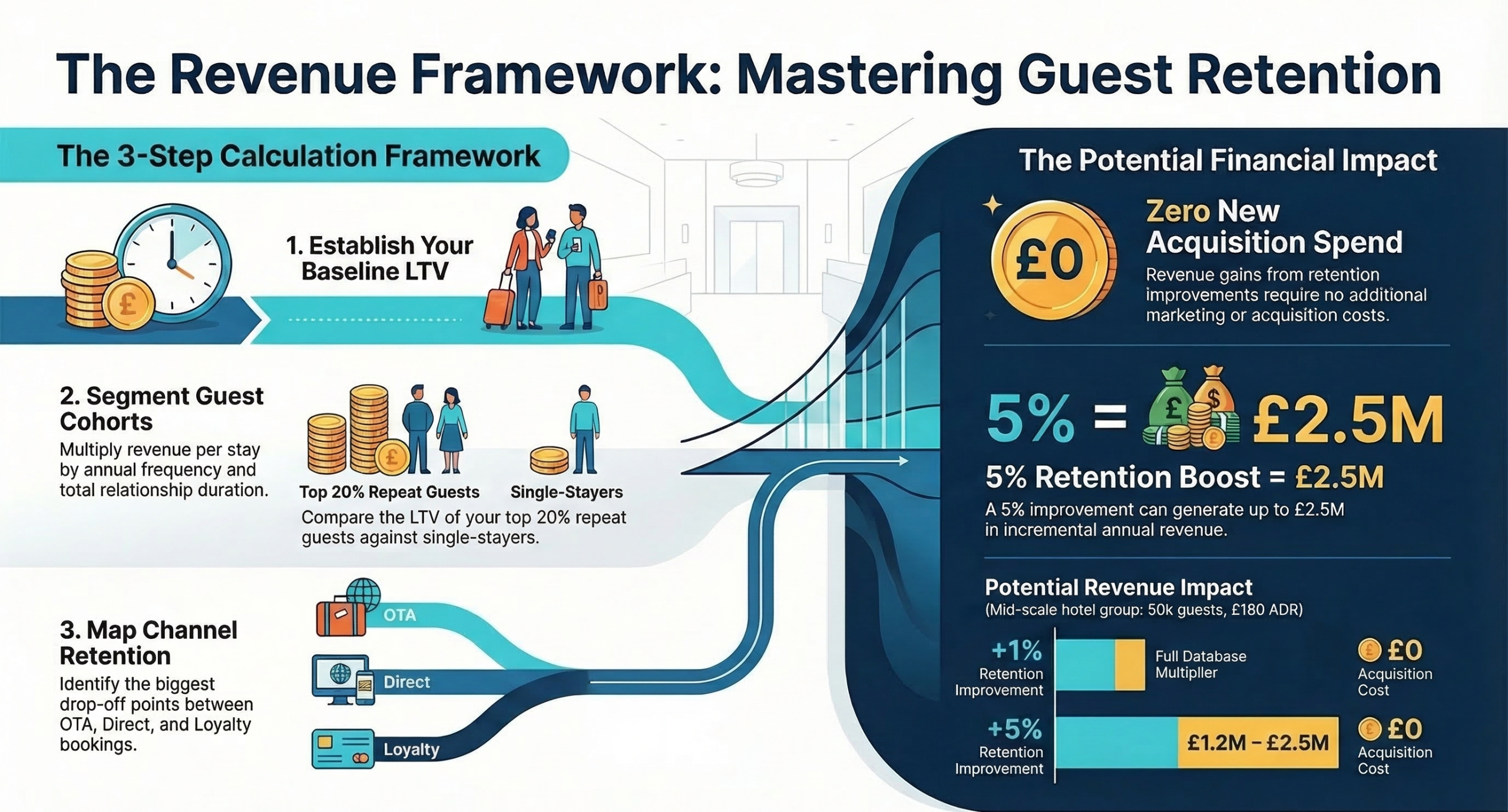
- Establish your baseline LTV: Multiply average revenue per stay by annual return frequency and average relationship duration in years.
- Segment your guest cohorts: Identify your top 20% of repeat guests. Compare their LTV against single-stay guests. That gap defines the prize.
- Map retention rate by channel: OTA guests, direct bookers, and loyalty members each return at different rates. Find the biggest drop-off point.
- Apply a churn cost multiplier: For each 1% retention improvement, calculate the revenue impact across your full guest database.
Consider a mid-scale hotel group at £180 ADR with 50,000 guests on file. A 5% improvement in repeat visit rate typically represents £1.2M–£2.5M in incremental annual revenue, with zero new acquisition spend.
What Intelligent Business Transformation Actually Changes
Intelligent business transformation doesn’t mean deploying a single tool. It means restructuring how guest data flows, how insight reaches frontline teams, and how the brand responds to individual behaviour at scale.
Step 1: Unified Guest Data Layer Integrate PMS, CRM, loyalty, and feedback systems into one source of guest truth. This resolves identity across channels and consolidates stay history.
Step 2: Predictive Churn Modelling Score guests by re-booking likelihood using recency, frequency, engagement signals, and sentiment. Flag at-risk profiles before they defect, not after.
Step 3: Automated Re-Engagement Workflows Trigger personalised outreach at the right moment. Post-stay follow-ups, anniversary offers, and seasonal nudges should be driven by behaviour, not batch scheduling.
Step 4: Cross-Property Guest Intelligence Guest preferences and history should travel with them across your portfolio. Every property should deliver a relationship, not a first impression.
Step 5: Real-Time Feedback Loops Connect in-stay sentiment data to operational teams immediately. Service recovery during the stay turns a detractor into a loyal advocate before checkout.
The Business Outcomes Hospitality Leaders Should Demand
For CEOs, COOs, and CTOs evaluating transformation investment, the metrics that matter are financial and relational, not technical:
- Repeat guest rate improvement measurable within the first 6–9 months of a unified data programme
- Revenue per available guest (RevPAG) more meaningful than RevPAR for loyalty-led hospitality brands
- Cost per retained guest vs. cost per acquired guest a ratio that shifts as your data intelligence matures
- NPS delta in loyalty segments quantifying relationship quality among your most valuable guests
- Time-to-intervention on at-risk guests how quickly teams act on churn signals
Winning hospitality brands today don’t have the largest marketing budgets. They know their guests better than the guests know themselves and they act on that knowledge at exactly the right moment.

Frequently Asked Questions
What causes guest retention gaps in hospitality brands?
Retention gaps stem from disconnected data systems, poor post-stay engagement, and no mechanism to identify at-risk guests early. The loss is gradual and spread across channels, which is why most hospitality brands don’t catch it until significant value has already gone.
How do you calculate the lifetime value loss from guest churn in hotels?
Start with average revenue per stay multiplied by return frequency. Compare this against your top loyal cohort’s LTV. The gap between the two numbers is your retention cost, and often the clearest case for transformation investment.
How can intelligent business transformation reduce guest retention gaps?
It integrates PMS, CRM, loyalty, and feedback channels into a unified data layer. The result is AI-driven personalisation, predictive churn signals, and automated re-engagement, so teams act on insight, not instinct.
How long does it take to see ROI from a hospitality retention transformation program?
Most brands see measurable repeat booking improvement within 6–9 months. Full ROI, from reduced acquisition spend and improved LTV, typically arrives within 12–18 months.
You may also like: The EU AI Act’s Impact on Hospitality: What Dynamic Pricing and Guest Profiling Systems Must Do Now